

Knowing USDA’s reported average rental rates is a good place to start negotiations for a lease. Credit: AdobeStock
Discussions about money can be awkward in almost every type of relationship, but even more so between landowners and farmers, or employers and workers. As we prepare for 2026, many farmers and landowners have begun discussions about farmland lease agreements. It is also a good time of the year to think about worker wages and benefits. One source of information available to help answer the question of how much to pay or charge is USDA’s reported averages from the previous year. Just knowing the average is only part of the story, but at least it offers an unbiased reference point for both parties to start those awkward conversations.
–
Farmland Rental Rates
The USDA’s National Agricultural Statistic Service (NASS) annually surveys farm owners/managers to provide average land rental rates. Unfortunately, their survey summary does not offer the range of rates paid, but does offer some county, state, and regional averages.
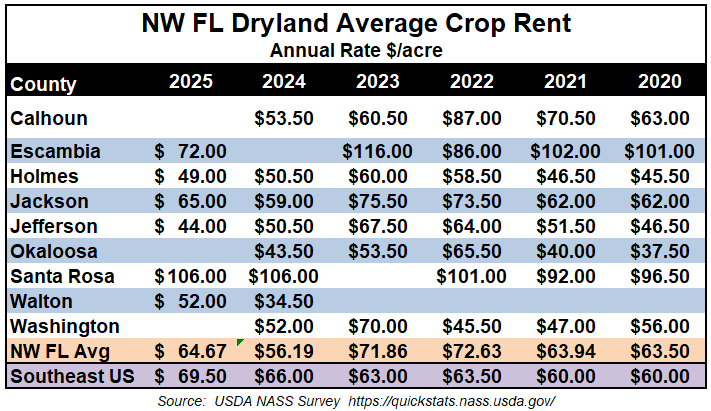
The following is a summary of the information NASS provided for Northwest Florida from 2025 surveys. The rates reported were the annual rate per acre, so these are not monthly rates. Table 1 provides the average rate per acre for renting dryland (non-irrigated or rain-fed) crop land by county. The average rental rates in 2025 ranged from $44/acre to $106/acre, with an average of $64.67 for the six Panhandle Counties in the NASS report. For the Southeastern states, the average dryland crop land rental rate was $69.50/acre.
 –
–
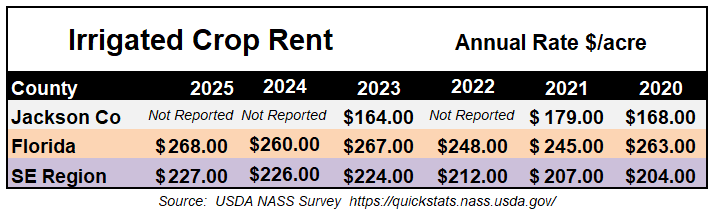
Average irrigated farmland rates were not reported specifically from any of the Panhandle Counties in 2025. The only county data from North Florida reported specifically this year was from Suwannee County – $143/acre. The average rate reported for the entire state of Florida was $268/acre, and from the Southeast Region was $227/acre. There is just not much data to work from here, so my suggestion would be to use the Southeast average as a guide. Part of the reason there is such variation here is based on the value of the crop being irrigated in Florida.
 –
–
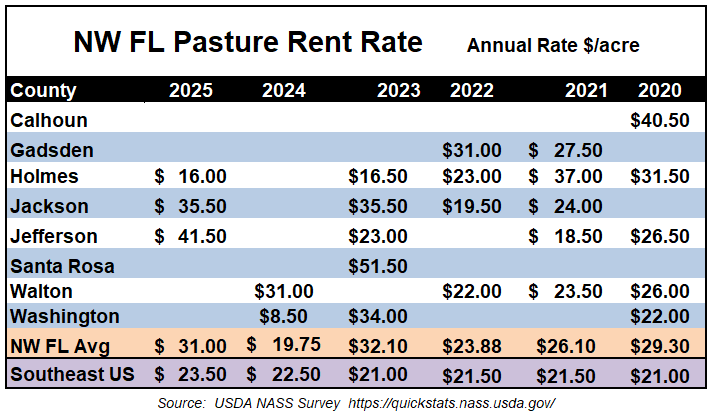
Pasture rent data was also limited from Panhandle Counties. The average from the six counties with data was $31/acre. As with irrigated rates above, the Southeastern average was $23.50/a, so that is my suggestion for a starting place for negotiations.
 –
–
Lease Agreements
If you are planning to enter an agreement on a lease, I would certainly recommend having a printed lease agreement with signed copies made for both parties, especially when making agreements for multiple years. Lease agreements don’t have to be complicated legal documents or even be notarized, but that certainly can be done to make them stronger legal documents, in case of a future dispute. The main thing that needs to be clear to both parties are the expectations of each party, the annual lease rate per acre, the number of acres being leased, and the date when payment is due annually. Typically, not every acre of the property can be farmed, so it may be that only part of the property is officially leased.
Things to consider including in a farm lease agreement:
Who has permission to access the property? Farmer, employees, and immediate family members, or simply associates of the lessee. Don’t forget to include landowner associates that might also be allowed access. Don’t forget to provide locks for both parties if the main entry gates are locked.
Who is responsible for maintenance? What specifically requires maintenance and how frequently?
What specific rights does the lessee (tenant) have? Is the land to be used only for commercial farming, or are recreational rights such as fishing and hunting included? The University of Tennessee has a nice publication that outlines what should be considered for farm leases: Introduction to Farmland Leasing.
The following link is an example of a farm lease agreement I created to guide negotiation discussions: Basic Farm Lease Agreement Example
–
Farm Worker Wages
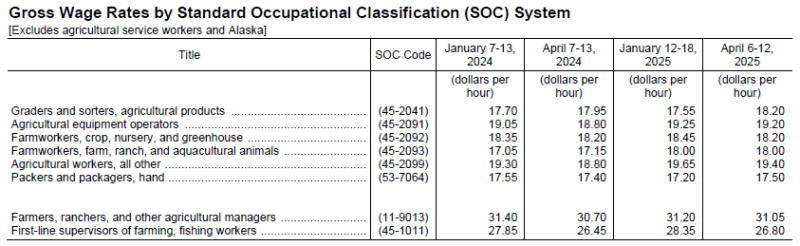
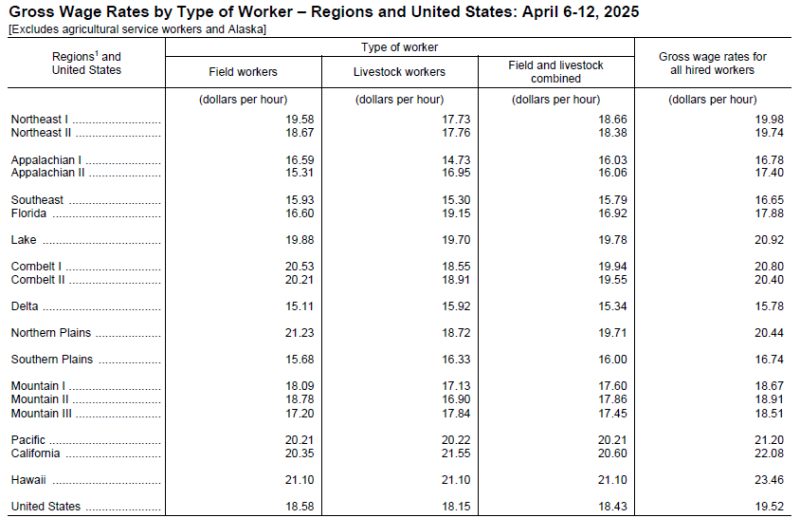
USDA provides a Farm Labor Report twice per year in May and November (the November Report was not available in 2025 due to the shutdown). The summary statement from the May 2025 Farm Labor Report said, “Farm operators paid their hired workers an average gross wage of $19.52 per hour during the April 2025 reference week, up 3 percent from the April 2024 reference week. Field workers received an average of $18.58 per hour, up 2 percent. Livestock workers earned $18.15 per hour, up 4 percent. The field and livestock worker combined gross wage rate, at $18.43 per hour, was up 3 percent from the 2024 reference week. ”
The NASS Farm Labor Report provides U.S. average wages for each classification of farm worker. That chart below shows how farm worker wages have gradually increased over the past two years.
 –
–
NASS does not offer county level data for worker wages but does offer regional and state average rates for the Southeast and Florida in the table below.
 –
–
Reference Sites
Look up a wide range of farm statistics for your state or county from annual NASS surveys and the 5-year Census of Agriculture through USDA NASS Quick Stats
May 2025 USDA Farm Labor Report
Tennessee Extension – Introduction to Farmland Leasing

demayo@ufl.edu - 850-482-9620
Follow me on Twitter
@UFCowman
- 2025 Weather Summary and 2026 1st Quarter Outlook - January 16, 2026
- 2025 Average Farmland Rental Rates, Lease Agreements, and Worker Wages Summary - January 16, 2026
- Friday Feature:1954 How to Dial Your Phone - January 16, 2026