
A newly developed runner‑type peanut—released by the University of Florida under the name ‘Gorbet’ has shown exceptional promise against two major peanut diseases in the Southeast. ‘Gorbet’ was named after Dr. Dan Gorbet, a retired peanut breeder from the University of Florida. Dr. Gorbet retired in 2006 after a remarkable and ground-breaking career and is still excited about advances in peanut breeding. His work was truly pioneering in breeding peanuts for resistance to diseases, especially late leaf spot. When he arrived in Florida in 1970, breeding peanuts for disease resistance was more of an afterthought. Today, breeding for disease resistance is a major goal of nearly all peanut breeding programs in the USA, and we have Dr. Gorbet to thank for helping to develop many of the protocols and for discovering much of the disease resistant germplasm that has proven useful for breeding new disease resistant varieties for farmers.
‘Gorbet’ joins two other University of Florida peanut cultivars, ‘Arnie’ and FloRun™ ‘725’, as only the third peanut cultivar with especially strong resistance to Tomato Spotted Wilt Virus (TSWV) that is derived from a resistant line discovered by Dr. Gorbet in the early 2000’s. The resistance to TSWV in ‘Gorbet’ is strong enough to allow April planting with low risk of TSWV. It also incorporates very strong resistance to late leaf spot. Over four years of testing, ‘Gorbet’ was found to have the lowest level of late leaf spot among several other cultivars which also possess a degree of resistance. In fungicide studies in 2024 and 2025, late leaf spot was well controlled in ‘Gorbet’ with about one-third to one-half of the typical fungicide applications as compared to susceptible varieties. Figure 1 below shows ‘Gorbet’ beside a susceptible variety with no fungicides applied to control late leaf spot. In fact, late leaf spot severity in ‘Gorbet’ sprayed every 28 days with a chlorothalonil fungicide was the same as when it was sprayed every 14 days, the typical schedule for peanut fungicides in the Southeastern U.S. This could represent significant savings of time and money for peanut growers. About 20 acres of breeder seed of ‘Gorbet’ was produced in 2025, so the first increase of Foundation Seed will be grown in 2026.
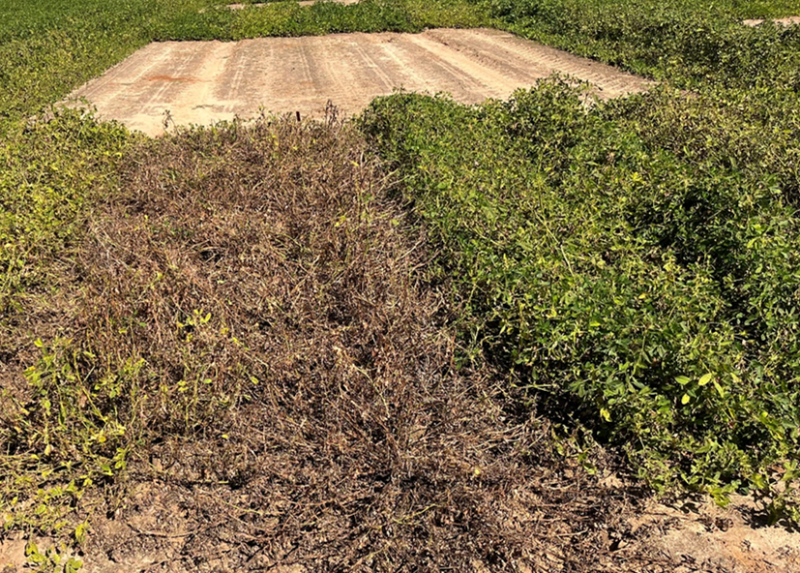
Figure 1. ‘Gorbet’ peanut variety on the right compared to a late leaf spot susceptible variety on the left when no fungicides were applied to control late leaf spot. Credit: Barry Tillman, UF/IFAS
- ‘Gorbet’ – A New Peanut Variety with Resistance to Late Leaf Spot and TSWV - January 23, 2026
- FloRun™ ‘725’ – A New High Yielding, Disease Resistant Peanut Variety - April 4, 2025
- Don’t Lean Too Hard on Your Peanut Variety for Disease Resistance - June 28, 2024