
Ian Small, Fanny Iriarte, and Kelly O’Brien, North Florida Research and Education Center -Quincy
In the summer of 2024, University of Florida plant pathologists at the North Florida Research and Education Center (NFREC) in Quincy detected stem canker and dieback disease of cotton (Gossypium hirsutum), caused by the fungus Diaporthe ueckeri. The disease was found infecting a commercial cotton cultivar in North Florida. This was the first confirmed report of the disease on cotton in both Florida and the United States: First Report of Canker and Dieback Caused by Diaporthe ueckeri in Cotton (Gossypium hirsutum) in Florida.
Because this pathogen caused rapid dieback and plant death under Florida conditions and may appear again, if conditions are favorable, UF/IFAS encourages all cotton producers, crop consultants, and Extension agents to be vigilant during the 2026 growing season.
–
How the Disease Was First Detected
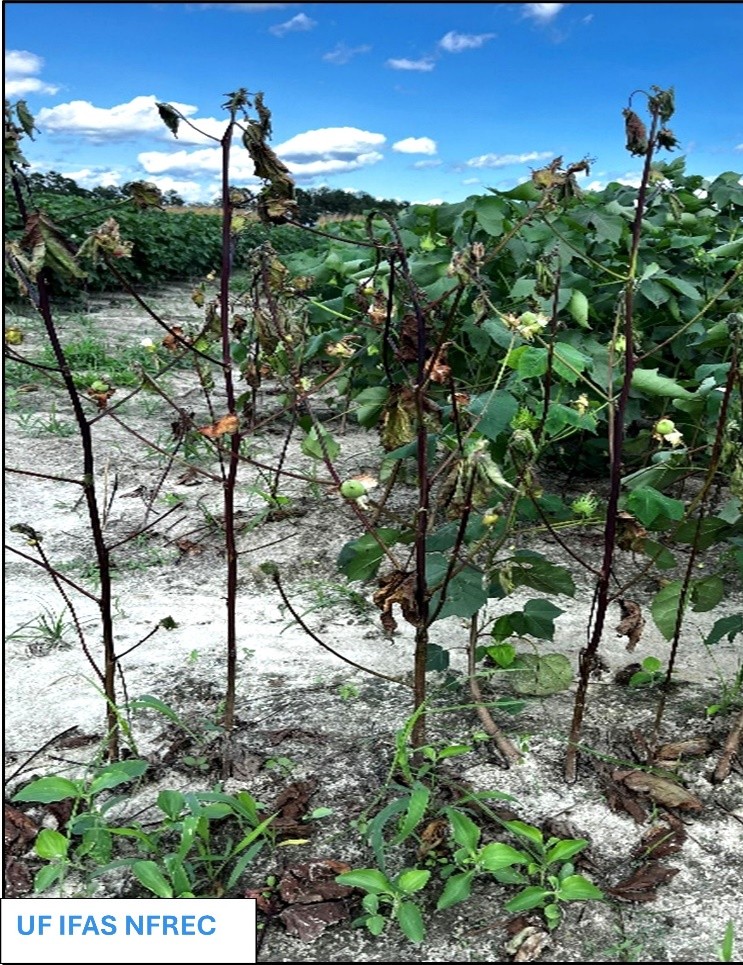
Figure 1. Cotton plants showing symptoms of canker and dieback. Credit: Ian Small, UF/IFAS
In July 2024, NFREC researchers observed cotton plants (Deltapine 2127 B3XF) in the first flower stage showing unusual symptoms in experimental plots in Quincy:
- Dark, elongated stem lesions (Figure. 1).
– - Sudden tip dieback forming a characteristic shepherd’s crook
– - Cankers progressing down the stem
– - Plant death within 4–5 weeks
– - Affected areas occurring in patches or small clusters
– - Disease incidence reached 25% in affected areas and appeared after a period of extreme heat (>32°C) followed by prolonged wet weather—conditions that likely favored infection.
–
What Causes the Disease?
Samples were submitted to UF IFAS NFREC Plant Disease Diagnostic Clinic (PDC) where clear symptoms of canker were detected after removing the cortex of the stems (Figure 2) laboratory molecular analysis at UF/IFAS NFREC Plant Disease Diagnostic Clinic and the Florida Department of Agriculture and Consumer Services (FDACS DPI) confirmed the identity of the pathogen as Diaporthe ueckeri a fungus previously known to cause cankers and root rots on crops like cassava and soybeans in Brazil. Sequencing analysis had a 99% identity with known isolates of D. ueckeri. This is a fungus similar to Diaporthe phaseolorum which causes stem canker on soybean.
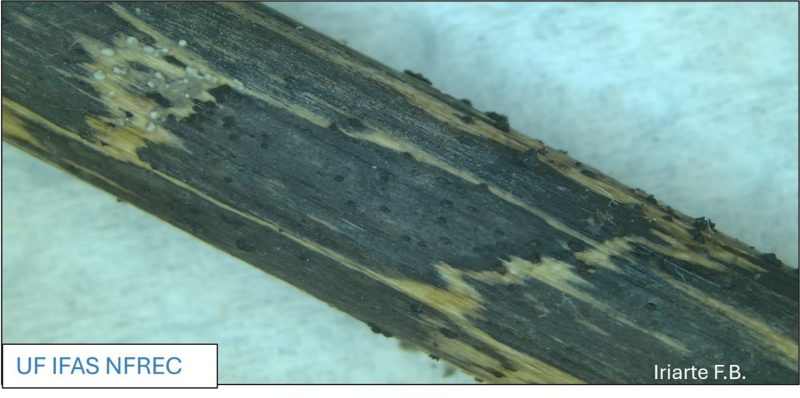
Figure 2. Cotton stem showing symptoms of canker after removing cortex and incubating for several days in moist chamber. Note the black “dots” are fungal structures called “pycnidia” containing hundreds of microscopic spores that can be spread to other plants by water splash, wind, or insect activity which can cause new infections. Credit: Credit Fanny Iriarte, UF/IFAS
–
Will It Show Up Again in 2026?
Field trials in 2025 were planted at the same NFREC location where the disease appeared the previous year. Despite thorough scouting during the early flowering and later reproductive stages:
- Stem canker was not detected in 2025
– - Hot–wet weather conditions in the summer were less persistent
– - Areolate mildew and target spot were present, but D. ueckeri was not found
–
Because the disease appeared suddenly in 2024 but not in 2025, researchers suspect that environmental conditions may strongly influence outbreaks. More research is underway.
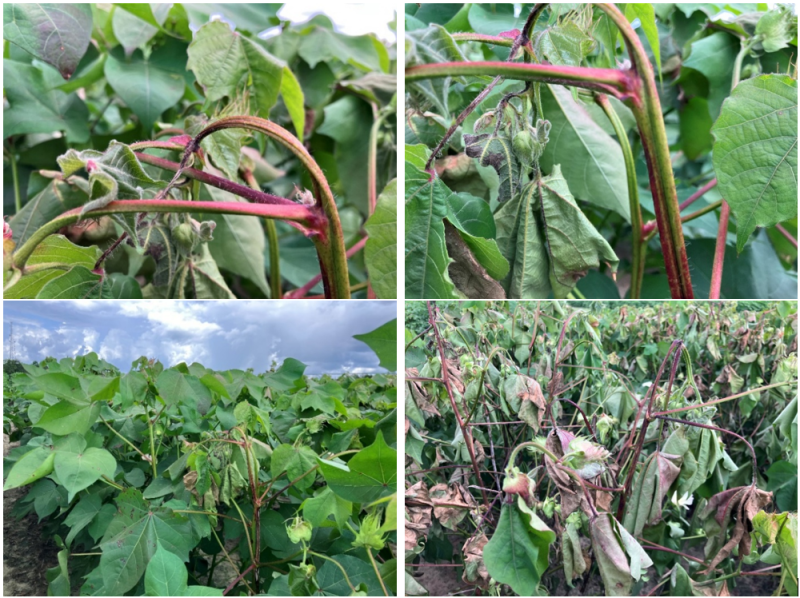
Figure 3. Stem canker disease up close, with shepherd’s hook and stem collapse in early disease stages in cotton plants 63 days after planting, July 25, 2024. Credit: Ian Small, UF/IFAS
–
What Growers and Consultants Should Watch For in 2026
Based on observations so far, D. ueckeri symptoms typically:
1. Start in the upper plant canopy. Early signs occur mid to late July near the upper nodes.
–
2. Include a “shepherd’s crook.” The terminal stem tip drops and dies back.
–
3. Show dark stem cankers. Necrotic lesions may expand downward and eventually cause plant death.
–
4. Appears in individual plants or patches. Scout isolated plants AND field clusters.
–
5. Coincides with hot, wet periods. Especially during early flowering (60–80 DAP).
–
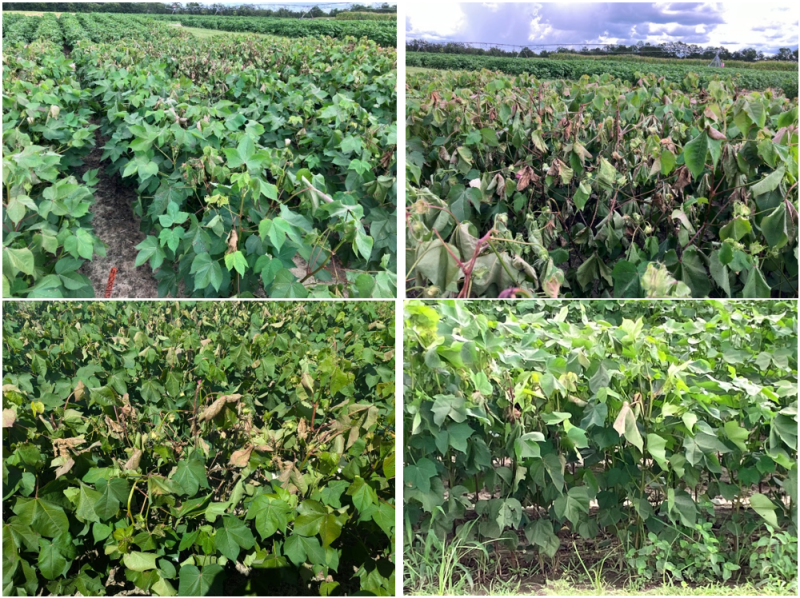
Figure 4. Patches of stem canker at a distance in early disease stages in cotton plants 63 days after planting, July 25, 2024. Credit: Ian Small UF/IFAS
–
What To Do if You Suspect Cotton Stem Canker or Dieback
If you notice these symptoms, UF/IFAS strongly encourages sending samples for diagnostic confirmation. Contact your county’s UF/IFAS Agriculture Agent for assistance collecting and submitting samples or submit samples directly to the Plant Diagnostic Clinic.
- How to Submit Samples. Send 2–3 stem sections including both symptomatic and healthy tissue.
–
Mail samples to:
Dr. Ian Small / Dr. Fanny Iriarte
UF NFREC Plant Disease Diagnostic Clinic
155 Research Road
Quincy, FL 32351
Contact:
Dr. Fanny Iriarte
fbiriarte@ufl.edu
850‑875‑7140
Dr. Ian Small
ismall@ufl.edu
850-875-7120
–
Why Early Detection Matters
This newly reported pathogen:
- Caused rapid plant death in its first known Florida detection
– - Is capable of producing cankers that progress rapidly under conducive conditions
– - Has not yet been fully characterized in terms of variety susceptibility
– - Needs monitoring so UF/IFAS can develop management strategies, including variety selection, cultural controls, and fungicide timing
–
By reporting suspect cases early, growers can help UF/IFAS:
- Map the disease distribution
– - Understand environmental risk factors
– - Develop practical, field ready management recommendations
–
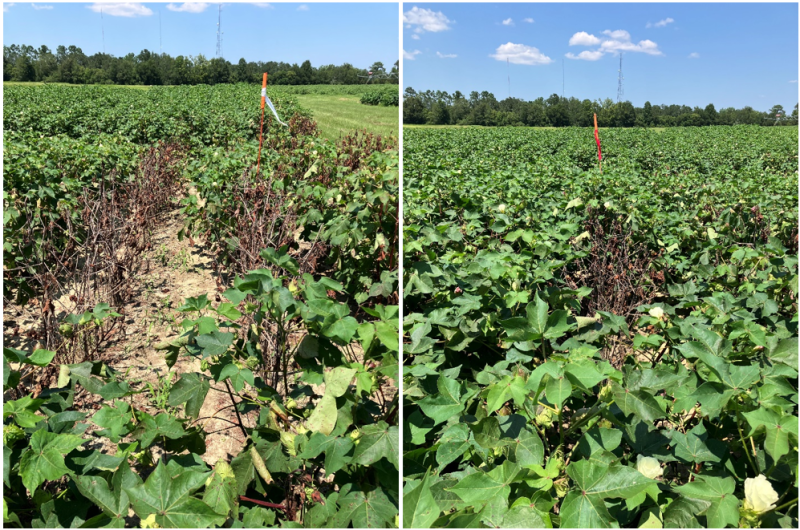
Figure 5. Late disease stage in cotton plants 81 days after planting, August 12, 2024. Credit: Ian Small, UF/IFAS
–
Stay Vigilant This Season
Although the disease was not observed in 2025, the initial 2024 outbreak demonstrates that Diaporthe ueckeri can be an aggressive pathogen in Florida cotton during periods of prolonged wet and hot conditions. UF/IFAS NFREC will continue monitoring in 2026 and will provide updates as more information becomes available.
Growers, Extension agents, and consultants are encouraged to scout regularly, especially during flowering and after several days of continuous hot and rainy weather. If you see symptoms of canker and dieback as described above, send a sample.
Working together, the Panhandle cotton community can stay ahead of this emerging issue.
–
Reference:
Fanny B. Iriarte, Hector Urbina, Claudia A. Paez, G. K. O’Brien, John McVay, and Ian M. Small. 2025. First Report of Canker and Dieback Caused by Diaporthe ueckeri in Cotton (Gossypium hirsutum) in Florida. Plant Health Progress 2025 26:4, 675-678
- Stem Canker and Dieback – An Emerging Disease of Cotton. What Panhandle Growers Need to Know - January 30, 2026
- Managing Peanut Health and Diseases in the Winter - January 31, 2025
- Bridging the Gap: Empowering Youth with Ag-Tech Skills - July 16, 2024