
Amanda Masholie, Sustainable Ag & Small Farms Agent, UF/IFAS Extension Walton County
Many horse farms and horse owners are immersed in their management strategies for cooler winter weather. Horse owners must plan for hay reserves and determine if they will blanket their animals or not based on shelter and animal working requirements. To blanket or not is the great debate!
In the wild, horses typically go into the winter carrying extra condition because they utilize their fat reserves as an extra layer of insulation. They also do not have a blanket station in the wild to be fitted with the creature comforts our domestic equine partners enjoy. Although wild horses benefit from carrying extra fat; this might not be ideal for stabled or blanketed domestic animals and could lead to unwanted issues with obesity.
Horses are very large animals with large muscle masses that produce heat when they are running, playing or even shivering. Physical activity in winter months will result in higher caloric needs for horses. Horse owners should consider feeding free choice high quality hay and supplemental grain when needed, especially to animals housed outside during freezing weather conditions.
A sedentary mature horse will require approximately 2% more high-quality forage for every degree the temperature falls below the lower critical temperature. Critical temperature for clipped or blanketed horses is 41° Fahrenheit (F) and for horses with a thick winter coat, critical temperature is 18° F. Smaller and older horses and ponies will be less tolerant of cold temperatures and may need additional provisions and protection. (Hoopes 2018)
Again, to blanket or not your horses is a constant debate. Regardless, when day length shortens and cold weather sets in, horses will grow a thicker denser hair coat. Unblanketed horses will start to look fluffy and puffy due to a phenomenon called piloerection where the hair stands up to trap air within. Horses have two layers of hair coat. The inner layer is softer and has air pockets that create insulation. The outer layer of hair has oils that keep moisture from penetrating the insulating layer that keeps the horse warm.

Credit: American Association of Equine Practitioners (AAEP)
–
Many horse owners may be considering purchasing round bales due to cost effectiveness and ease of feeding pastured animals. But there are a few important considerations when choosing to feed round or square hay. (AAEP 2025)
–
- Has the round bale hay been stored correctly and is your farm equipped to store hay correctly?
Improperly harvested and stored round bales lose nutrient value and quality rapidly. Additionally, round bales are more susceptible to moisture issues such as mold, dust, and bacterial growth which is known to cause respiratory and digestive issues in equines.
–
- Are your horses protected from botulism?
Round bales can provide an optimum environment for the development of botulism toxin. This toxin is produced under certain environmental conditions such as when hay is harvested damp, stored while damp or under high moisture conditions, or when an unwanted carcass of a dead animal like birds, rats, possums, or mice is contained within the bale. Prevention of this disease through vaccination is critical especially in disease prevalent areas. Consult with your veterinarian to determine if your equine needs vaccination in your region. It’s much better to be safe than sorry.
–
- Can you secure high-quality round bales?
Is a source of high-quality round forage available in your area? Ask hay suppliers for hay testing results and seek assistance from your local Extension Service in determining forage quality.
–
- Do you have an appropriate round bale feeder?
Round bales not placed in an equine designed hay ring or feeder can create more waste and may not meet your horses’ nutritional demands. Also hay rings purchased should be specifically designed for horses to keep the animals safe.
–
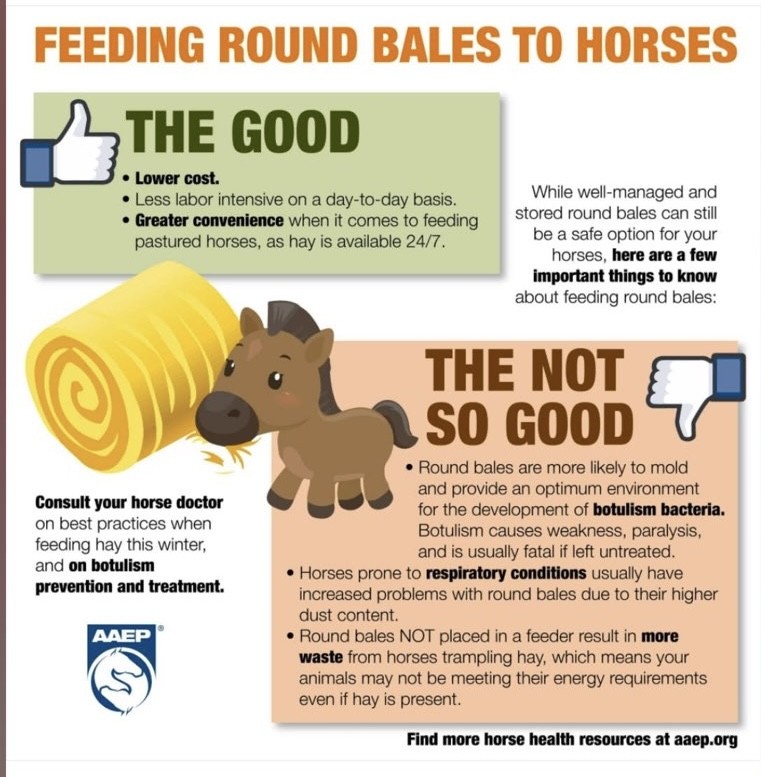
Credit: American Association of Equine Practitioners (AAEP)
–
For assistance with management considerations for your horses, please feel free to contact Amanda Masholie, Sustainable Ag and Smalls Farms Extension Agent at the UF/IFAS Walton County Extension Office at 850-892-8172.
–
References:
–
The American Association of Equine Practitioners. “Cool Facts: Equine Winter Adaptations” 01/03/2025.
–
The American Association of Equine Practitioners. “Feeding Round Bales to Horses: The Good, The Not So Good.” 07/22/2025.
–
Hoopes, Karl H. DVM USU Equine Extension Specialist. 01/2018 “Caring for Horses in Cold Weather”. Utah State University Extension AG/Equine/2018-01pr.

As the Sustainable Ag and Small Farms Extension Agent in Walton County, I support the food and fiber system by specializing in the following areas: small homesteads, animal science, farm planning, farm management, beginning farmer, direct marketing and soil health.
- Small Farm Start Up School is Coming to the Panhandle – April 14 - January 16, 2026
- Winter Management Considerations for Horses - January 9, 2026
- Considerations for Horse Owners Responding to Recent EHV-1 Outbreak - November 21, 2025