
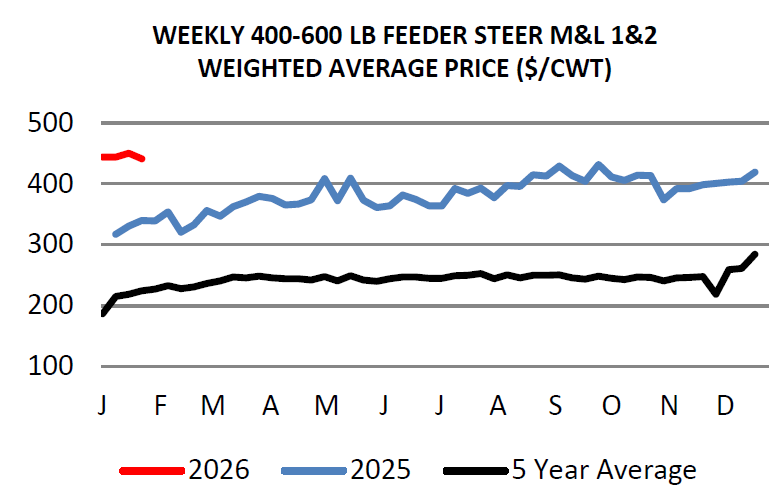
 The cattle business was really good for most ranchers in 2025, and there is every reason to be optimistic about 2026. The chart to the right features 400-600 pound feeder steer prices from cattle sold in Alabama livestock markets in January 2026, and 2025, as compared to the 5-year average. Even though there have only been three weeks of data thus far in 2026, this chart shows that weaned steer prices are still climbing as compared to last year. History tells us that strong markets always come back to the average at some point, but barring some sort of market disruption, it will likely not be this year. Economists are anxiously awaiting USDA’s annual January 1 cattle inventory report at the end of January to confirm the current size of the U.S. cattle herd, but we know from recent monthly cattle on feed reports that rebuilding has remained limited by the number of heifers on feed. How long can these good prices hold? That is the question everyone is asking, but for the most part the cattle market is not something cow-calf operations can control. You can control the size of your herd, but for many cattle ranches in the Panhandle, forage resources and our own challenges with drought have limited herd expansion. The other challenge was that weaned heifers were so valuable, it was hard to keep back extra heifers rather than cash in on the high market in 2025.
–
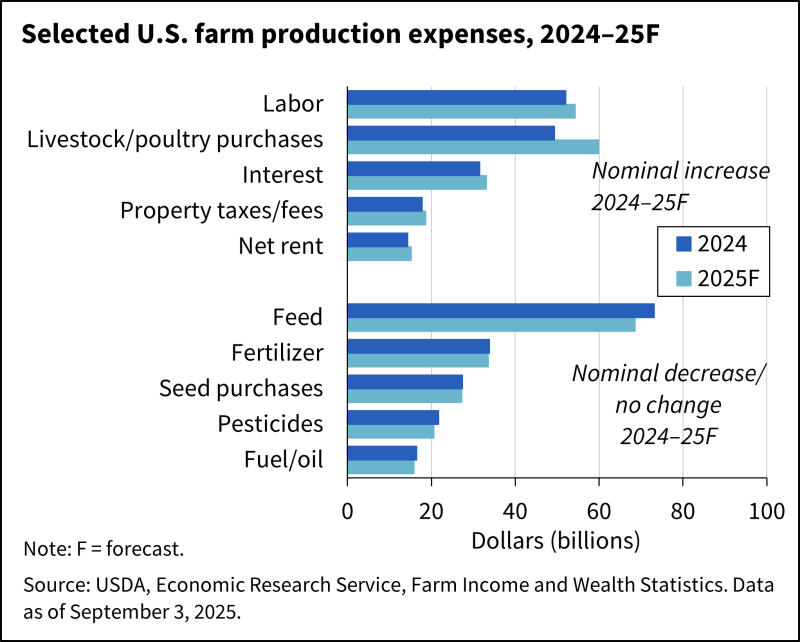
Suffice it to say that the strong cattle market has been a tremendous boost to profitability. However, input prices have increased significantly as well since 2020. The chart above shows how input prices in September 2025 compared with 2024. Input cost increases have leveled out considerably since 2021, but there have not been significant decreases in input costs. The key point is that not only are cattle selling for all time highs, but they were also more expensive to raise than they have ever been before. While cattle ranchers have limited control over the cattle markets or the cost of inputs, you do have some control over your purchasing decisions. No, you can’t “starve a profit out of a cow” and have a productive operation, but you can choose what, when, and the quantity of inputs purchased each year. Managing costs has always been a key management focus for cow-calf operations. Higher market prices provide some pressure release, but we all know this won’t last for years and years. Efficiency is still paramount to profitability in the cattle industry. I saw a great quote from Dr. Danny Klinefelter, Texas A&M Agricultural Economist (now deceased) on this subject called “The 5% Rule.”
THE 5% RULE
A 5% increase in price received,
A 5% decrease in costs, & A 5% increase in yield will often produce more than a 100% increase in net returns.
The effect is cumulative, multiplicative and compounding!” Dr. Danny Klinefelter, Texas A&M Agricultural Economist
–
Ranch Record Keeping
One of the most important management resources managers can utilize are their own production and financial records to efficiently manage costs. I recently revamped the record keeping system I originally created for cattle ranchers in 2004, but more on that later. Over the years I have had numerous conversation with cattle producers about how they manage their herds. One thing that stands out with the most successful owners/managers is their grasp of their overall herd productivity and their operating costs. Once you know your costs of production for your cattle and forage operations, you can make informed decisions to improve efficiency. Trial and error is too expensive in 2026; instead ranchers need to make calculated estimates before making significant changes. That is only possible with a complete set of both production and financial records from the previous year. With detailed records, the following are the type of questions you would have the information to answer for Dr. Klinefelter’s challenge:
–
- Income: What was your income per cow exposed? What was your income per acre? What was your non-cattle income last year?
– - Costs: What was your cost per cow exposed? What was your costs per weaned calf sold? What was your average costs per acre of pasture or per bale of hay?
– - Yield: What was your average weaning weight per cow exposed? What was the average weaning weight of each steer and heifer sold? What was the average weight of your hay bales and how many bales were produced per acre? How many pounds of beef were sold per acre?
–
Required Records
There are very few records that you are required to keep as a cattle producer, but there are four categories that are required by either state or federal law. General categories include federal and state taxes, restricted use pesticide records, employee records and worker protection standards, and fertilizer use in designated Best Management Action Plan (BMAP) areas. Another more recent addition was the Veterinary Feed Directive, which requires a documented prescription to feed antibiotics to specific groups of cattle for a set period of time.
–

Generated with AI
- The IRS requires that farmers and ranchers submit summarized records of income and expenses on the 1040 Schedule F Form with either the cash or accrual accounting systems for income tax submissions. Some states (not Florida) also require summarized records for farm income taxes as well. The Schedule F Form, however, is not very detailed and only asks for the summary, such as Part 1:2 that asks for a total for: sales of livestock, produce, grains, and other products you raised. The form also asks for summaries of total expenses by category such as, 11-Chemicals, 16-Feed, 17-Fertilizers and lime, and 19-Gasoline, fuel, and oil. The form is designed to answer two key questions: Total Income and Total Expenses, for a single answer of net farm profit or loss to determine the total income taxes owed from the previous year.
– - Many of the farm chemicals, particularly herbicides, are not categorized as “Restricted Use Products.” There are some products that are commonly used for armyworm control in Bermudagrass hay fields, such as Mustang Maxx, Dimilin 2L, or Besiege that do require a Pesticide Applicator License to purchase and apply them. Federal law requires certified private pesticide applicators keep records for federally restricted use pesticides (RUP) within 14 days of application and for a period of 2 years.
– - The Occupational Safety and Health Administration (OSHA) requires employee and worker protection standard records to protect worker safety and health for operations with 11 or more employees, OSHOA 1904.1(a)(1) says that “If your company had 10 or fewer employees at all times during the last calendar year, you do not need to keep OSHA injury and illness records unless OSHA or the Bureau of Labor Statistics informs you in writing that you must keep records under § 1904.41 or § 1904.42. However, as required by § 1904.39, all employers covered by the OSH Act must report to OSHA any work-related incident that results in a fatality, the in-patient hospitalization of one or more employees, an employee amputation, or an employee loss of an eye.”
– - Senate Bill 712 Florida requires that “agricultural producers within a Basin Management Action Plan (BMAP) area must enroll in the FDACS BMP program and track fertilizer applications of nitrogen (N) and phosphorous on a NUTRIENT APPLICATION RECORD FORM. Enrolled producers must retain the applicable records for at least five years.”
– - Since June of 2023, over the counter antibiotics have no longer been available, so cattle producers were required to have a prescription from a veterinarian for their use. There were also two records that were added to this new requirement: A Veterinarian-Client-Patient Relationship (VCPR) Agreement signed by the farm owner and veterinarian, which shows the annual working relationship between the farm and the veterinarian; and a Veterinary Feed Directive (VFD) Order which is the specific prescription for use of antibiotics in feed or water systems for a specific group of animals, within a specified time-frame.
–
Ranch Management Records
No one is totally exempt from record keeping at some level, but there are many types of records that are essential for making informed management decisions to take advantage of The 5% Rule to improve the profitability of your cattle ranching operation. The following are some examples records worth considering:
–
Key Records for the Ranch
- January Inventory – This is an inventory of all assets on the farm at the end of the previous year which would include breeding cattle, replacement heifers, calves, and fed cattle for beef, plus other livestock such as ranch horses, and stock dogs. You also want to track how many acres of pasture are owned and rented, as this number may change from year to year. You also want to track all of the tractors, equipment, and implements you have, as this inventory certainly will fluctuate on an annual basis. Then there are also assets such as farm supplies, such as seed, chemical, fencing supplies, etc. that have been purchased but not used that should also be included in your total annual assets.
– - Pasture and Field Records – There are also some key records that are helpful in managing pastures. Daily, monthly, and annual rainfall makes a big impact on how forages grow or even how farm chemicals work. You check your rain gauge after every rain, so why not keep track of it. It is also helpful to track planted and harvest acreage, soil tests and fertilizer applications, pest scouting and pesticide applications, and even grazing days on each field as you mover the heard around the farm each year. These types of records can be really help you determine your most productive pastures or the problem areas that might need renovation in the coming year.
– - Hay Inventory and Feeding Reproduction Records – How much hay did you make and feed this year? Tracking hay inventory as it is harvested and fed can be really useful information. If you had hay tested for quality, you should also figure out which cattle should receive the best hay or the worst hay. The same may be true of the off-farm feed you purchase. While you have the invoices that show the cost and the total amount purchased, are you tracking feeding at the herd level? If you know how much feed you herd is consuming on a weekly basis, you can order what you need in a timely manner so you won’t run out, or avoid over purchasing more than you need.
– - Breeding Season Records – Some of the most important records you can keep are the ones for the breeding herd. Bull breeding soundness exam results, artificial insemination (A.I.) and natural breeding activity, and pregnancy rates are all extremely important performance measures of herd productivity.
– - Calving Season Records – Keeping records during calving season is something most cattle producers enjoy tracking. When calves are born, the sex of the calf, and which cow each calf belongs to are essential records, but it is also important to track calving ease, birth weight, cow body condition, and udder and teat scores on the cow at birth. One record that is very powerful but often overlooked is what percentage of the cows calve in each 21 day period. It is important just to know the total number of live calves born, but you would also like to know how many are born withing the first and second 21-day cycle of the breeding season.
– - Herd Health – The national and Florida Beef Quality Assurance (BQA) programs have brought attention to several key herd health records. Multiple calf sale programs provide premiums for cattle that have been vaccinated with a booster shot before sale. Most require some form of record that can be shared with the buyer to document that vaccinations. But much more than proof of vaccination, herd health records should also include sick cattle treatment, and as mentioned earlier, the use of antibiotics. Other helpful records are tracking your health product inventory which includes monitoring expiration dates, as well as tracking withdrawal times for specific drugs administered to healthy or sick animals before sale.
– - Cattle Performance – From tracking calving intervals for each cow, weaning weights for specific calves, to post-weaning weight gain, there are a number of performance records that are useful for cattle ranchers. There are some key indicators for cattle performance that are worthy of comparison between production years such as, death loss of calves at different stages, average weaning weights, comparison between cow herds, and ultimately calculating benchmark performance in a year-end analysis. One of the best tools I have seen is having individual cow cards that track the performance of each cow’s calves each year, as well as her specific calving intervals. Each cow in the herd can have her own report card that you add data to near the end of each production year.
– - Finances: Expenses & Income – You are required to complete a Schedule F for your income taxes, but there is so much more that can be included for making future management decisions. Tracking income, expenses, employee payroll, or even day laborers is all important. The bottom line is that you can’t calculate profitability without being able to accurately account for total income and expenses.
– - Year-end Analysis – All of the records mentioned in this article are of limited value unless you use them to make decisions that improve the efficiency or productivity of your operation. You have to create the year-end summary reports for analysis. I read some strong words of wisdom from an interview with Terrell Miller, CEO CattleMax, who was quoted in a recent Drover’s Journal article as saying, “Without reporting and analysis, you’re simply filling filing cabinets. It’s not just about putting data in — it’s about getting useful information out.”
–
Ranch Record Keeping Systems
The most powerful tools that have been developed for record management for cattle ranchers are computer software. The software is set up for easy record data input which it can analyze and provide a wide range of reports. The faculty and staff at the North Florida Research and Education Center (NFREC) Beef Unit near Marianna us the program CattleMax and find it very helpful for managing their 300-head herd. Courtney Bir and Brent Ladd, Oklahoma State Agriculture Economists have complied a fact sheet that compares multiple Cow-Calf Production Record Software systems that are commercially available. Some can be purchased directly, while others offer monthly or annual subscriptions. This fact sheet provides comparisons to help narrow down the systems of interest and also provide websites and contact information for each system, so you can get more information once you narrow down your options.
For those of you that are not computer savvy, or just prefer an old fashion system with written records, there are some other options worth considering. The National Cattlemen’s Beef Association (NCBA) sells the “Redbooks” which are very popular pocket-sized record systems for cow-calf producers. These books are released in October each year and include a calendar, basic cattle inventory record, individual calf records, and some other key annual performance measures. They are handy because you carry them with you in your shirt pocket every day. The major challenge is that these books were only designed for one year’s worth of records. While the pocket size is very convenient, they are a little hard to write much information in them. You also have to remember to take them out of your pocket when it is raining, or you’re pulling a calf. But if you are not currently keeping cattle records, this is a pretty easy way to start, and for only $14.77 NCBA will ship them directly to you. New ones are released each year in early October through the NBCA Store.
What I am most excited to share with you is that I completely revamped the Florida Beef Cattle Ranch Record Book in 2025. The 3rd edition is bigger and better than the first two editions. The Ranch Record Book is designed with printed record sheets in a loose-leaf binder to keep in your truck or office. I created three versions of the 3rd edition. The 363-page Commercial Cattle Ranch Record Book comes with all sheets for 100 commercial cows, 10 pastures or crop fields, and 2 years’ worth of most records. There is also a Registered Cattle Ranch Record Book with exactly the same records except for the individual cow record shhets. I have also created a single copy version that is 114 pages, so you can print it out and then make copies as needed of each record sheet you want. Or you can browse through the whole selection of record sheets individually and just print out the ones that you want. You can access all of these for free by using the following website: https://go.ufl.edu/ranchrecordbook. However, the UF/IFAS Extension Office in Jackson County will print a complete record book for you for $20, or we will print and ship it to you directly for $30. We can even customize it for you to some degree, such as providing a mix of commercial and registered cow cards in a single record book. Take a look at what is available through the website then mail in the following order form with a check made payable to the “University of Florida.”
3rd Edition Florida Cattle Ranch Printed Record Book Order Form
–
Benchmark to Make Progress
Generated with A.I.
That cattle business is much more fun with strong prices. No mater which form or record system you choose, this is a great time to start tracking how you are currently managing your herd. The main idea here goes back to The 5% Rule I shared with you near the beginning of this discussion. You can’t manage what you don’t measure. Once you start keeping records of production, costs, and income, you can set annual benchmarks or targets to aim for. You probably won’t be able to make a 5% improvement in each of these areas in a single year or even two. Benchmarks will help you map the direction you want to head. Once you have the data, then you can start analyzing it on an annual basis, and that is when the innovation happens. Once you know where you are, you can start a plan for where you want to go. Even if profit or loss is not your primary motivation for raising cattle, everyone can benefit from a better understanding of the net value of what you accomplish each your with your land and cattle. I will also discussing this topic at the upcoming Beef Cattle Conference & Trades Show, so I invite you to come to hear this and other presentations.
If you want more information on record keeping and management of cattle ranches, contact your county’s agriculture or livestock extension agent. We are here to provide unbiased, research-based information to help you make informed decisions to improve the efficiency of your farm or ranch.

demayo@ufl.edu - 850-482-9620
Follow me on Twitter
@UFCowman
- Ranch Record Keeping for Annual Analysis & Innovation - January 23, 2026
- Friday Feature: 2026 Farm Dog of the Year - January 23, 2026
- 2025 Weather Summary and 2026 1st Quarter Outlook - January 16, 2026