
Ed Borgato, UF/IFAS Weed Scientist, West Florida Research and Education Center – Jay
The Critical Window: Why Timing is Everything in Weed Control
Even a single seed that slips into a field can trigger a cascade of control challenges over the years. When a peanut or cotton field first emerges, there’s a window where weeds must stay below a level that can harm the crop. That period spans roughly 3‑8 weeks after emergence for peanuts and 3‑5 weeks for cotton. This window varies according to weed emergence timing relative to the crop, weed density, species composition, and a range of production factors such as cultivar, fertility, irrigation, and weather conditions. In practice, the thresholds for most of the troublesome weeds in this region are set low, meaning that if weeds are in the field, herbicide action is almost always needed. The recipe for successful weed-management program is well known; begin with clean fields and employing a combination of preplant, pre-emergence, and post-emergence herbicides that provide overlapping residual activity. The issue is when weeds get out of control.
–
When Plans Go “Wild”: The 30-60-Day Challenge
Even the best-planned herbicide schedules can face setbacks between 30 and 60 days after planting, the period during which weed control becomes particularly difficult for many reasons. First, the rapid weed growth can narrow the optimal window for post-emergence applications to only a few days. Second, the spread of herbicide-resistant populations further complicates control. Not to mention that recent production seasons in the Florida Panhandle have also demonstrated how drought during planting can reduce residual herbicide performance, while frequent rainfall, as observed in 2025, can delay postemergence operations. As these delays occur, weeds increase in size, and often in density as well, placing additional pressure on herbicide performance.
–
The Classic “Spray or Not” Dilemma
Deciding whether a late-season herbicide application will be economically justified remains a recurring challenge. The major weed species affecting Florida cotton and peanut production can significantly reduce yield, decrease harvest efficiency, and diminish product quality, hence they should be managed provided the effort is economically viable. This viability depends largely on efficacy and for postemergence applications to be effective they must target weeds at the correct growth stage. Further complicating matters is the fact that stressed weeds, such as those affected by drought, heavy rain, or cloud cover often don’t respond well to herbicide treatments. As a result, growers frequently confront the same question each season, “Will this application provide enough benefit to justify the cost?“
–
Why the First Seed Often Becomes the Biggest Problem
The debate on whether or not applications will pay off is difficult to answer. When weeds reach advanced stage, while crops near critical development, the likelihood of a cost-effective response diminishes dramatically due to greater weed tolerance and increased risk of crop injury. Adverse weather conditions and the inability to safely remove weeds mechanically further reduce the odds of a successful intervention. Reliance on in-season herbicide applications can lead to inconsistent results, frequent weed escapes, and increasing selection pressure for resistance. The repetition of these events over years makes that first seed a silent threat that now undermines crop production in the region.
–
Work Toward a Year-Round Safeguard
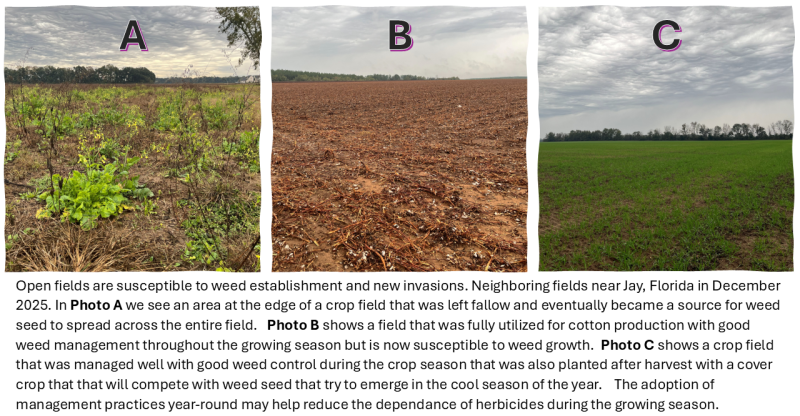
Sustainable weed management demands a holistic, year-long approach. Diversifying management strategies and embedding preventive strategies is a must to avoid seed bank replenishment and new sources of introductions, and more importantly to reduce dependency on herbicides to mitigate weed pressure before it reaches the critical levels in critical timings.
- Surprise!January WASDE Report Moves Corn and Soybeans Lower – Cotton Flat - January 16, 2026
- Don’t Ignore Cow Size When Comparing Calf Weaning Weights - January 9, 2026
- Federal Estate Tax and Gift Tax Limits Announced For 2026 - December 19, 2025