
Marcelo Wallau, UF/IFAS Forage Extension Specialist, Department of Agronomy, Maria Elena Mailhos, Variety Trial Coordinator, Department of Agronomy, and Diwakar Vyas, UF/IDFAS Department of Animal Science
Many producers are gearing up to plant corn silage quite soon. In South Florida, corn planting starts early, January into February; for North Florida, between early March (irrigated) all the way through May (dryland). Good silage starts with a good crop, and that is always a combination of genetics and agronomic management. Thus, the choice of hybrid really matters. It is the first integrated pest management (IPM) decision a farmer can make. Selecting materials that are adapted to the environment and have strong pest and disease resistance packages can result in greater productivity and lower cost of production. To help with those decisions, we want to share the latest data from the 2025 spring corn silage trials conducted in Citra, Florida (Figure 1). In this trial, our team evaluated 36 commercial and experimental corn hybrids, from 14 different companies, to provide unbiased performance and quality data.
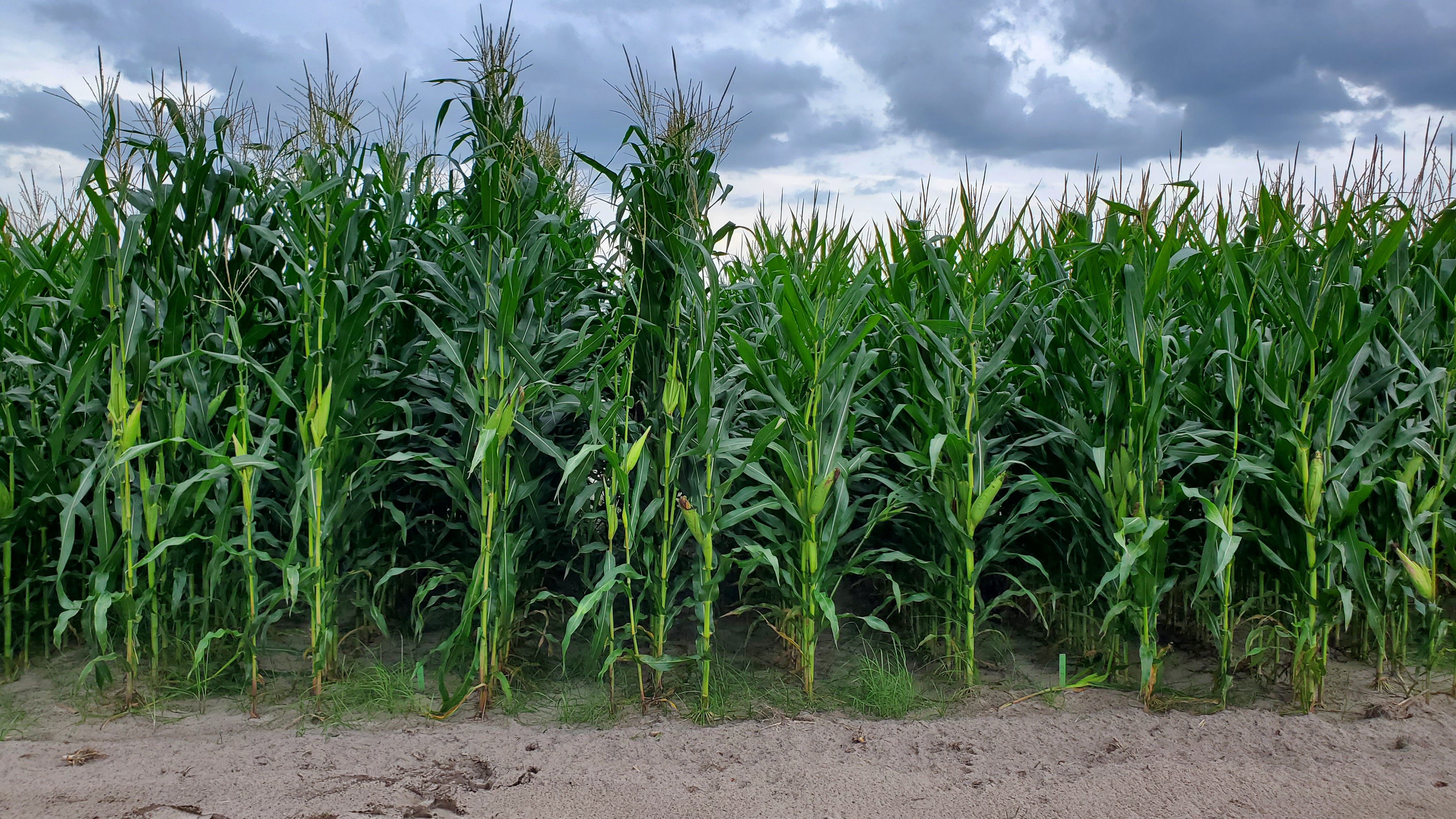
Figure 1: Choosing the right corn hybrid can have a large impact on silage productivity and animal performance. Ther are large differences in plant stature, grain filling, tolerance to pest and diseases, and to the stress environment common to Florida.
–
The trial was planted on March 26, 2025, at a rate of 32,600 seeds per acre in 30-inch rows. Fertility management included 280 lb of N, 56 lb of P2O5, and 225 lb of K2O per acre, applied in split doses with pre-incorporated fertilizer, a starter application, and four additional applications throughout the season. Weed and pest control consisted of Dual II Magnum and Prowl H2O at planting, followed by GLY-4 Plus one month after planting for glyphosate-tolerant hybrids; followed by fungicide applications of Headline SC and Headline Amp later in the season. The trial was irrigated as needed, and harvest occurred between July 1 and July 3, 2025.
We targeted harvesting at ½ to ¾ milk line, around 35% dry matter which is ideal for ensiling. That’s when we have the best compromise between quantity and quality. Forage quality parameters included net energy for lactation (NEl), crude protein (CP %), starch, water-soluble carbohydrates (WSC), acid detergent fiber (ADF), ash, amylase-corrected neutral detergent fiber (aNDF), and NDF digestibility at 30 hours (NDFD30). We also estimated milk per ton of silage and milk per acre of silage using the Milk2024 formulas from the University of Wisconsin. These metrics help identify hybrids that balance yield and quality, which is critical for maximizing milk production per acre and per ton (top-right quadrant in Figure 2). High starch and digestible fiber improve energy availability, while strong disease resistance ensures consistent performance under Florida’s challenging conditions. This trial was conducted independently by UF/IFAS faculty and is open to all seed companies for hybrid entry, ensuring transparency and unbiased evaluation.
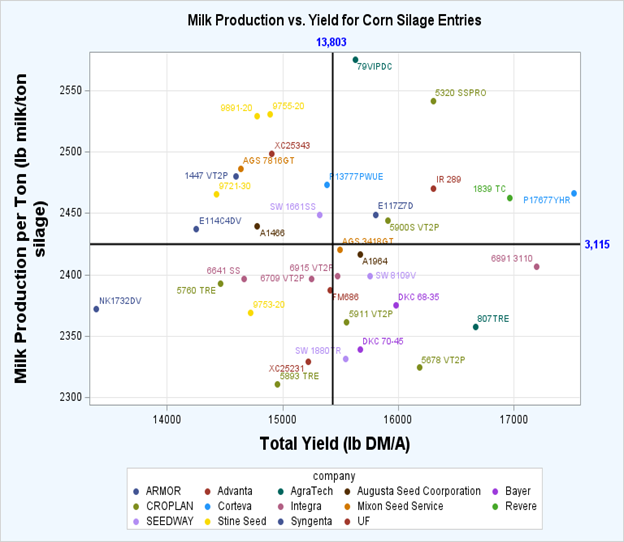
Figure 2: Total biomass harvested in relation to milk production per ton for corn hybrids tested in the official variety trial by the University of Florida Forage Team. Each point represents the average of four replications. Hybrids in the top right quadrant are among the top performers (Table 1)
–
Table 1 brings the biomass harvested and estimated milk production per ton and per acre for each hybrid. Values in bold and with an * are considered statistically different than the average. For the columns that do not have values bolded, there were no statistical differences. Table 2 contains the nutritive value parameters evaluated from the unfermented corn samples. You can also download the complete report through the following link: UF-IFAS 2025 Spring Corn Results. For the complete dataset, please access our Official Variety Trial website. There, you will also find the results from other trials, including sorghum, sorghum x sudan, and cool-season forages. The 2025 results along with the historical database is also accessible through our Silage Hybrid Selection Tool.
Table 1: Total production (lbs. dry matter per acre) and estimated milk production per ton of silage and milk production per acre for the 2025 Corn Silage Hybrid Trial
| Company | Hybrid | Relative maturity | Total Production | Milk production per ton | Milk production per acre | |||
| lb DM/A | lb milk/ton silage | lb milk/A | ||||||
| ARMOR | 1447 VT2P | 114 | 14,593 | 2,480 | 18,153 | |||
| Advanta | XC25231 | 117 | 15,222 | 2,329 | 17,686 | |||
| Advanta | XC25343 | 117 | 14,906 | 2,498 | 19,038 | |||
| AgraTech | 79VIPDC | 115 | 15,631 | 2,575 | 20,217 | |||
| AgraTech | 807TRE | 118 | 16,668 | 2,358 | 19,728 | |||
| Augusta Seed Coorporation | A1466 | 116 | 14,781 | 2,440 | 18,076 | |||
| Augusta Seed Coorporation | A1964 | 114 | 15,673 | 2,417 | 18,887 | |||
| Bayer | DKC 68-35 | 118 | 15,982 | 2,375 | 18,973 | |||
| Bayer | DKC 70-45 | 120 | 15,673 | 2,340 | 18,373 | |||
| CROPLAN | 5320 SSPRO | 113 | 16,301 | 2,541 | 20,861 | * | ||
| CROPLAN | 5678 VT2P | 116 | 16,180 | 2,324 | 18,625 | |||
| CROPLAN | 5760 TRE | 117 | 14,460 | 2,393 | 17,313 | |||
| CROPLAN | 5893 TRE | 118 | 14,953 | 2,311 | 17,257 | |||
| CROPLAN | 5900S VT2P | 119 | 15,912 | 2,444 | 19,448 | |||
| CROPLAN | 5911 VT2P | 119 | 15,554 | 2,362 | 18,460 | |||
| Corteva | P13777PWUE | 113 | 15,383 | 2,473 | 19,101 | |||
| Corteva | P17677YHR | 117 | 17,519 | * | 2,466 | 21,651 | * | |
| Integra | 6641 SS | 116 | 14,665 | 2,397 | 17,631 | |||
| Integra | 6709 VT2P | 117 | 15,247 | 2,396 | 18,278 | |||
| Integra | 6891 3110 | 118 | 17,198 | * | 2,406 | 20,659 | ||
| Integra | 6915 VT2P | 119 | 15,474 | 2,399 | 18,534 | |||
| Mixon Seed Service | AGS 3418GT | 118 | 15,498 | 2,420 | 18,779 | |||
| Mixon Seed Service | AGS 7816GT | 116 | 14,635 | 2,486 | 18,207 | |||
| Revere | 1839 TC | 118 | 16,967 | * | 2,463 | 20,950 | * | |
| SEEDWAY | SW 1661SS | 116 | 15,317 | 2,449 | 18,836 | |||
| SEEDWAY | SW 1880TR | 118 | 15,546 | 2,332 | 18,117 | |||
| SEEDWAY | SW 8109V | 117 | 15,756 | 2,399 | 18,921 | |||
| Stine Seed | 9721-30 | 112 | 14,426 | 2,465 | 17,927 | |||
| Stine Seed | 9753-20 | 116 | 14,724 | 2,369 | 17,417 | |||
| Stine Seed | 9755-20 | 111 | 14,890 | 2,530 | 18,943 | |||
| Stine Seed | 9891-20 | 119 | 14,775 | 2,529 | 18,772 | |||
| Syngenta | E114C4DV | 114 | 14,254 | 2,437 | 17,388 | |||
| Syngenta | E117Z7D | 117 | 15,802 | 2,449 | 19,451 | |||
| Syngenta | NK1732DV | 117 | 13,387 | 2,372 | 15,890 | |||
| University of Florida | FM686 | 120 | 15,410 | 2,388 | 18,438 | |||
| University of Florida | IR 289 | 120 | 16,306 | 2,470 | 20,270 | |||
| Mean | 15,435 | 2,425 | 18,757 | |||||
| SE | 886 | 118 | 1,353 | |||||
* indicates hybrids that performed similarly to the best hybrid, according to F-test at P < 0.05; All mean reported are Least Square Means.
–
Table 2: Nutritive value parameters for the hybrids tested in the 2025 Corn Silage Hybrid Trial (unfermented).
| Company | Hybrid | NEl | CP | Starch | aNDF | NDFD30 | |||||
| Mcal/100 lb DM | ———————– % DM ———————– | % NDF | |||||||||
| ARMOR | 1447 VT2P | 0.61 | 8 | 29.6 | 43.2 | 42.5 | |||||
| Advanta | XC25231 | 0.57 | 8.8 | * | 22.9 | 48.6 | 49.3 | ||||
| Advanta | XC25343 | 0.61 | * | 8 | 29.1 | * | 43.9 | 46.6 | |||
| AgraTech | 79VIPDC | 0.63 | 7.7 | 32.5 | 40.5 | 43.7 | |||||
| AgraTech | 807TRE | 0.58 | 8.1 | 25.2 | 47.8 | 45.8 | |||||
| Augusta Seed Coorporation | A1466 | 0.6 | 7.6 | 29 | 45 | 46.9 | |||||
| Augusta Seed Coorporation | A1964 | 0.59 | 7.4 | 26.5 | 44.6 | 42.9 | |||||
| Bayer | DKC 68-35 | 0.58 | 7 | 25.9 | 47.5 | 46.6 | |||||
| Bayer | DKC 70-45 | 0.57 | 7.5 | 25.6 | 47.9 | 43.6 | |||||
| CROPLAN | 5320 SSPRO | 0.62 | 7.8 | 30.4 | 41.8 | 46.3 | |||||
| CROPLAN | 5678 VT2P | 0.57 | 7.6 | 22.3 | 47.7 | 43.8 | |||||
| CROPLAN | 5760 TRE | 0.58 | 7.3 | 25.7 | 46 | 43.8 | |||||
| CROPLAN | 5893 TRE | 0.56 | 7.9 | 23.6 | 48.7 | 45.3 | |||||
| CROPLAN | 5900S VT2P | 0.6 | 8 | 26.9 | 44.4 | 43.7 | |||||
| CROPLAN | 5911 VT2P | 0.58 | 8.1 | 25.7 | 47.6 | 45.4 | |||||
| Corteva | P13777PWUE | 0.6 | 8.1 | 28.9 | 43.8 | 47.3 | |||||
| Corteva | P17677YHR | 0.6 | 8.1 | 27.7 | 43.9 | 46.1 | |||||
| Integra | 6641 SS | 0.59 | 7.3 | 26.7 | 45.3 | 42.3 | |||||
| Integra | 6709 VT2P | 0.59 | 7.9 | 24 | 46 | 46.7 | |||||
| Integra | 6891 3110 | 0.59 | 7.7 | 24.6 | 45.8 | 46.8 | |||||
| Integra | 6915 VT2P | 0.59 | 8.1 | 26.2 | 46.5 | 45.6 | |||||
| Mixon Seed Service | AGS 3418GT | 0.59 | 7.3 | 25.5 | 45.6 | 45 | |||||
| Mixon Seed Service | AGS 7816GT | 0.61 | 7.6 | 29.6 | 43.9 | 45.6 | |||||
| Revere | 1839 TC | 0.6 | 7.6 | 29.7 | 44.1 | 43.6 | |||||
| SEEDWAY | SW 1661SS | 0.6 | 7.4 | 28.4 | 44.2 | 42.8 | |||||
| SEEDWAY | SW 1880TR | 0.57 | 7.4 | 25.3 | 47.7 | 43.8 | |||||
| SEEDWAY | SW 8109V | 0.59 | 8.2 | 24.2 | 46.9 | 49.6 | * | ||||
| Stine Seed | 9721-30 | 0.6 | 7.4 | 28.4 | 43.6 | 44.1 | |||||
| Stine Seed | 9753-20 | 0.58 | 7.7 | 25.3 | 47.7 | 47 | |||||
| Stine Seed | 9755-20 | 0.62 | 8.1 | 29.6 | 42.2 | 45.1 | |||||
| Stine Seed | 9891-20 | 0.62 | 8.4 | 28.2 | 42.7 | 48.3 | |||||
| Syngenta | E114C4DV | 0.6 | 7.9 | 25.7 | 44.8 | 48.5 | |||||
| Syngenta | E117Z7D | 0.6 | 7.4 | 30.1 | 43.7 | 41.8 | |||||
| Syngenta | NK1732DV | 0.58 | 8.1 | 24.7 | 46.5 | 47.8 | |||||
| University of Florida | FM686 | 0.58 | 8.1 | 21.1 | 48.3 | 49.6 | * | ||||
| University of Florida | IR 289 | 0.6 | 8.9 | * | 23.1 | 46.8 | 53.6 | * | |||
| Mean | 0.59 | 7.8 | 26.6 | 45.4 | 45.7 | ||||||
| SE | 0.04 | 0.5 | 5.3 | 3.5 | 1.9 | ||||||
* indicates hybrids that performed similarly to the best hybrid, according to F-test at P < 0.05; All mean reported are Least Square Means.
–

Figure 3. Comparison of the last three years of data for corn hybrid tested by the Forage Team. Hybrids that consistenly perform well across years are more stable, more adapted and less affected by environmental conditions. (Click on graphic for full screen viewing) A printable version is available at this link: Corn silage – three-year data
–
Save the date – Upcoming events
Coming up on February 26th, we are hosting the “Cool-season forage tour” in north Florida, where we visit a local dairy to see cool-season forages performing under a high fertility environment, and a beef cattle operation where those same materials are being used for grazing. On May 28th, our team will host the Corn Silage and Forage Field Day in Citra, FL, a traditional event cohosted with the University of Georgia forage and livestock group from Tifton. For those interested in our events, check the QR code below (https://tinyurl.com/CoolSeasonTour2026), and keep an eye out for more announcements on our social media channels.
If you are interested in more information about our trials or have any questions about the data, reach out to us at forages@ifas.ufl.edu and follow us on social media: UF IFAS Forages on YouTube, UF Forage Team on Facebook, and uf.forages on Instagram.

- Variety Choice Matters – Results from the 2025 Spring Corn Silage Variety Trial - January 9, 2026
- 2025 Southeastern Hay Contest Sets New Records - October 24, 2025
- 2025 Cool-Season Forage Official UF/IFAS Variety Trial Results - September 5, 2025