
Q. My oleander shrubs are overgrown. How severely can they be pruned?
A. Oleanders flower on current season’s growth. So, if you prune just before new growth occurs, you’ll still get flowers. However, severe pruning (removing 1/3 or more of the plant), may result in the oleander not flowering for several years. Pruning severely causes a plant to put all of its energy into recovering the lost growth at the expense of producing flowers. But sometimes the need to severely reduce a plant’s size overrides the need for flowers. Oleanders can grow to a height of 10 to 20 feet with a spread of 10 to 15 feet.
Q. I have a holly bush that has grown too large. Will it recover if I prune it way back? I also have large azaleas that I trimmed back last year but they’re overgrown again. Can I trim them back severely again and have them recover?
A. Hollies and azaleas generally respond well to severe pruning. And they probably will recover. But, as you’ve experienced with your azaleas, plants are designed to grow to a certain height. When you prune to reduce their height, they will regain the growth, again and again. So, you may have a regular job on your hands in pruning these plants every year or so to maintain the desired height. To prune for the sake of reducing the height may result in fewer berries in the case of the holly, if it’s a female plant, and fewer flowers in the case of the azaleas. Eventually, you may decide to remove these overgrown plants and replace them with smaller maturing ones.
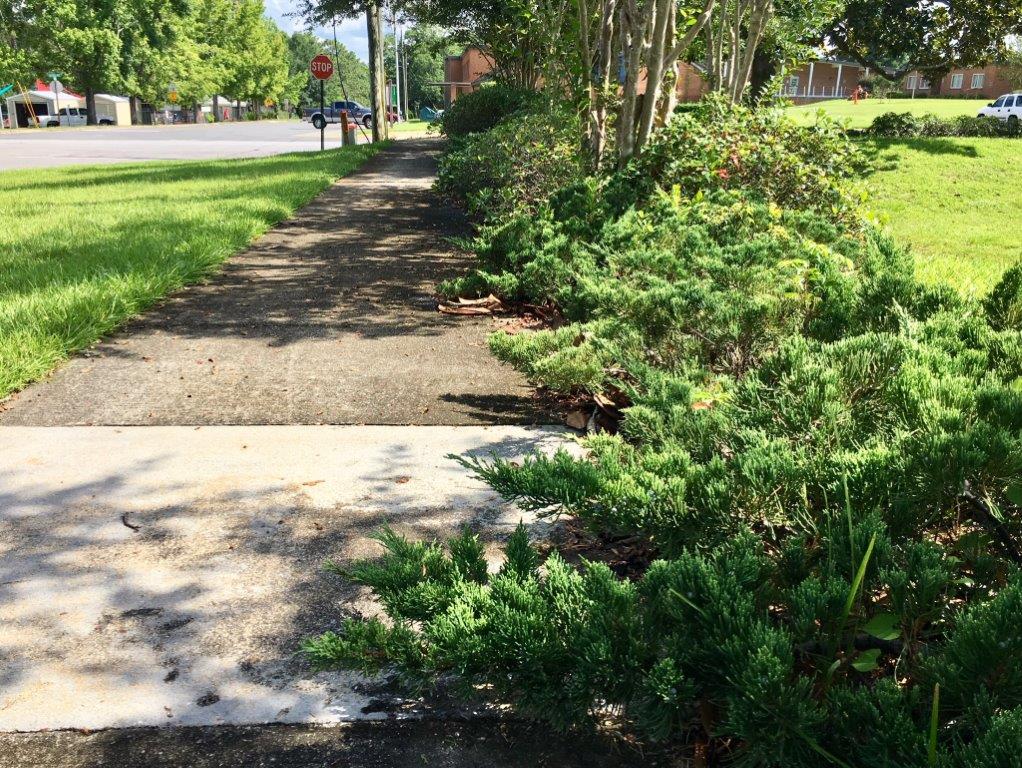
Consider replacing junipers that routinely grow over sidewalk instead of pruning to force them to fit. Credit: Larry Williams
The best time to severely prune, sometimes referred to as hard pruning (removing 1/3 or more of the height), is late winter (late February to mid-March), just before new growth occurs. When a plant becomes too large for its location, the problem goes back to planting the wrong plant in the wrong place. The plant is only doing what it is genetically designed to do. It’s a good idea to find out how large a plant grows (both in height and spread) before planting it. To plant a plant that is designed to grow ten feet in height where you need a plant that only grows three feet in height can result in having to routinely prune to “force it to fit.” Sever pruning is usually only a temporary fix as the plant still has the same root system it had prior to pruning. As a result, it usually will regrow to become in balance with its root system. Some shrubs such as boxwoods, junipers and arborvitae do not respond well to severe pruning.
- Pruning Overgrown Shrubs - January 22, 2026
- Know What You’re Doing when Amending Florida’s Sandy Soil - December 18, 2025
- Evaluate and Renovate Landscape During Fall - October 30, 2025