
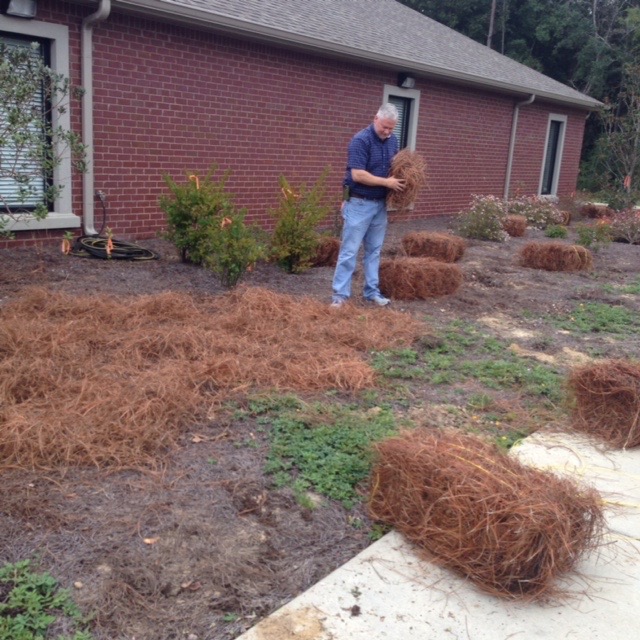
Pine straw being used as mulch in plant bed. Credit: Larry Williams
There is a difference between mulching and amending the soil. Mulching involves placing material such as pine straw, leaves or pine bark on top of the soil. Amending the soil is the incorporation of the material into the soil (in the root area).
Soil amendments and mulch can be organic or inorganic. Most soil amendments are organic (coming from a living organism) such as pine straw or peat moss. A few inorganic (non-living) soil amendments include sand, perlite and vermiculite.
Many common organic soil amendments don’t last long in our soils and climate. Materials such as peat moss decompose rapidly in our sandy soils, under our warm, moist conditions. Microorganisms break the “stuff” down rapidly, once it is in the soil. As a result, the benefits from the additional organic matter are quickly lost unless additional organic matter is repeatedly incorporated within the soil.
Slower decomposing materials such as sawdust or other wood products will last longer. But microorganisms that help decompose wood within the soil use or tie up some of the available plant nutrients such as nitrogen during the decomposition process. So additional nitrogen may need to be added to meet the nitrogen requirements for plants that are growing in the amended soil when wood is used as a soil amendment. Additional nitrogen may be needed until the wood is thoroughly decomposed. This may take months to years based on how well rotted the wood was when incorporated. It’s best to use well-rotted sawdust as a soil amendment. Nitrogen deficiency results in a general light green to yellow color in plant leaves.
Mushroom compost contains a high degree of lime. As a result, it will raise the soil pH, making the soil more alkaline or less acidic. It has its place as a soil amendment but should not be used where “acid loving” plants are to be grown. This would include plants such as centipedegrass, blueberries, azaleas, camellias and gardenias. It’s best to know the soil pH before using mushroom compost to avoid ending up with soil that’s too alkaline for the plants you intend to grow.
There needs to be a reason to amend the soil. Is the soil too heavy and poorly drained such as is the case with clay or muck type soils? Then, you may need to add something such as perlite or sand to “open” the soil to improve drainage. Is the soil sandy with a low pH? Then, you may want to use mushroom compost.
Amending soil for no good reason can be a time consuming and costly mistake.
- Know What You’re Doing when Amending Florida’s Sandy Soil - December 18, 2025
- Evaluate and Renovate Landscape During Fall - October 30, 2025
- Summer is Too Hot for Lawn Herbicides - August 23, 2025