
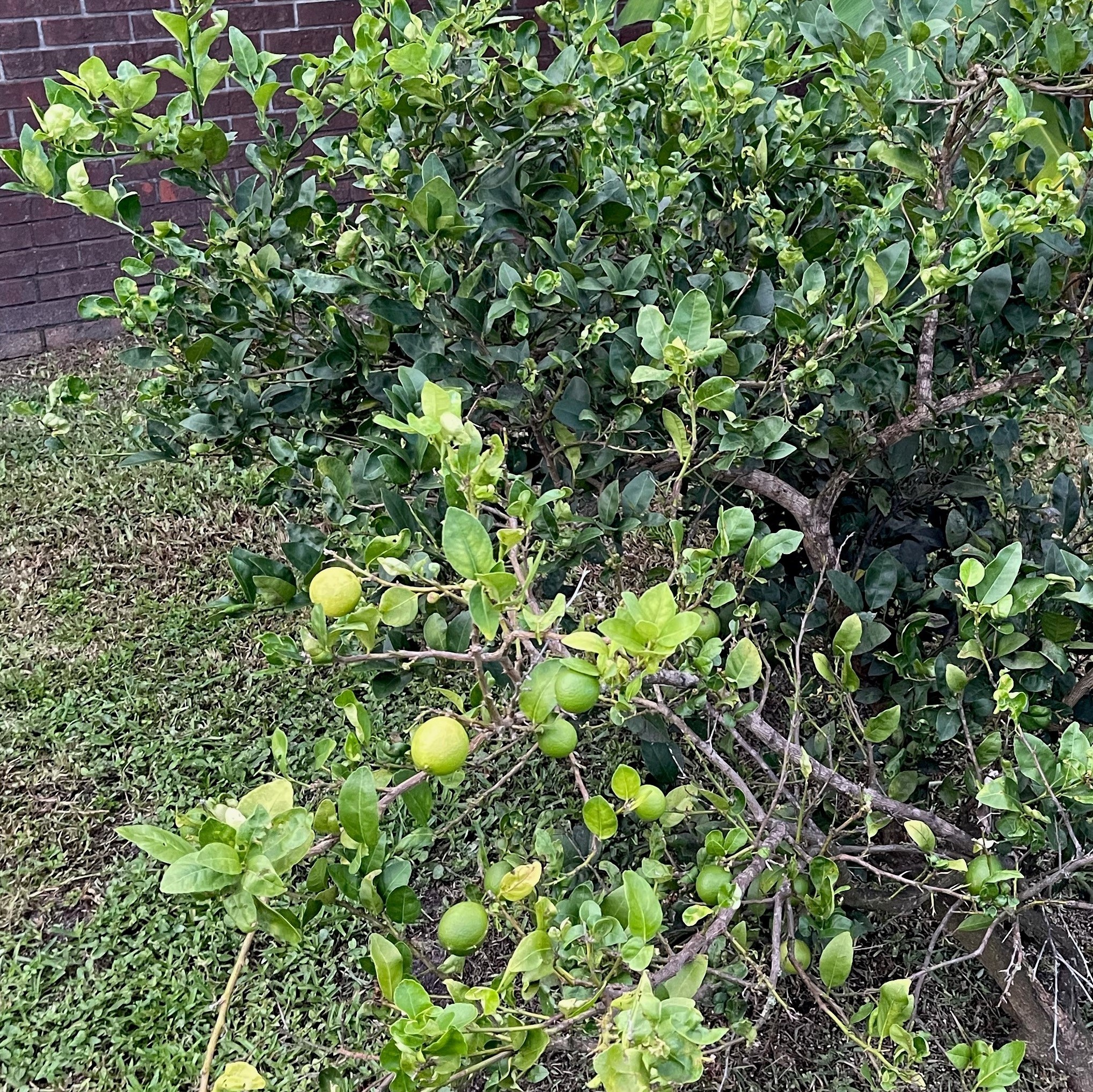
The Christmas season is all about the gifts! This statement couldn’t be further from the truth, but most likely some gifts will be given. An old traditional gift is gift fruit. And a lot of the time that gift fruit is a mix of citrus from Florida. A unique citrus that I’ve been wanting to add to my grove is the limequat. A few weeks ago I had a close encounter with a limequat at a local nursery, but it was in disguise. The limequat in question had a tag that read ‘Key Lime’. I am a fan of Key lime pie, therefore I like Key limes, but I knew I don’t want the added maintenance of protecting a Key lime tree from the cold. I had a suspicion this plant was a limequat, but I decided to pass on it. This experience prompted me to do a little research, so I don’t pass up on this opportunity in the future.
Key Lime fruit at various degrees of ripeness. Photo Credit: Ray Bodrey, University of Florida/IFAS Extension – Gulf County
Key Lime vs. Persian Lime
Before we talk more about limequats, I think it’s important we discuss the differences between Key limes and Persian limes. The Persian lime, Citrus latifolia, originated in southeast Asia. The first report of these trees in the United States was at a home in California in 1875. Like Persian limes, the Key lime, Citrus aurantifolia, originated in southeast Asia and was brought to the Americas by Spanish and later became naturalized in the Florida Keys and throughout Central and South America. Although these limes are two different species, they are both hybrids of crosses between the same three species (Citrus medica, Citrus grandis, and Citrus micrantha). Persian limes are more cold hardy than Key limes and neither are as cold hardy as limequats.

Kumquats growing on a tree. Photo Credit: University of Florida/IFAS
Limequat
Limequats resulted from cross pollination between a Key lime and a kumquat. However, limequats are less cold hardy than kumquats. Similar to kumquats, the skin of limequats is sweeter than their flesh. Three common cultivars of limequats are ‘Eustis’, ‘Lakeland’, and ‘Tavares’. ‘Tavares’ limequats produce larger fruit than ‘Eustis’ and ‘Lakeland’, but their mature fruit are more orange in color. A number of commercial and retail nurseries sell a limequat variety under the name ‘Key’ or ‘Key Lime’, which stemmed my confusion at the local nursery. All confusion could have been avoided if I would have known the scientific name at the time of my visit. (Limequats are listed as either Citrus x floridana or Citrofortunella x floridana.)
So now you know how limequats came about. For more information on limequats and other citrus species, please visit the UF/IFAS Gardening Solutions Citrus Page.
- Is a Limequat a Lime or a Kumquat? - December 26, 2025
- Gardening in the Panhandle LIVE! Program Summary: Pests of Florida Lawns and Landscape Plants - May 28, 2025
- Fun Facts About Ferns - April 30, 2025