
We will begin with a statement most know, but bears repeating… Snakes are just another animal trying to get through the day. They need to eat, avoid being eaten, find a place to sleep, and – at some point in the year – find a mate. They are no different than raccoons or hawks. But our reactions to these animals are very different to our reaction to raccoons and hawks. When hiking in the woods when someone says “bald eagle” the reaction is uplifting, maybe get a photo. But if someone says “snake” the reaction is different. If they say “rattlesnake” that reaction increases several magnitudes. In Manny Rubio’s book on rattlesnakes, he mentions that 50% of our population is “uneasy” about them and 20% are terrified of them – ophidiophobia is a real thing. That said, rattlesnakes are part of the barrier island ecology, and it is good to learn more about them.
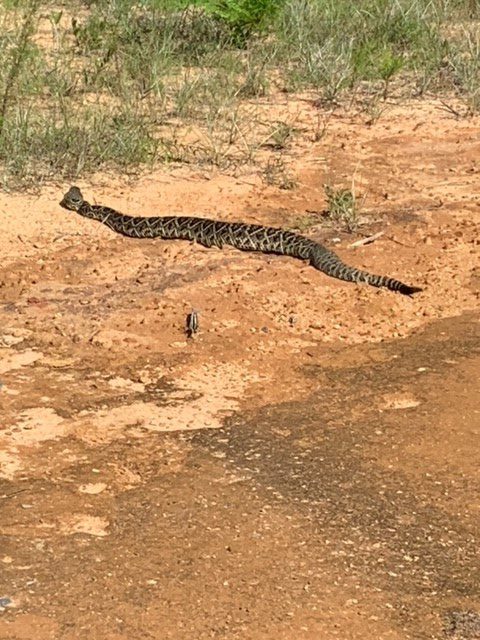
This eastern diamondback rattlesnake was seen crossing a dirt road near DeFuniak Springs shortly after the humidity dropped.
Photo: Lauren McNally
Rattlesnakes are only found in the new world. There are 30 species listed in the U.S. and Canada and three of those live in Florida. One of them, the eastern diamondback rattlesnake, lives on our barrier islands. The pygmy rattlesnake may as well, but I have not encountered it (nor have heard of others encountering). The canebrake/timber rattlesnake is not common in Florida, and I have never heard of them on our islands.
These snakes differ from others in that they possess modified scales at the tip of their blunt tails we call rattles. Many snakes vibrate their tails when alarmed but this snake’s vibrations can be heard at a distance (up to 20-30 feet sometimes) to warn potential predators they are there. Each time the snake sheds its skin it will leave a new segment on the rattle. This is not a good way to age the snake however because they may shed several times in one year and older segments can break off. There have been reports of rattlesnakes with deformed tails and no rattles at all, but this is rare.
They also possess facial pits that have cells which can detect temperature radiating from an object, including “warm blooded” prey, while hiding. These thermal receptors lie along the bottom of the facial pit and are connected to the optic nerve; thus, they can sort of “see” heat.
Their eyesight is not as good as birds and mammals, and they have an elliptical pupil. They appear to use their eyesight in determining the size of the approaching animal and thus, their reaction to it.
They have nostrils but smell does not seem to play as important a role as Jacobsen’s organ does. This organ is found on the roof of their mouths. Rattlesnakes (all snakes) will flick their forked tongues to collect air molecules and stick the tip of each fork into a groove in the roof of their mouths that lead to this organ. Here they can taste/smell what is within their environment. The “taste” of potential prey will increase the frequency of tongue flicks and could cause the snake to move forward.
The fangs are the part of this animal we are most concerned about. They are hollow tubes connected to a venom gland which are located behind each jaw and give the snake the triangular head shape they are known for. These fangs are folded in a sheath so that they can close their mouths. Whether only one or both fangs are extended during a bite is controlled by the snake. Fangs often break off but smaller new ones are ready to replace them when needed. They will replace these fangs every two months, one at a time.
The strike involves opening the mouth, extending the fangs 90°, opening the mouth 180°, thrusting forward, bite down, inject, recoil, re-fold fangs, and back into the attack position. There are “offensive” and “defensive” strikes. Venom is “expensive” for snakes to produce and is meant for killing prey. The amount injected (if any at all) is controlled by the snake. A “defense” strike is slightly elevated. The upward angle reduces thrust and penetration depth.
Other general characteristics of rattlesnakes includes a triangular shaped head, most have a dark “mask” over their eyes, scales protruding over the eyes, keeled scales giving them a dry/rough appearance, and the males have longer tails than the females.
In our next post we will look at rattlesnake predation.
References
Rubio, M. 2010. Rattlesnakes of the United States and Canada. ECO Herpetological Publishing & Distribution. Rodeo, New Mexico. pp. 307.
Gibbons, W., Dorcas, M. 2005. Snakes of the Southeast. The University of Georgia Press. Athens, Georgia. pp. 253.
Graham, S.P. 2018. American Snakes. John’s Hopkins University Press. Baltimore, Maryland. pp. 293.
- Rattlesnakes on Our Barrier Islands; Part 5 – Reproduction - January 12, 2026
- Rattlesnakes on Our Barrier Islands; Part 4 – Thermoregulation - December 29, 2025
- Rattlesnakes on Our Barrier Islands; Part 3 – Envenomation - December 22, 2025