
All animals have a thermal range within which they can survive. For some it is very small range, for others it is amazingly large. Whatever their range is, they function best near the upper portion of it. “Warm blooded” animals (endotherms) have high metabolisms and generate warmth internally. Most have covering over their skin, fur or feathers, that assist with insulating them. “Cold blooded” animals (ectotherms) are the opposite. They have lower metabolisms, generate less internal heat, and most have covering over their skin (scales) that do not provide sufficient insulation. Thus, ectotherms must bask in the sun to get their body temperatures up to peak functioning levels. They will also hide in the shade or water to cool down. Rattlesnakes are ectotherms.
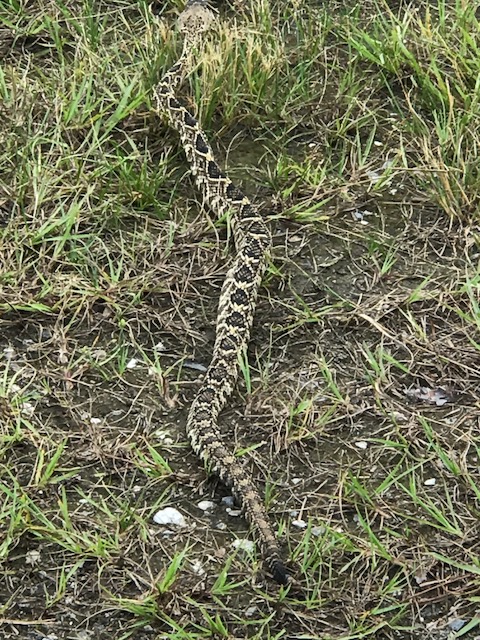
Eastern diamondback rattlesnake crawling near Ft. Pickens Campground.
Photo: Shelley Johnson
Generally, the coldest part of the day is just before dawn. If a snake was hunting at night, and many species do, they will venture out in the morning to find a sunny spot to warm up so they can complete the digestive process. They do need sun, but they need to avoid open spaces where predators can find them. Often, they will select spots near the edge of a wooded area, or edge of rocky outcrop, so they can dash in if trouble arrives. Snakes have been known to stretch out on roads where the pavement has been heated during the day. Unfortunately, many are hit by vehicles while doing this. As the day warms up, they will move into cooler spaces to avoid overheating. Rattlesnakes are more active, and prefer to hunt during the daylight hours, though evening movements do occur.
There are seasonal behavior changes to deal with thermoregulation. During winter, in regions where it gets cold (maybe even snows), rattlesnakes will hibernate. Hibernation involves gorging on food in the fall to store fat to feed off during the hibernation period. Next, they will find a good hiding spot – a rocky den, a cave, gopher tortoise burrow, hole beneath a tree stump – where they will be safe from predation until spring. Once in this hibernaculum, they will lower their breathing and heart rate and allow their body temperature to drop. They go into a state of torpor where they are basically shut down. Many rattlesnakes use the same hibernacula each year, finding it by their sense of smell. Some species will share this space with several others – literally a den of snakes.
In the spring, when the air temperatures reach 70°F, they will emerge and immediately seek food. In some locations the summers will become very hot and so feeding and reproduction are on their minds before it becomes too hot, and they have to hide again. It is during these feeding/mating forays that many people encounter them. During this period they may move during periods of the day, and into locations they might avoid otherwise.
If they live in locations where summer can be very hot, they will repeat this behavior to avoid overheating – this is called aestivation. Another problem with hot summers is dehydration. Aestivation is more spontaneous than hibernation.
The eastern diamondback rattlesnake, the one often found on our barrier islands, lives only in the warmer parts of the southeastern U.S. It does get cold in some parts of their range, but they are not common where it snows. However, it does get very hot where they live and so even though hibernation is part of their life cycle, aestivation is common.
Next, we will look at reproduction.
References
Rubio, M. 2010. Rattlesnakes of the United States and Canada. ECO Herpetological Publishing & Distribution. Rodeo, New Mexico. pp. 307.
Gibbons, W., Dorcas, M. 2005. Snakes of the Southeast. The University of Georgia Press. Athens, Georgia. pp. 253.
Graham, S.P. 2018. American Snakes. John’s Hopkins University Press. Baltimore, Maryland. pp. 293.
- Rattlesnakes on Our Barrier Islands; Part 4 – Thermoregulation - December 22, 2025
- Rattlesnakes on Our Barrier Islands; Part 3 – Envenomation - December 22, 2025
- St. Joe Red Tide Claiming Terrapins - December 15, 2025