by Rick O'Connor | Dec 15, 2025
It is understood that rattlesnakes are carnivores and will select some form of meat for their food. The general principle is to select something that is easy to kill and requires less energy to do so. Most rattlesnakes will select rodents but depending on the species and the part of the world they are in, some will select lizards or other prey.
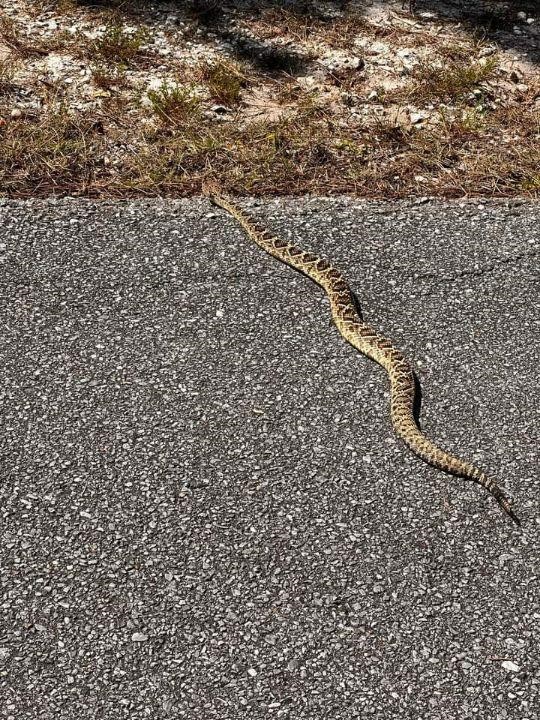
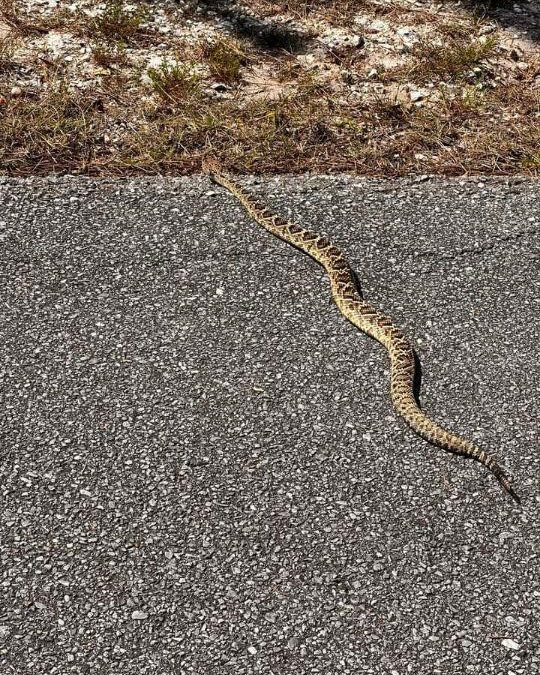
Eastern Diamondback Rattlesnake.
Photo: Bob Pitts.
Due to their long periods of hibernation and/or aestivation, their feeding seasons are shortened. If you add low prey availability when they emerge from hiding, the feeding season is shorter still. They respond by binge eating – basically gorging on prey as often as they can. They may consume massive meals that will take over a week to digest.
Rattlesnakes who feed on rodents over lizards will grow larger. Many species have young with bright pink or yellow tips on their tails, much like cottonmouths and copperheads. These are used to lure small prey such as lizards and toads. They are predominantly ambush hunters, lying in wait for selected prey to wander into striking range. They like spots where they are half in the shade, half in the sun to do this.
Here is a scenario…
In the spring, when the temperature reaches 70°F, rattlesnakes will leave the hibernacula they used for hibernation. Having not eaten in a while, food is on their mind. They will use their sense of smell to find the trails of their potential prey, find a good ambush spot, and wait. Some studies suggest they sleep while waiting. They may first detect their prey by seeing it. It could be by hearing or smelling. Or by a combination of these. They will begin to flick their tongues – using the Jacobsen’s organ – to further identify the target. When within range, the facial pits can help “see” the target and assist in accuracy of their strike.
The strike is extremely fast. The snake injects their venom, releases, re-coils, and folds their fangs back into their sheath. The target often will run but is usually dead within a minute and not far away. The rattlesnake will now find the scent trail with their tongue and follow its meal. It can take several minutes to an hour to find it. Once found the prey is dead and already in the process of digestion due to some of the enzymes within their venom. In some prey the rattlesnake may not release and rather hold on to the prey after the bite. This often happens when they select birds, possibly due to the difficulty of finding them because they may fly before they die. Another interesting twist to this scenario holds for the timber rattlesnakes, who sometimes lie at the base of a tree with their heads facing up the trunk waiting on an unaware squirrel coming down.
Swallowing the prey involves “unhinging” their lower jaw making the diameter of their mouths larger. This way rattlesnakes can swallow large prey such as squirrels and rabbits. They have six rows of smaller pointed teeth in their mouths. There are two rows on the lower jaw, two on the upper, and two on the roof of their mouths. With the fangs folded back in their sheath, they begin to grab the prey with one set of jaws (the right or left) pull in, then alternate with the other jaw. It appears they are “walking the prey down” their throat. There is a tube called the glottis on the forward portion of the lower mouth that is used for breathing while their mouth is full. They have been seen taking breaks and resting while this process is ongoing. After swallowing, they re-align their lower jaw and find a place to rest and digest the meal.
Being ectothermic they will need to find warmth to digest their meal. They require internal temperatures between 80-85°F for proper digestion, so, they will need to find a location where there is good sunlight but enough cover to hide them. Depending on the size of the meal, digestion can last up to a week.
This scenario can be altered if prey density is low. If it is, rattlesnakes may move, and forage more than they typically do. As you can see, an approaching human during any part of this scenario would be unwanted by the snake.
In the next article we will take a closer look at the venom of these snakes.
References
Rubio, M. 2010. Rattlesnakes of the United States and Canada. ECO Herpetological Publishing & Distribution. Rodeo, New Mexico. pp. 307.
Gibbons, W., Dorcas, M. 2005. Snakes of the Southeast. The University of Georgia Press. Athens, Georgia. pp. 253.
Graham, S.P. 2018. American Snakes. John’s Hopkins University Press. Baltimore, Maryland. pp. 293.
by Rick O'Connor | Dec 8, 2025
We will begin with a statement most know, but bears repeating… Snakes are just another animal trying to get through the day. They need to eat, avoid being eaten, find a place to sleep, and – at some point in the year – find a mate. They are no different than raccoons or hawks. But our reactions to these animals are very different to our reaction to raccoons and hawks. When hiking in the woods when someone says “bald eagle” the reaction is uplifting, maybe get a photo. But if someone says “snake” the reaction is different. If they say “rattlesnake” that reaction increases several magnitudes. In Manny Rubio’s book on rattlesnakes, he mentions that 50% of our population is “uneasy” about them and 20% are terrified of them – ophidiophobia is a real thing. That said, rattlesnakes are part of the barrier island ecology, and it is good to learn more about them.
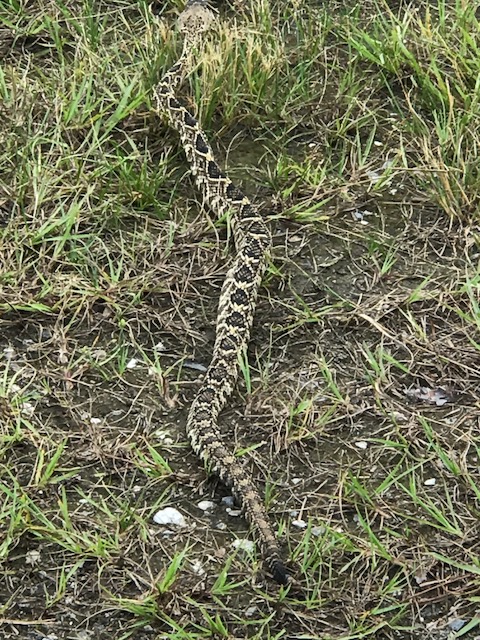
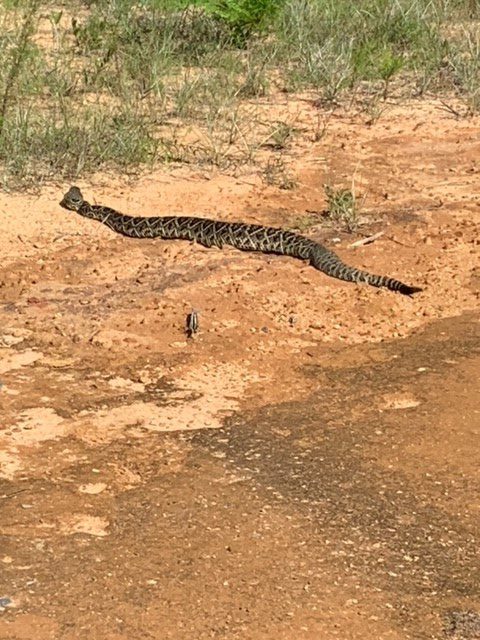
This eastern diamondback rattlesnake was seen crossing a dirt road near DeFuniak Springs shortly after the humidity dropped.
Photo: Lauren McNally
Rattlesnakes are only found in the new world. There are 30 species listed in the U.S. and Canada and three of those live in Florida. One of them, the eastern diamondback rattlesnake, lives on our barrier islands. The pygmy rattlesnake may as well, but I have not encountered it (nor have heard of others encountering). The canebrake/timber rattlesnake is not common in Florida, and I have never heard of them on our islands.
These snakes differ from others in that they possess modified scales at the tip of their blunt tails we call rattles. Many snakes vibrate their tails when alarmed but this snake’s vibrations can be heard at a distance (up to 20-30 feet sometimes) to warn potential predators they are there. Each time the snake sheds its skin it will leave a new segment on the rattle. This is not a good way to age the snake however because they may shed several times in one year and older segments can break off. There have been reports of rattlesnakes with deformed tails and no rattles at all, but this is rare.
They also possess facial pits that have cells which can detect temperature radiating from an object, including “warm blooded” prey, while hiding. These thermal receptors lie along the bottom of the facial pit and are connected to the optic nerve; thus, they can sort of “see” heat.
Their eyesight is not as good as birds and mammals, and they have an elliptical pupil. They appear to use their eyesight in determining the size of the approaching animal and thus, their reaction to it.
They have nostrils but smell does not seem to play as important a role as Jacobsen’s organ does. This organ is found on the roof of their mouths. Rattlesnakes (all snakes) will flick their forked tongues to collect air molecules and stick the tip of each fork into a groove in the roof of their mouths that lead to this organ. Here they can taste/smell what is within their environment. The “taste” of potential prey will increase the frequency of tongue flicks and could cause the snake to move forward.
The fangs are the part of this animal we are most concerned about. They are hollow tubes connected to a venom gland which are located behind each jaw and give the snake the triangular head shape they are known for. These fangs are folded in a sheath so that they can close their mouths. Whether only one or both fangs are extended during a bite is controlled by the snake. Fangs often break off but smaller new ones are ready to replace them when needed. They will replace these fangs every two months, one at a time.
The strike involves opening the mouth, extending the fangs 90°, opening the mouth 180°, thrusting forward, bite down, inject, recoil, re-fold fangs, and back into the attack position. There are “offensive” and “defensive” strikes. Venom is “expensive” for snakes to produce and is meant for killing prey. The amount injected (if any at all) is controlled by the snake. A “defense” strike is slightly elevated. The upward angle reduces thrust and penetration depth.
Other general characteristics of rattlesnakes includes a triangular shaped head, most have a dark “mask” over their eyes, scales protruding over the eyes, keeled scales giving them a dry/rough appearance, and the males have longer tails than the females.
In our next post we will look at rattlesnake predation.
References
Rubio, M. 2010. Rattlesnakes of the United States and Canada. ECO Herpetological Publishing & Distribution. Rodeo, New Mexico. pp. 307.
Gibbons, W., Dorcas, M. 2005. Snakes of the Southeast. The University of Georgia Press. Athens, Georgia. pp. 253.
Graham, S.P. 2018. American Snakes. John’s Hopkins University Press. Baltimore, Maryland. pp. 293.
by Rick O'Connor | Sep 28, 2018
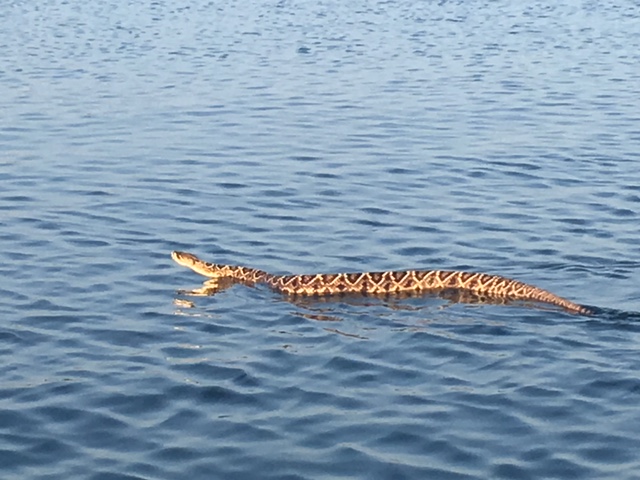
In the past week, three eastern diamondback rattlesnakes were encountered near the Ft. Pickens area on Pensacola Beach. The first was at a condominium unit near the park gate where construction work was occurring, the second was found swimming in the surf of the Gulf of Mexico within the national seashore, and the third was in the national seashore’s campground. This is an animal we rarely encounter on our barrier islands – but that is the keyword… encounter… they are there, but tend to avoid us.
Eastern diamondback rattlesnake crawling near Ft. Pickens Campground.
Photo: Shelley Johnson
Report on rattlesnake in Gulf surf –
https://www.pnj.com/story/news/local/2018/09/26/snake-rescue-pensacola-beach-shocks-visitors/1430731002/
The eastern diamondback rattlesnakes (Crotalus adamanteus) is the largest venomous snake in the United States. An average snake will reach six feet and five pounds, but they can reach eight feet and up to 15 pounds. Because of their large bodies, they tend to move slow and do not often try to escape when approached by humans. Rather, they lie still and quite hoping to be missed. If they do feel you have come to close, they will give their signature rattle as a warning – though this does not always happen. If they are considering the idea of striking – they will raise their head in the classic “S” formation. Know that their strike range is 2/3 their body length – larger than many other native snakes – so a four foot snake could have a three foot strike range. Give these snakes plenty of clearance.
Eastern diamondback rattlesnakes prefer dry sandy habitats, though they are also found in pine flatwoods (such as Naval Live Oaks north of highway 98 in Gulf Breeze). They are quite common in the upland sandhills of longleaf pine forests. They spend the day in tree stump holes and gopher burrows and hunt small mammals and birds in the evenings. They are particular fond of rabbits. The dunes of our barrier islands are very similar to the sandhills of the pine forest further north. They are actually good swimmers and saltwater is not a barrier – distance is. They have been seen numerous times swimming from Gulf to Pensacola Beach or the opposite. Again, they tend to avoid encounters with humans and are not often found on lawns etc.
Diamondbacks give birth to live young around August. The females will find a dark-cool location to den and give birth several young. Anywhere from four to 32 offspring have been reported. The female remains with the young for about 10 days until they have their first molt (skin shedding) and then she leaves them to their fate.
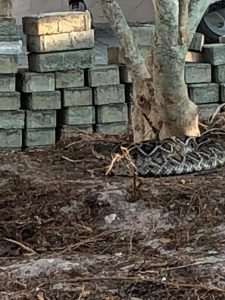
Diamondback rattlesnake near condominium construction site Pensacola Beach.
Photo: Sawyer Asmar
So what’s up with three encounters in a relatively small location within one week?
My first inclination is two possibilities – maybe a combination of the two.
- We have had a lot of rain this year – and then T.S. Gordon came through. Snakes like to be on high dry ground as much as anyone else and they tend to move closer to human habitats because they are built on higher ground.
- Breeding season for eastern diamondbacks is late summer early fall. This time of year, the males are on the move seeking interested females – so they are encountered more.
As far as finding one in the surf of the Gulf of Mexico. I am not sure. I have never seen this and the newspaper account suggested it was not doing well when found. Again, I have seen plenty swimming the Intracoastal but this is a first for the Gulf. I would say it had wondered the wrong way.
They are actually fascinating animals and are not a threat unless you approach too close. Give them room and feel lucky if you get to see one.
References
Eastern Diamondback Rattlesnake. Natural History. Center for Biological Diversity. https://www.biologicaldiversity.org/species/reptiles/eastern_diamondback_rattlesnake/natural_history.html.
Krysko, Kenneth L., and F. Wayne King. 2014. Online Guide to the Snakes of Florida. Florida Museum of Natural History, University of Florida, Gainesville, FL, USA. [Online: September 2014] Available at: http://www.flmnh.ufl.edu/herpetology.
https://www.floridamuseum.ufl.edu/herpetology/fl-snakes/list/crotalus-adamanteus.
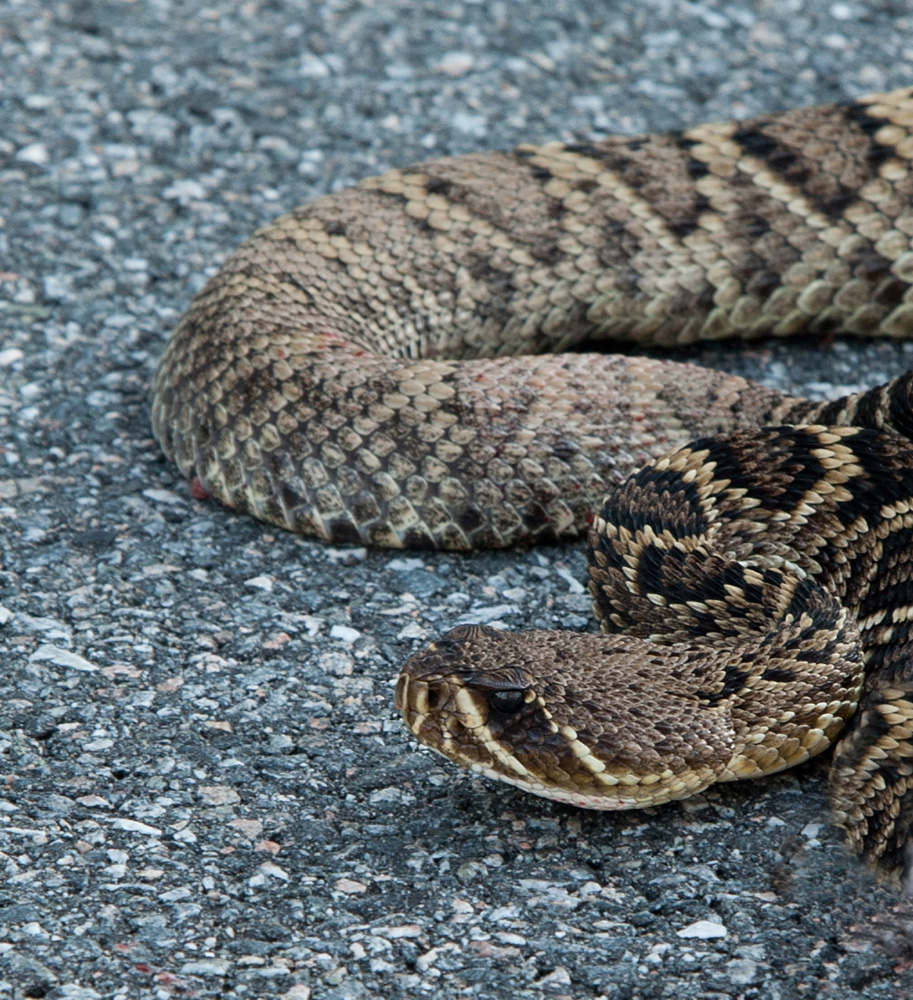
by Rick O'Connor | Dec 8, 2017
The observations I made of rattlesnakes is just that… observations, there is no scientific study I am aware that supports what I appear to have seen, but I have noticed it – more than once now.
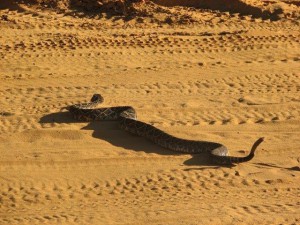
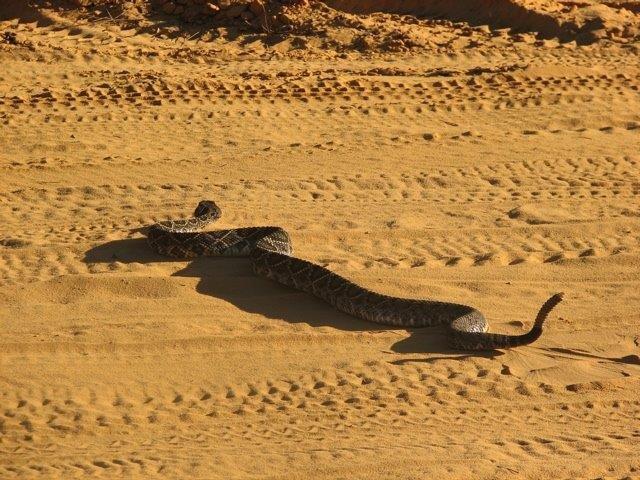
Eastern Diamondback Rattlesnake crossing road at Eglin AFB. Photo: Carrie Stevenson
The eastern diamondback rattlesnake (Crotalus adamanteus) is a legendary animal in the southeast United States. William Bartram mentions it several times during his travels through Florida in the 1770’s. His Florida nickname “Pug Puggy” actually came from an incident where he killed a large one in a garden of a Seminole camp. Almost every story about the colonial/settling period of state, whether fiction or non-fiction, includes this snake. They are the largest venomous snake in the U.S., reaching up to six feet, and can have the girth of a man’s arm. They have a large head, holding large venom glands, and have a strike range of 33% their body length – the stuff of legends.
However, few people of died from this animal. One website list 53 fatal snakebites in the United States since 1900, 11 are listed “prior to 1900”. Of the 53 snakebites, 34 (64%) were from rattlesnakes – all 11 (100%) of the “prior to 1900” were rattlesnakes. However, there are a reported 16 species of rattlesnakes in the U.S., only three live in the southeast. From this list, there are only three confirmed Eastern Diamondback bites (5%), and an additional 7 that “may” have been. They were identified as rattlesnakes and the victims lived in the southeast, but the bite could have been from the timber or pygmy rattlesnake. The vast majority of lethal rattlesnake bites come from out west. Granted, in the early part of our state’s history many rattlesnake bites went unreported, however 3 confirmed deaths (10 possible) since we became a state is not that many when compared to the number of Floridians who have died in automobile accidents or violent crimes. That said, this is still a legendary animal that many fear, and the snake lives on Pensacola Beach.
In the past month, I have received several photographs of the eastern diamondback seen in the National Seashore. The observation – they seem to be more common when we are not around. No doubt, they were probably once common on the island. Many are surprised by this because the only way to access Santa Rosa Island, initially, was to swim – but rattlesnakes are good swimmers. They do not prefer the water, but have no problem crossing it. They are primarily consumers of rodents, taken prey as large as rabbits if they can, and hunt primarily at night – so viewing during the day is not common.
However, when the road to Pickens was closed after Hurricane Ivan, daytime encounters with eastern diamondbacks increased. There were numerous reports of individuals seeing them moving around the park. Then the road re-opened, and no one saw them anymore. Hurricane Nate caused enough damage that the park, once again, had to close for repairs – and the photos began to come in. It will be interesting to see if the number of encounters begins to decline no that it has re-opened. Are these snakes aware of our presence and seek refuge? It would be nice to know they did, but both Ivan and Nate arrived in the fall when rattlesnakes begin to move for breeding. How many of these snakes would be seen whether the road was open or not. I know when the road is open I do not hear as much from the public. I also know that recently FWC was requesting reports of encounters with this snake because they feared it was declining across the state. Along with several other species of local snakes – such as the Southern Hognose (Heterodon simus) and the Florida Pine Snake (Pituophis melanolucas migitus), they were asking the public to report sightings. They recent removed the eastern diamondback from this list – suggesting that encounters were more common than they thought. Again, maybe a case of “I’m here but I’m hiding”.
The familiar face of an Eastern Diamondback Rattlesnake.
Photo: Nick Baldwin
For me, it is an interesting observation. I find the animal fascinating, maybe because of its legendary status and rare encounters, but I find it fascinating nonetheless. I certainly understand the safety concerns with having this animal so close to us, but the records of bites and fatalities suggests the threat is not as large as we perceive it. I would certainly recommend homeowners maintain their property as to reduce the risk of an encounter, but know most do – or else you would be seeing more of them. As with sharks, I for one am glad to know they are still around.