by Rick O'Connor | Dec 21, 2015
This is a question I have been asked several times in the last week. As most of you know the red tide that has been occurring off the panhandle the last few months is still around. Dead fish were reported on Pensacola Beach again the weekend of Dec 12-13 and a few people said they were having eye and throat problems. This weekend I received a call of dead fish inside the bay but the caller was not suffering from eye and throat issues. Its December… what’s going on?
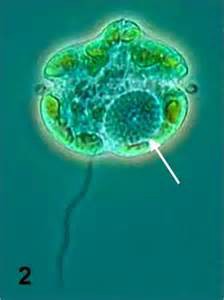
The dinoflagellate Karenia brevis.
Photo: Smithsonian Marine Station-Ft. Pierce FL
Well let’s look again at what red tide is and what facilitates the bloom. Red tide is caused by small microscopic plants called dinoflagellates. Dinoflagellates, like all plants, develop defense against herbivores that may try and feed on them. A few of these dinoflagellates release toxins when disturbed as a defense. They are in the Gulf all of the time but usually in low numbers, maybe 300 cells per liter of water, and cause no problems. But when conditions favor growth and reproduction they do just that – grow and reproduce – in great numbers, maybe 3000 cells per liter. When this happens the water actually darkens with their presence and the amount of toxin they release increases due to the increase number of cells – now marine creatures other than those that feed on them are impacted by the toxin – this is a red tide.
So, what are these conditions?
Well, like all plants dinoflagellates like sunlight, warm temperatures, and nutrients (fertilizers). So you would think that these blooms would occur when most plants grow – summer… and you would be right. There is another condition that contributes and those are currents. If currents are strong it will spread the bloom and the concentrations are spread as well, lowering the concentration per liter of water and thus reducing or diminishing the red tide.
We generally have plenty of sunshine here in the panhandle – temperatures are relatively warm, though they are warmer in south Florida – and there are nutrients. Nutrients are available naturally in the Gulf but are increased when we have a lot of rain as the runoff brings nutrients from land. But remember red tides are not always the result of human pollution – they occur naturally but can be increased or extended with excess nutrients from human runoff. The currents here along the panhandle tend to keep red tides at bay most of the time – we do not see them often here, but that is not the case with southwest Florida. In the Port Charlotte area red tides are more common part of life. It is warmer, there is more agriculture and municipal nutrients entering the Gulf, and the currents there are slower/weaker than we have here.
So what is up in the panhandle this year?
Well the sun is still shining! Feels great out there actually. The water temperatures were in the upper 60’s inside Pensacola Bay this week and that is typical, but the Gulf is still in the 70’s, and that is typical as well. What is not typical is the warmer air temperatures. This will slow the temperature drop of the Gulf and allow plants to extend their non-dormant season. H2O is a polar molecule (has an electric charge) and so the molecules are bonded together like two magnets. Because of this it takes more heat (energy) to warm the water and so area waters warm at a slower rate than the air. If the air temperatures remain warm it will be longer before the Gulf cools down. These warmer temperatures may extend the red tide a bit longer. As far as nutrients, heavy rains in October and November probably supplied more food for the plants and contributed to the beginning of the tide. Currents pushed the red tide inshore where we began to experience the eye problems and fish kills. The north winds from the recent fronts passing through may generate upwellings in the Gulf. Upwellings are currents that bring water from the ocean floor to the surface, this would bring nutrients with it. So we still have sun, warm temperatures, and nutrients – and the bloom is still with us. What will reduce the problem will be wind and currents to drive it offshore… and time – the Gulf will eventually cool and the tide will be reduced. How long is anyone’s guess.
So why is it 70 degrees in December?
That is a question for another article…
You can track red tides in the panhandle by visiting http://myfwc.com/REDTIDESTATUS
by Rick O'Connor | Oct 31, 2015
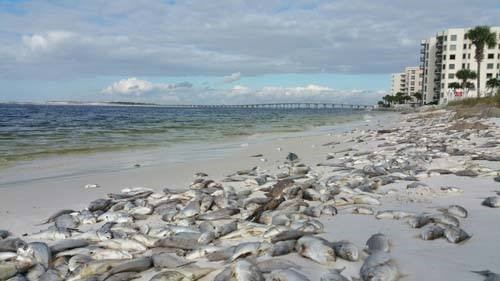
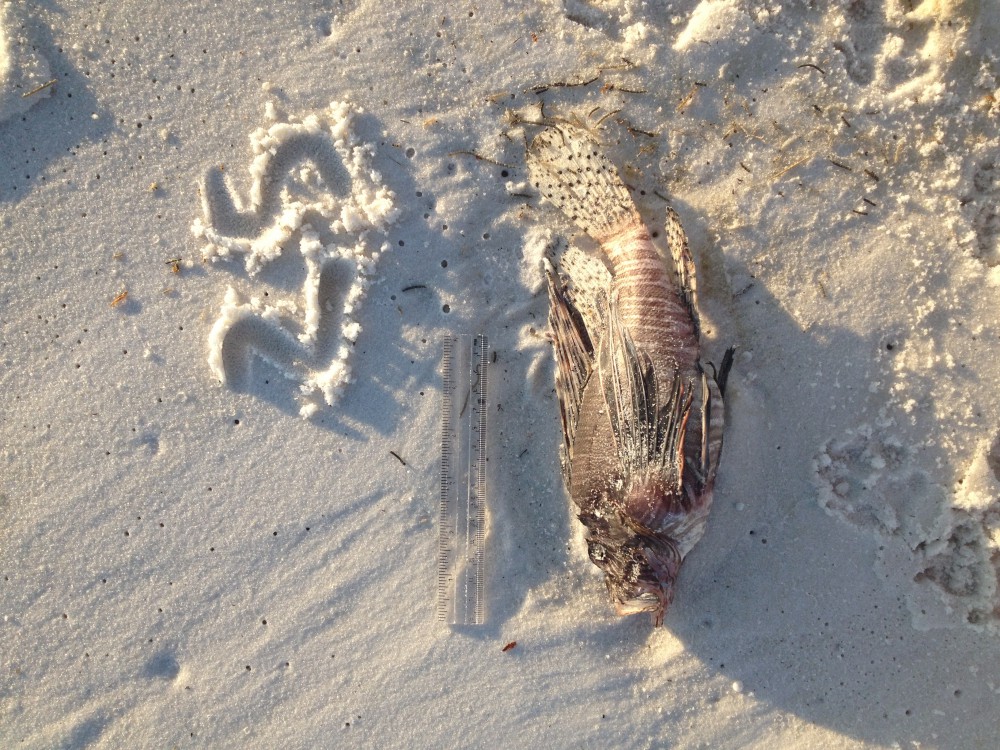
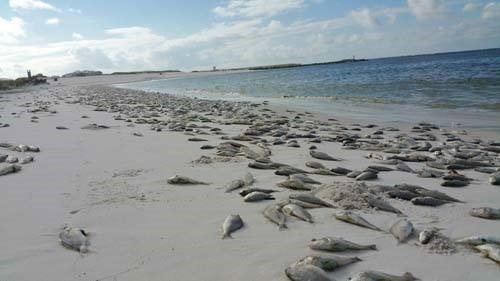
Many coastal Panhandlers woke up this week to the sight and smell of dead fish. Thousands of them washed ashore from Panama City to Pensacola. This mass die off included a variety of species including whiting, sheepshead, hake, cusk eels, and even lionfish; there were also reports of dead bass from the Dune Lakes in Walton and Okaloosa counties. What caused this mass die off of fish?
The suspect is red tide…
Most of us along the panhandle have heard of red tide but we may not know what it is or what causes it. Many attribute the red tide events to human impacts, stormwater runoff etc., but in fact they have been around for centuries. There are records suggesting that the European colonials experienced them and I have read one account that the Red Sea got its name from the frequency of these events there. So what is this “red tide” and what causes it?
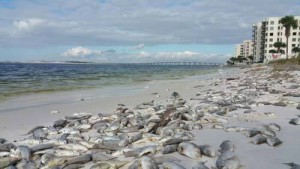
Dead fish line the beaches of Panama City.
Photo: Randy Robinson
It is actually a bloom of small single celled plants called dinoflagellates. There are thousands of species of dinoflagellates in the world’s oceans and not all cause red tide, but there are several species that do. These small microscopic plants drift near the surface of the ocean acquiring sunlight to photosynthesize. They possess two small “hairs” called flagella (hence the name “dinoflagellate”) to help orient themselves in the water column. Most have a shell covering their body called a theca and some shells have small spines to increase their surface area to resist sinking. One method of defense found in some dinoflagellates is the production of light – bioluminescence. This light is produced by a chemical reaction triggered by the creature as a flash of blue – many locals refer to it as “phosphorus”. Other dinoflagellates instead will release a toxin… some of these are ones we call “red tide”.
Red tide organisms are always in the water column of marine environments but are usually in low concentrations, maybe 300-500 cells per milliliter of water. But under favorable conditions, warm water with nutrients, they multiple… sometimes in great numbers, such as 3000-5000 cells/ml, and we have a “bloom”. The number of cells within these blooms can be high enough that we can actually see the water change color… hence “red tide”.
The dinoflagellate Karenia brevis.
Photo: Smithsonian Marine Station-Ft. Pierce FL
The most common red tide dinoflagellate associated with the Gulf of Mexico is Karenia brevis. Karenia blooms typically form offshore and are of little impact to the coastal communities. However when the wind and tides are right these blooms will drift towards shore. When they do fish kills occur and humans have eye and throat irritations. Marine mammals in particular struggle with red tide. As the bloom comes near shore it reaches the bottom of the water column and many of the bottom dwelling fish suffer. Most of the photos of fish I saw in the October 2015 fish kill were bottom dwellers, including many invasive lionfish.
Is there anything we can do to prevent red tides?
Not really… Again, they are naturally occurring event. We may increase the frequency of the events by discharging excessive nutrients into the water from our run-off but they would probably occur anyway. Red tide events are not as common in the panhandle as they are in southwest Florida. The Gulf waters near Charlotte Harbor are shallow, warm, and near the many manicured lawns, gold courses, and the discharge of much of the agriculture in the state. Occasionally blooms formed in that part of the state drift north but this year a bloom formed off of Bay and Gulf counties in early October. The recent storm that passed through probably pushed the bloom inland and to the west. The biggest hazard of humans is eye, throat, and skin irritation. It is quite uncomfortable to be around these blooms. In 1996 a local bloom was concentrated enough that the campground at Ft. Pickens had to be closed. I was in Galveston Texas when I heard about the red tide occurring in the Florida panhandle. As I was leaving Galveston the newspaper reported the closer of all oyster harvesting in Texas due to a red tide generated in the Padre Island area and was moving north. Seems that red tide is covering a large portion of the Gulf coast the last week of October. That said… anything communities can do to reduce nutrient runoff will certain decrease the frequency of red tides.
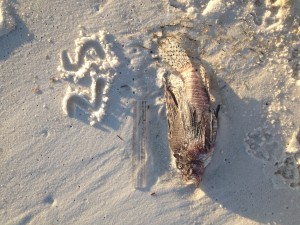
The carcass of the invasive lionfish was part of the October red tide kill.
Photo: Shelly Marshall
The Florida Fish and Wildlife Conservation Commission post red tide updates from around the state on their website and the Escambia County Extension Office post a local water quality update each Friday that has red tide information as well.
FWC
http://myfwc.com/research/redtide/
Escambia County Extension
http://escambia.ifas.ufl.edu