Agriculture is not the first thing that comes to mind when you’re in Bay County, especially when you’re enjoying a day at the beach! In the 2022 Census of Agriculture, 139 farms were reported, covering more than 70,324 acres. Much of what’s counted as farmland in Bay County is forested land managed for timber rather than traditional row-crop agriculture. Other commodities include hay, berries, livestock, honey and aquaculture. Together, agricultural sales generated $3.69 million dollars in 2022. Agriculture exists here, but it is not the primary economic driver. Tourism plays a much larger role, bringing $3.1 billion in visitor spending and supporting over 35,000 jobs.
This can be a common in areas where there is a large amount of tourism. Both systems depend on healthy natural resources, for different but equally important reasons. This is especially true when it comes to water, which makes up 27% of the county by area. Large scale producers use Best Management Practices (BMPs) to reduce the amount of chemical and nutrient runoff into our water systems.
If an area does not have a lot of agriculture does that mean we are safe from pollution in our water? No. Runoff isn’t just a problem in agricultural systems. A single lawn may not contribute much on its own, but when you add them up they can become a significant source of water pollution.
One of the easiest ways you can reduce impacts on our water resources is with how you fertilize your lawns. Here are some residential BMPs you can follow in your own yard. If you are fertilizing next to a body of water, leave a 10-foot strip unfertilized on the water’s edge. Don’t apply more than 1 pound of slow release nitrogen per 1,000 square feet at a time or exceed 4 pounds per 1,000 square feet per year. If you are using a quick release nitrogen do not apply more than ½ pound at one time for the same area. This chart below can be used to calculate how much fertilizer that is based on the percent of nitrogen. Nitrogen is always the first number, followed by phosphorus and potassium. Remember that right now your lawn doesn’t need any fertilizer. Dormancy is a protection from winter freezes, and fertilizer put out now will not be taken up effectively by dormant grass.
Nitrogen percent in fertilizer
Pounds of fertilizer to apply 1lb of nitrogen / 1000 sqft
5%
20 lbs
10% (10-10-10)
10 lbs
20%
5 lbs
U.S. Department of Agriculture, National Agricultural Statistics Service. (2022). 2022 Census of Agriculture, Bay County, Florida. https://quickstats.nass.usda.gov/
Bay County Chamber of Commerce. (2025). Business & community profile. https://panamacity.org/tourism-business/
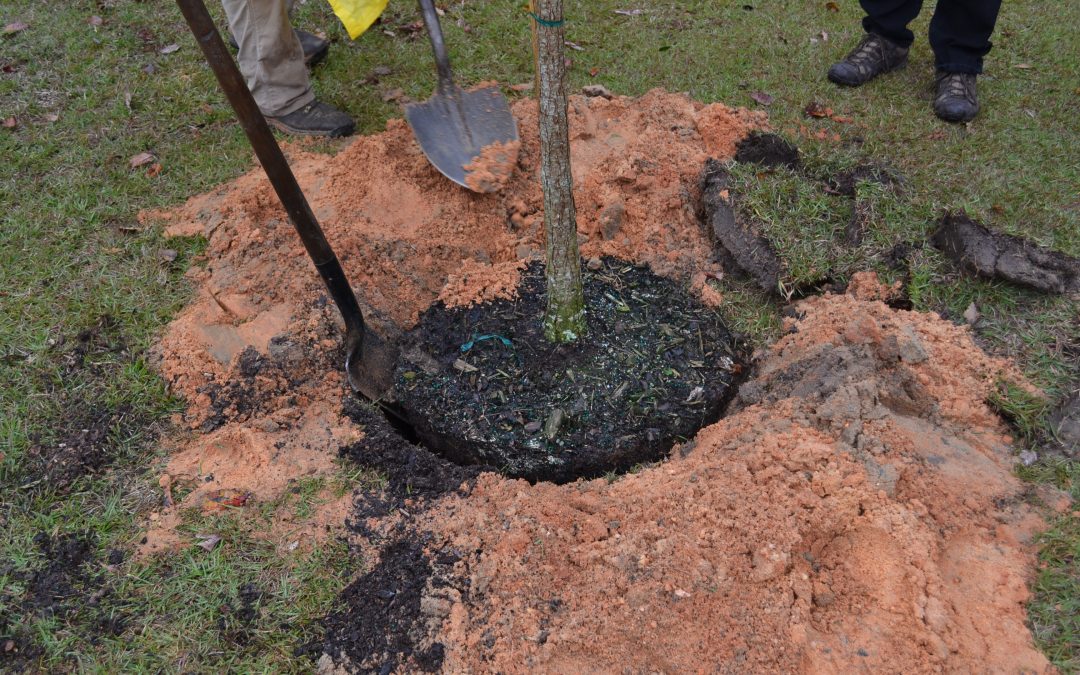
Our winter season is a good time to install many trees and shrubs. Here is a basic review of a few planting practices to make sure that your new plants get off to the good start.
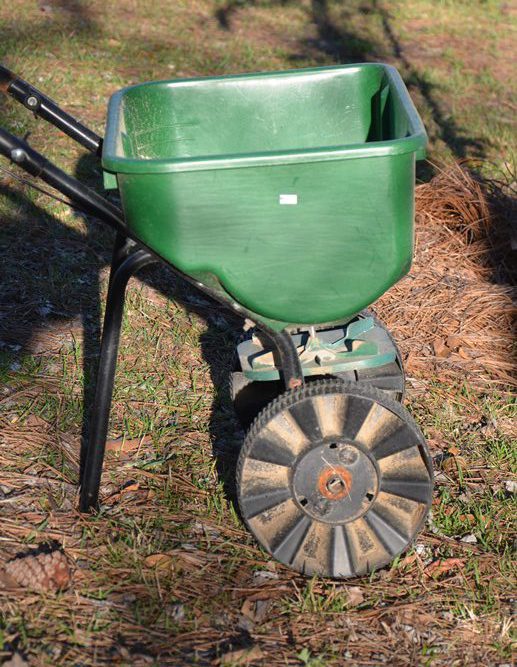
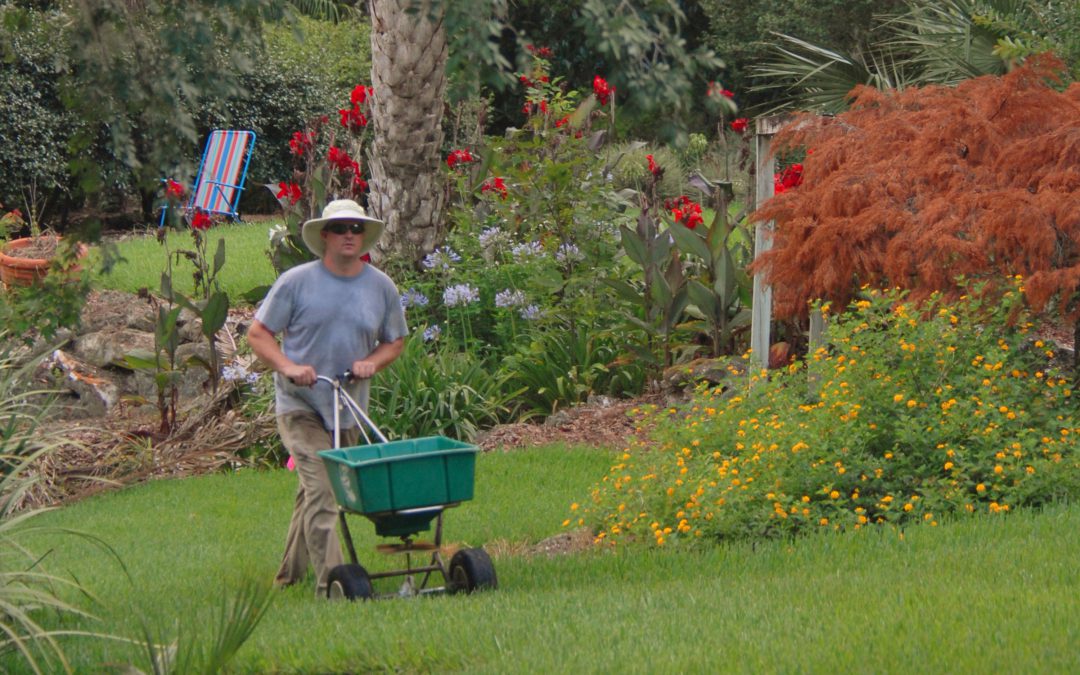
Fertilizer Spreader – Image Credit Les Harrison ,UF / IFAS Extension
Plants require nutrients to grow and they typically get them from the soil. Oftentimes, we apply fertilizer to help them along. Fertilizers provide specific nutrients for your plants and are available in a variety of different forms. When used correctly, fertilizers are a great tool that can help plants thrive. If used incorrectly, fertilizers can harm plants and also the environment.
Different plants have different nutrient requirements and in many cases, fertilizer may not be necessary so do your research before purchasing fertilizers. Sometimes, certain plants, like azaleas or blueberries, need a special formulation of fertilizer.
Think about having your soil tested to see what nutrients are already present in your soil. Contact your local Extension Office for sampling procedures.
Fertilizer Components
Most fertilizers used in the home landscape and garden are blends of several elements mixed together to create a specific formulation of plant nutrients.
Macronutrients
Macronutrients are nutrients required by plants in relatively large amounts for optimum growth. The three main nutrients contained in fertilizers are nitrogen (N), phosphorus (P), and potassium (K). Most folks are familiar with these because they are represented by three numbers that appear on the fertilizer bag. You may be familiar with the term ‘complete fertilizer’. This means the fertilizer with contain all three of the major plant nutrients – N, P and K. Other macronutrients include calcium (Ca), magnesium (Mg), and sulfur (S).
Micronutrients
Micronutrients are nutrients most plants need in small quantities. They are sometimes referred to as trace elements or minor elements. These nutrients include boron (B), chlorine (Cl), copper (Cu), iron (Fe), manganese (Mn), molybdenum (Mo), and zinc (Zn). They are often available in sufficient quantities in the soil, but are also present in many fertilizers. Micronutrients are also sold as individual nutrients.
Types of Fertilizer
Inorganic Fertilizers
Inorganic fertilizers are materials that are mined or synthesized from non-living materials. Many inorganic fertilizers contain nutrients that are immediately available to plants. Others are formulated to be released over a period of time.
Organic Fertilizers
Organic fertilizers are materials that are derived from plants and animals. One of the most common forms of organic fertilizers is manure. Organic matter incorporated into the soil before planting will help fertilize your vegetable plants, but you’ll need to add additional fertilizer after planting.
The quick availability of nutrients, especially nitrogen, is very important in vegetable growing. Therefore, you may want to supplement any organic fertilizer you apply with some inorganic fertilizer for quick feeding. It is a common practice for gardeners to use a combination of fertilizers and techniques in the garden.
Slow- or Controlled-Release Fertilizers
Slow- and Controlled-Release fertilizers provide nutrients to plant roots over an extended period of time. This allows you to fertilize less frequently and prevent nutrients from leaving your landscape and entering groundwater or waterways.
Understanding a Fertilizer Label
The fertilizer label includes a series of numbers that indicate the percentage of nitrogen, phosphorous, and potassium, by weight. The numbers will read something like 15-0-15 or 16-2-8. The first number represents the percentage of nitrogen in the bag, the second refers to phosphorus, and the third number is the amount of potassium. For example, a 50-pound bag of 16-2-8 is 16% nitrogen (8 pounds total); 2% phosphorus (1 pound total); and 8% potassium (4 pounds total). The remaining weight is usually comprised of inert ingredients.
Preventing Pollution
Follow UF/IFAS Recommendations. Rates, application timings and formulas vary depending on the plant.
Do not fertilize before a heavy rain. If rain is in the forecast for the next 24 hours, wait to apply fertilizer. Heavy rains can cause fertilizer to leach into groundwater.
Keep fertilizer off hard surfaces. If fertilizer is spilled on a driveway or sidewalk, sweep it up and dispose of it. Fertilizers can wash into storm drains and nearby bodies of water.
Large patch Rhizoctonia solani (known as brown patch in cool season grasses) is a common disease of many turfgrass species. It usually occurs during the cooler months from October through May when temperatures are below 80 degrees Fahrenheit. However, signs and symptoms of large patch and other Rhizoctonia diseases can be observed throughout the summer. Less common Rhizoctonia species that occur during the summer months are Rhizoctoni zeae and Rhizoctonia oryzae. Extended periods of turf wetness from excessive rainfall or overwatering provide ideal conditions for the disease to develop and spread.
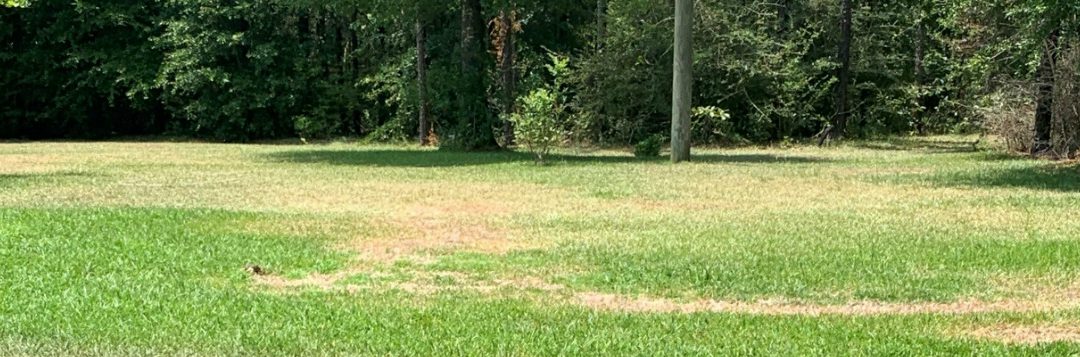
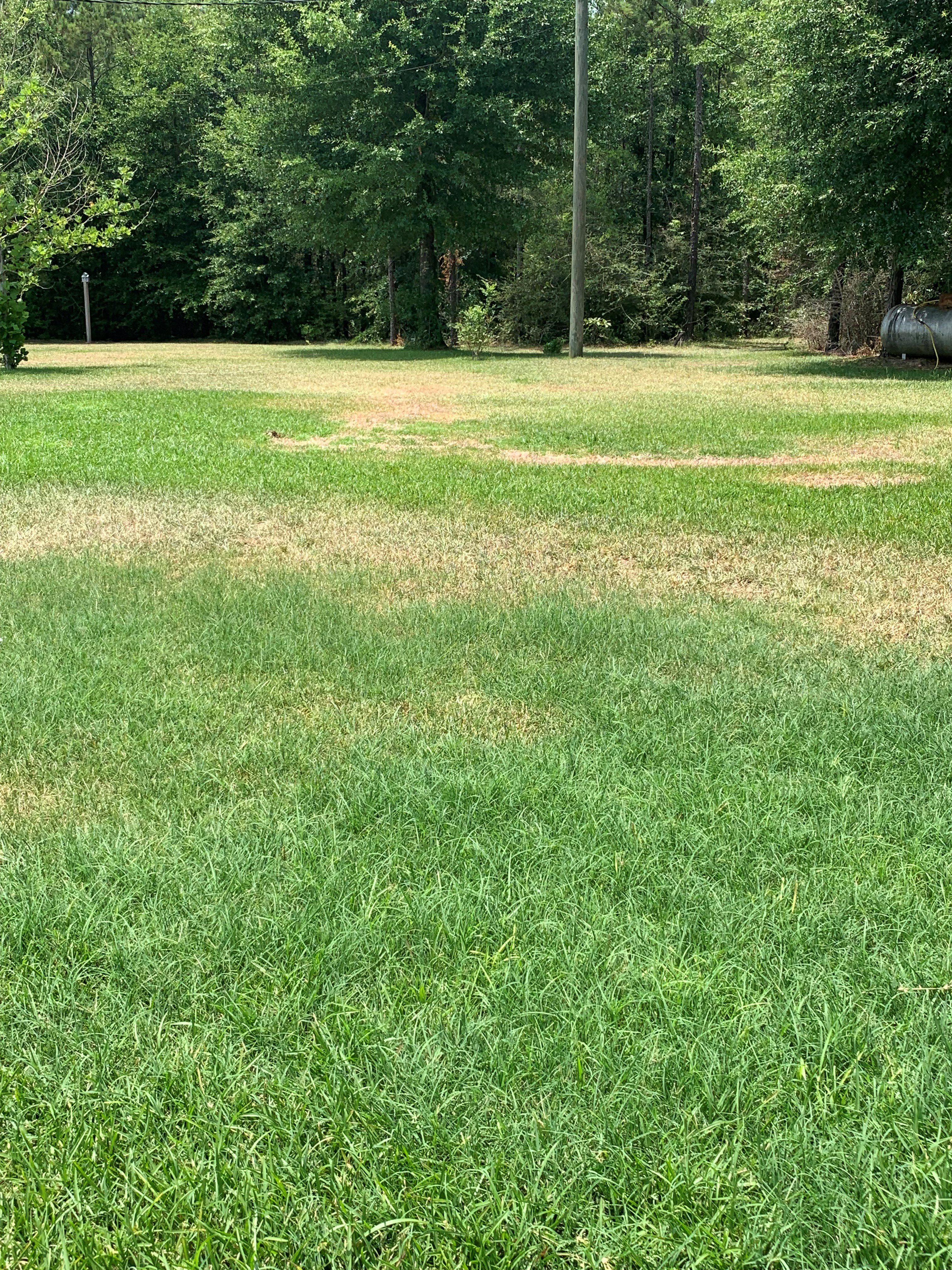
Rhizoctonia in a zoysiagrass lawn. Photo Credit: Matt Lollar, University of Florida/IFAS Extension – Santa Rosa County
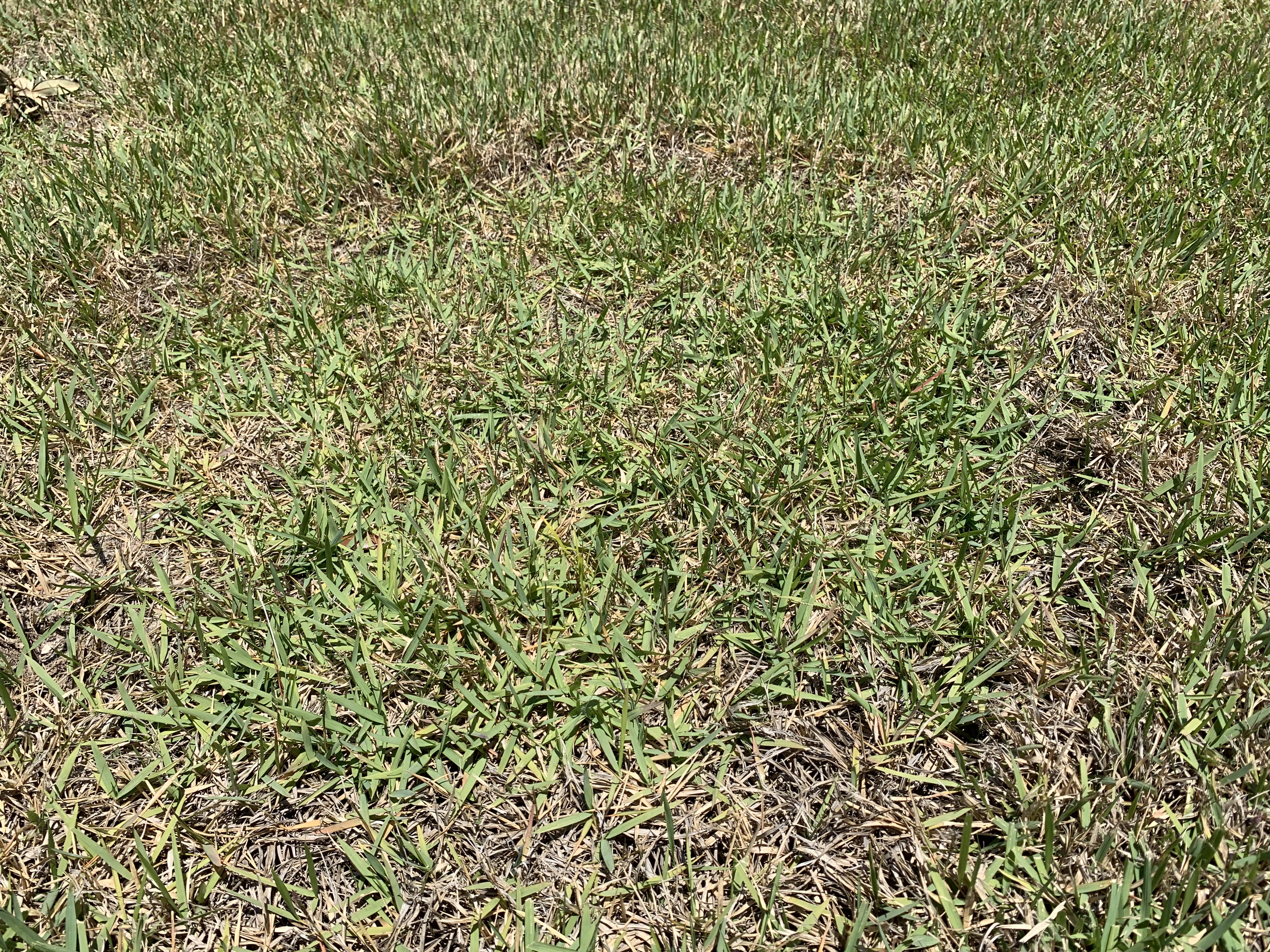
This summer in Santa Rosa County, Rhizoctonia has been positively diagnosed in both St. Augustinegrass and zoysiagrass lawns and suspected in a number of centipedegrass lawns. The disease usually starts as small, yellow patches (about a foot in diameter) that turn reddish brown, brown, or straw colored as the leaves start to die. Patches often expand to several feet in diameter. It is common to see rings of yellow or brown turf with otherwise healthy turf in the center. The fungus infects portions of the blades closest to the soil, eventually killing the entire leaf. Grass blades can easily be pulled off their stems, but roots are not affected by the disease.
Rhizoctonia in a St. Augustinegrass lawn. Photo Credit: John Atkins, University of Florida/IFAS Extension – Santa Rosa County
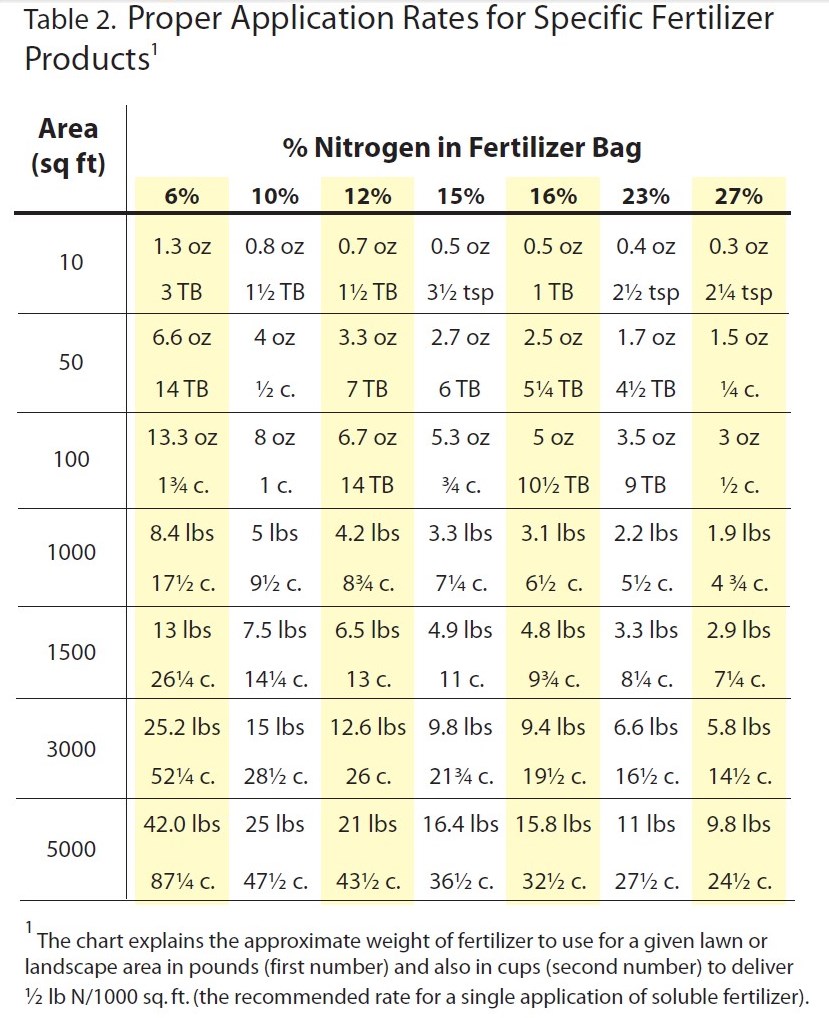
Overwatering and excessive fertilization can both contribute to the development of Rhizoctonia disease. Improper timing of fertilizer application can also promote disease development. In the Florida Panhandle, turfgrass is actively growing from April to October. Slow-release fertilizers are recommended to allow for a more even distribution of nutrients over the course of multiple months. Recommended fertilizer rates are based on turfgrass species, geographical location, and fertilizer analysis. Please refer to the UF/IFAS Publication: “Urban Turf Fertilizer Rule for Home Lawn Fertilization” for rate recommendations.
Chart excerpted from Florida-Friendly Landscaping publication.
If large patch or another Rhizoctonia disease is confirmed in your lawn, then chemical controls are necessary to keep the disease from spreading. Fungicide products containing the active ingredients azoxystrobin, chlorothalonil, fludioxonil, flutolanil, iprodione, mancozeb, metconazole, myclobutanil, polyoxin D, propiconazole, thiophanate-methyl, thiram, triadimefon, trifloxystrobin, or triticonazole are viable options for keeping the disease from spreading. For best results, follow the fungicide label for application instructions. It’s important to not only treat the affected areas, but also the healthy turf surrounding these areas in order to keep the diseased spots from growing in size.
Unfortunately, turf diseases are often not noticed until large patches of declining and dead turf are noticed. In these cases when large dead patches exist in the lawn, it is usually necessary to resod these areas. As with most problems that arise in the landscape, good cultural practices are the most proactive way to mitigate the chances with turfgrass diseases. The UF/IFAS Florida Friendly Website provides up-to-date solutions and recommendations for caring for Florida landscapes.
The Evidenced-Based Zoysiagrass Management Workshop is returning to Milton on April 23 at the University of Florida – Milton Campus. Attend to get updates on managing zoysiagrass and to earn CEUs. Register at: UF/IFAS Evidence-Based Zoysiagrass Workshop