
Select Page
Soil Sample – How To

Soil Sample – How To

Taking soil samples is an important step in maintaining soil health and maximizing your plant growth. Good crop, grass and landscape production often require the application of fertilizer and lime in the spring so late winter soil sampling will help you prepare for what you need to apply. Understanding the makeup of the soil will help you maximize growth and minimize input cost.

Soil sampling will help you understand the makeup of your soil. The samples can determine current pH levels, fertility levels of principle nutrients (Nitrogen, Potassium, Phosphorus), and nutrients that need to be added to your soil. Knowing these things about your soil will help you figure out the amount of fertilizer and lime your crops and soil need. When taking soil samples, it is important to know that they will not give you recommendations on what crops to grow. Poor crops caused by drought, disease, insect damage and the use of too much water are not able to be detected by soil samples.

When taking soil samples, it is important to understand the different areas of crop growth, soil color, and fertilizer and lime history. Knowing this information will help you divide your field or lawn into areas for sampling. You will need to take 10-15 core samples of the area you are wanting to fertilize. When collecting the core samples avoid wet spots, feeding areas, fence rows, under trees and areas of high foot or vehicle traffic. Samples can be taken with a sampling tube, auger, shovel or trowel. Field or pasture samples should be taken at a depth of 6 inches and lawns should be taken at a depth of 3 inches. After the 10-15 core samples have been taken, mix them together and place the composite sample in a small bag. It is important to name the sample areas on the bags.

Ben Hoffner taking Soil Sample – photo credit – Ben Hoffner

The Jefferson County Extension Office Agriculture Agent can help with taking soil samples and testing. Appropriate information sheets, submission forms and sample bags are available at the Extension Office. There is a small fee of $3 or $10 per sample depending on which test you would like. Once samples are sent in to the University of Florida’s soil testing lab, the results will take a few weeks to get back to you. Consult with the Agriculture Agent if you need help interpreting the test results or fertilizer recommendations.

Please reach out to the Jefferson County Extension Office with any questions or assistance regarding soil sampling.

Ben Hoffner – Horticulture/ Ag & Natural Resources Agent

Contact – b.hoffner@ufl.edu or (850) 342-0187

For more information:


Is a Limequat a Lime or a Kumquat?

Is a Limequat a Lime or a Kumquat?

The Christmas season is all about the gifts!  This statement couldn’t be further from the truth, but most likely some gifts will be given.  An old traditional gift is gift fruit.  And a lot of the time that gift fruit is a mix of citrus from Florida.  A unique citrus that I’ve been wanting to add to my grove is the limequat.  A few weeks ago I had a close encounter with a limequat at a local nursery, but it was in disguise.  The limequat in question had a tag that read ‘Key Lime’.  I am a fan of Key lime pie, therefore I like Key limes, but I knew I don’t want the added maintenance of protecting a Key lime tree from the cold.  I had a suspicion this plant was a limequat, but I decided to pass on it.  This experience prompted me to do a little research, so I don’t pass up on this opportunity in the future.

Key Lime fruit at various degrees of ripeness.

Key Lime fruit at various degrees of ripeness. Photo Credit: Ray Bodrey, University of Florida/IFAS Extension – Gulf County

Key Lime vs. Persian Lime

Before we talk more about limequats, I think it’s important we discuss the differences between Key limes and Persian limes.  The Persian lime, Citrus latifolia, originated in southeast Asia.  The first report of these trees in the United States was at a home in California in 1875.  Like Persian limes, the Key lime, Citrus aurantifolia, originated in southeast Asia and was brought to the Americas by Spanish and later became naturalized in the Florida Keys and throughout Central and South America.  Although these limes are two different species, they are both hybrids of crosses between the same three species (Citrus medica, Citrus grandis, and Citrus micrantha).  Persian limes are more cold hardy than Key limes and neither are as cold hardy as limequats.

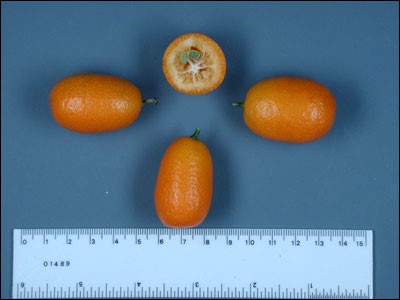
Kumquats growing on a tree

Kumquats growing on a tree. Photo Credit: University of Florida/IFAS

Limequat

Limequats resulted from cross pollination between a Key lime and a kumquat.  However, limequats are less cold hardy than kumquats.  Similar to kumquats, the skin of limequats is sweeter than their flesh.  Three common cultivars of limequats are ‘Eustis’, ‘Lakeland’, and ‘Tavares’.  ‘Tavares’ limequats produce larger fruit than ‘Eustis’ and ‘Lakeland’, but their mature fruit are more orange in color.  A number of commercial and retail nurseries sell a limequat variety under the name ‘Key’ or ‘Key Lime’, which stemmed my confusion at the local nursery.  All confusion could have been avoided if I would have known the scientific name at the time of my visit.  (Limequats are listed as either Citrus x floridana or Citrofortunella x floridana.)

So now you know how limequats came about.  For more information on limequats and other citrus species, please visit the UF/IFAS Gardening Solutions Citrus Page.

Citrus Choices for the Panhandle

Citrus Choices for the Panhandle

The panhandle of Florida is a great place to grow citrus with our plentiful sunshine and sandy soil. But some varieties do better than others. Here are some that thrive in the more northerly climes of Florida:

Nagami kumquat. Photo credit: UF/IFAS.

Nagami kumquat. Photo credit: UF/IFAS.

  • Satsuma mandarin is cold hardy to 15°F once established. There are a few different available cultivars with fruit ripening October through December. Fruit needs to be picked promptly when ripe.
  • Kumquat is cold hardy to 10°F once established. ‘Nagami’ and ‘Meiwa’ are the two common cultivars of the small tart fruits. Fruit matures in fall and winter and holds fairly well on the trees.
  • Calamondin is a lesser known variety that bears small fruit that resemble tangerines. The tart fruit is great for jams and chutneys. Fruit is borne all year.
  • Some of the sweet oranges that do well in the panhandle are Navel, Hamlin and Parson Brown. They are cold hardy to 14°F once established and are harvested November through January.
  • Minneola or Honeybell tangelo is also hardy to 14°F and harvested in January. This is a cross between a Duncan grapefruit and a Darcy tangerine. This bell-shaped fruit is very juicy and sweet. Unlike the other citrus varieties, it needs another citrus nearby for cross-pollination in order to produce an abundant crop.
  • Meyer Lemon is the choice to make if you would like to grow lemons in the panhandle. Other lemons may be damaged by our occasional freezes.

Grapefruit and lime can be grown – although unreliably – on the coast with protection from northwestern winter winds. They are much more susceptible to freezes in more northerly panhandle locations.

In order to have the healthiest and most productive trees, learn about how to properly care for citrus and how to recognize and combat the pests and diseases that occur.

Citrus canker symptoms on leaves, fruit and stem. Photo by Timothy Schubert, FDACS

Citrus canker symptoms on leaves, fruit and stem. Photo by Timothy Schubert, FDACS

There are threats to our dooryard and commercial citrus from pests and disease. Only vigilance will help to combat the challenges so that we may continue to grow and enjoy our citrus. What can we do to protect our citrus?

  • Report any serious diseases like suspected citrus canker or citrus greening to the Division of Plant Industry by calling toll-free 1-888-397-1517. Inspections and diagnosis are free. Citrus canker has been confirmed in south Santa Rosa County in the past 3 years.
  • Purchase citrus trees only from registered nurseries – they may cost a little more but they have gone through an extensive process to remain disease and pest free. That will save you $$ in the long run!
  • Don’t bring plants or fruit back into Florida – they may be harboring a pest!
  • Citrus trees or fruit cannot move in or out of the State of Florida without a permit. This applies to homeowners as well as to the industry. This rule protects our vital dooryard trees and citrus industry.

For more information please see:

Save Our Citrus Website

UF IFAS Gardening Solutions: Citrus

Citrus Culture in the Home Landscape

UF IFAS Extension Online Guide to Citrus Diseases  

Your Florida Dooryard Citrus Guide – Common Pests, Disease and Disorders of Dooryard Citrus


Preparing Your Vegetable Garden

Preparing Your Vegetable Garden

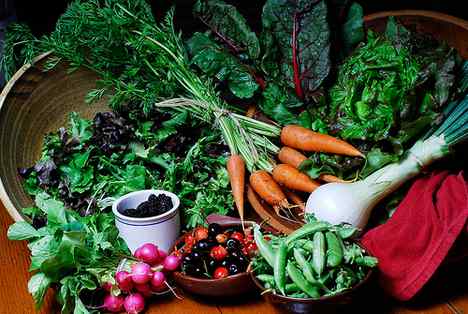
Healthful outdoor exercise, a feeling of accomplishment, and potential saving on the family food bill are good reasons why more and more Floridians are turning to home vegetable gardening.

Image Credit: FAMU

Image Credit: FAMU

Usually, the most physically challenging part of a vegetable gardening project is to get the soil ready for planting.  However, whatever you do, don’t give in to the temptation to cut corners on this phase of the operation.  If you do a poor job of preparing the soil, you can expect poor results from your garden, even if you work hard on planting and cultivation.  If you’re planning a large garden, you may want to rent a rototiller or even a small tractor and plow, to use in preparing the soil.  But, for a small backyard garden, you can do the work with a spade or shovel.