As many of you know, I do programs with snakes and receive a lot of calls about them. But in recent weeks I have seen an increase in the number of calls and the number of encounters inside of homes. Though most of the home invasions have been in the garage, one found a gray rat snake in the cushions of her couch. In addition to the home invasion calls I have also seen an increase with venomous snake encounters and thought I would write about the possible reasons for this increase.
For many, snakes on the property is an unnerving situation.
Photo: Molly O’Connor
Of the 48 species of snakes found in Florida, 40 are found in the western panhandle – where I live. I decided to try a snake watch where they public would report what snakes they were seeing and what time of year. As of September 15, there have been 54 reports. 32 of those (59%) were reported in April and May. There are two explanations for this. One, it is the beginning of spring and the warm temperatures have them moving from their wintering habitats. Two, it is spring, and this is breeding season. When breeding hormones are flowing snakes are bolder during their movements and may expose themselves more often in the search for mates. It is also true that they have been in brumation during the winter when they feed very little and are need of food. This could make them move more than normal as well.
I divided the species into subgroups mimicking publications by Dr. Whit Gibbons. Based on this, in the western panhandle there are 7 species of small snakes, 8 mid-sized, 7 large snakes, 13 water snakes, 4 venomous snakes, and 1 non-native species. The encounters by these subgroups so far include 1 of the 7 small snakes (14%), 3 of the 8 mid-sized snakes (38%), 5 of the 7 large snakes (71%), 5 of the 13 water snakes (38%), 3 of the 4 venomous snakes (75%), and the non-native Brahminy Blind Snake has not been reported yet.
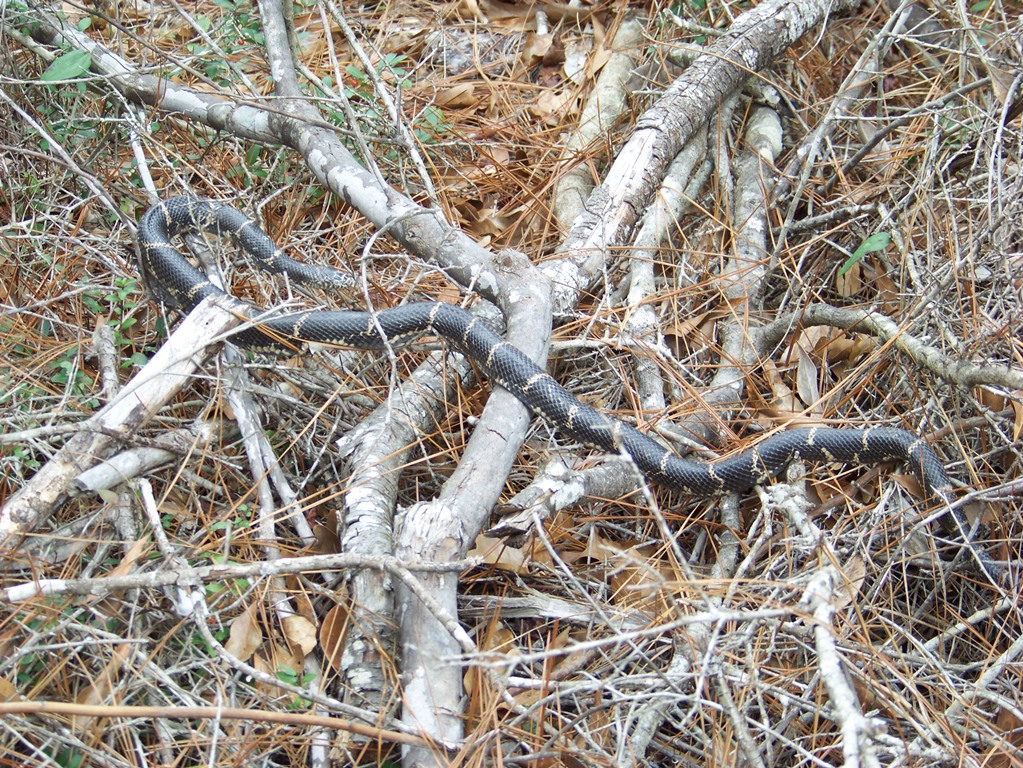
The eastern king snake is one of the larger snakes in the western panhandle.
Photo: Rick O’Connor
The high percentage of large snake encounters makes sense because they are – well… large and easier to see. The explanation for the high percentage of venomous snake encounters is numbers. There are only four species to be found in the western panhandle. It does not take many encounters to get a high percentage.
Water snakes will be encountered only if folks are visiting local waterways and are relatively still while there. My guess is that most encounters were from basking snakes or ones swimming across a body of water in which the observer happened to be there. Most snakes will freeze and hide when they since we are near, and most are well camouflaged. There are plenty of people who visit local waterways where these snakes exist. The lower percentage of encounters with this subgroup does not mean they are not there; they were just not seen. Many reports come from fishermen who are relatively still in their boats while fishing. If you move, they stop. If you stop, they move – and more will be seen.
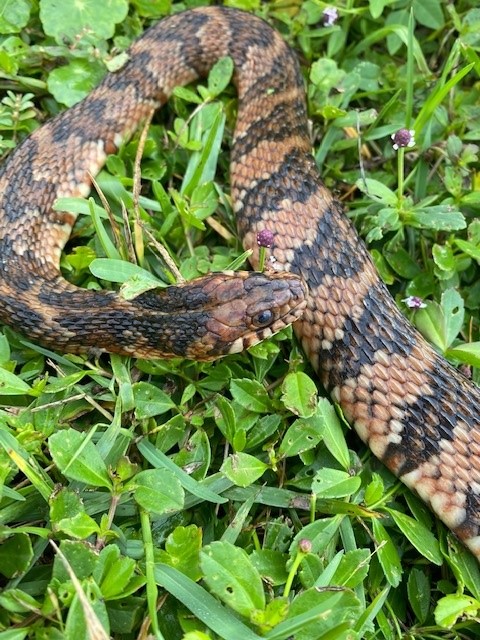
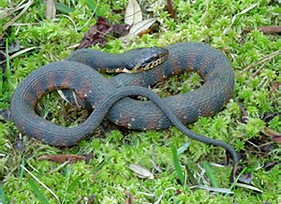
The banded water snake is one of the more commonly encountered water snakes.
Photo: Rick O’Connor
If you look at the encounters by species, we have found 17 of the 40 western panhandle species have been encountered so far (43%). There has been a total of 54 encounters. Most, 13 (24%) have been with the southern black racer. This is a common large snake that does very well in human habitats like our neighborhoods and parks. It is active during the day and is fast enough to avoid trouble so may be more willing to expose themselves than other species. They also have a preference for more open spaces where they can be seen.
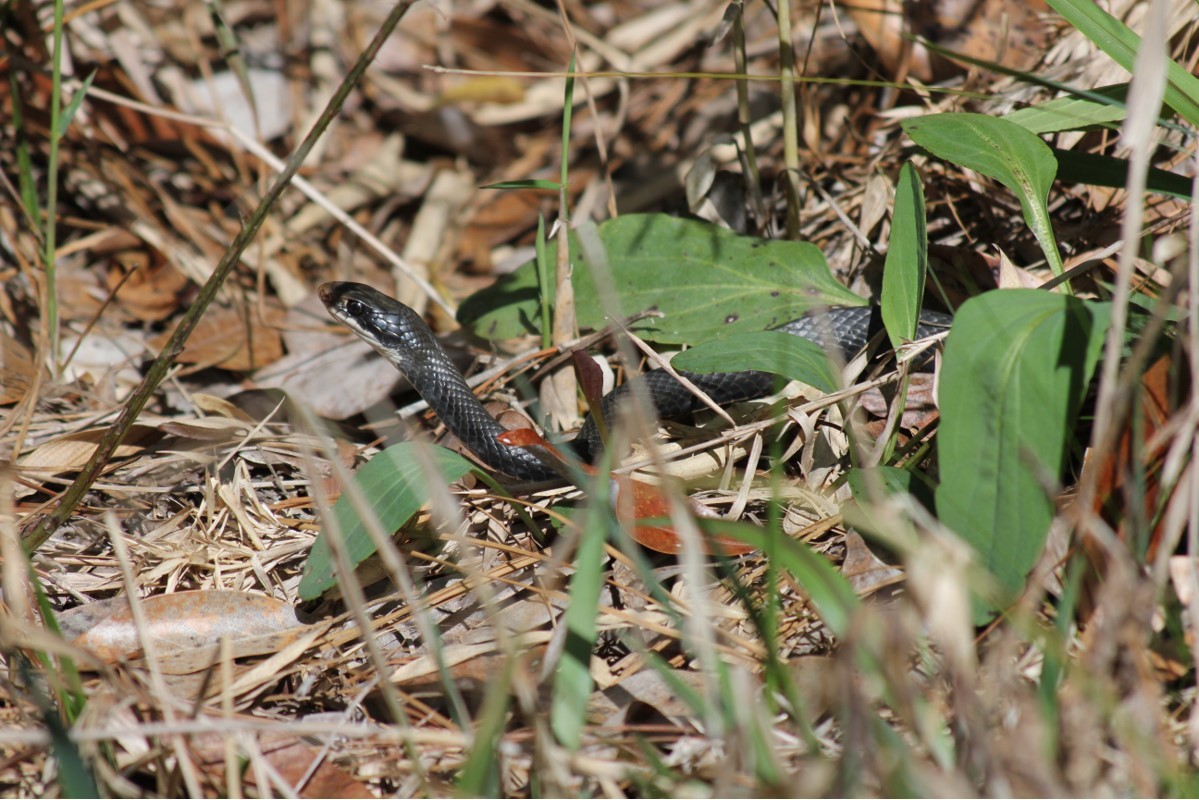
The southern black racer differs from other black snakes in its brilliant white chin and thin sleek body.
Photo: Jacqui Berger.
The second most frequently encountered snake so far this year has been both the eastern ribbon snake and the cottonmouth – 9 reports of both. The two account for 33% of all reports. Eastern ribbon snakes are fans of water and are often found along the edge of water bodies. With the increase in rainfall, many areas are wetter and encounters with this mid-sized snake have increased. They are most active during the day, especially on warm days, and this may also play a role in why they have been seen more often than other species.
The cottonmouth is an interesting story. Of the four species of venomous snakes, three of these have been encountered, and their encounters make up 15 of the 54 so far this year (28%). Of the 15 encounters, 9 were cottonmouths (60% of the venomous snake encounters, and 17% of all snake encounters reported). It is a commonly encountered snake. Seeing the cottonmouth as one of the top three encountered snakes in our area makes some people nervous. Like some of the other commonly encountered snakes, they like water – and there is plenty of it in the western panhandle. They prefer quiet water locations such as ponds, swamps, and lakes. They frequent water holes on golf courses and retention ponds in neighborhoods. It is also obvious that new developments are going up closer to wetlands than they did in the past – which would increase your chances of encounters. I recently completed a three-year survey of a gated community on Perdido Key where encounter rates were high. The interesting thing here is that barrier islands have little freshwater and are not classic cottonmouth habitat. But for decades there have seen an increase in encounters, which prompted many studies on how they are surviving. There are certainly natural freshwater systems on both Perdido Key and Santa Rosa Islands, but we have also created such habitats as well. It is possible that the cottonmouth is better suited to exploit these island habitats than other species of water snakes and thus are encountered more often. I plan to do more surveys for this, and other water snakes, on our islands beginning in 2023 and will let everyone know what we discover.
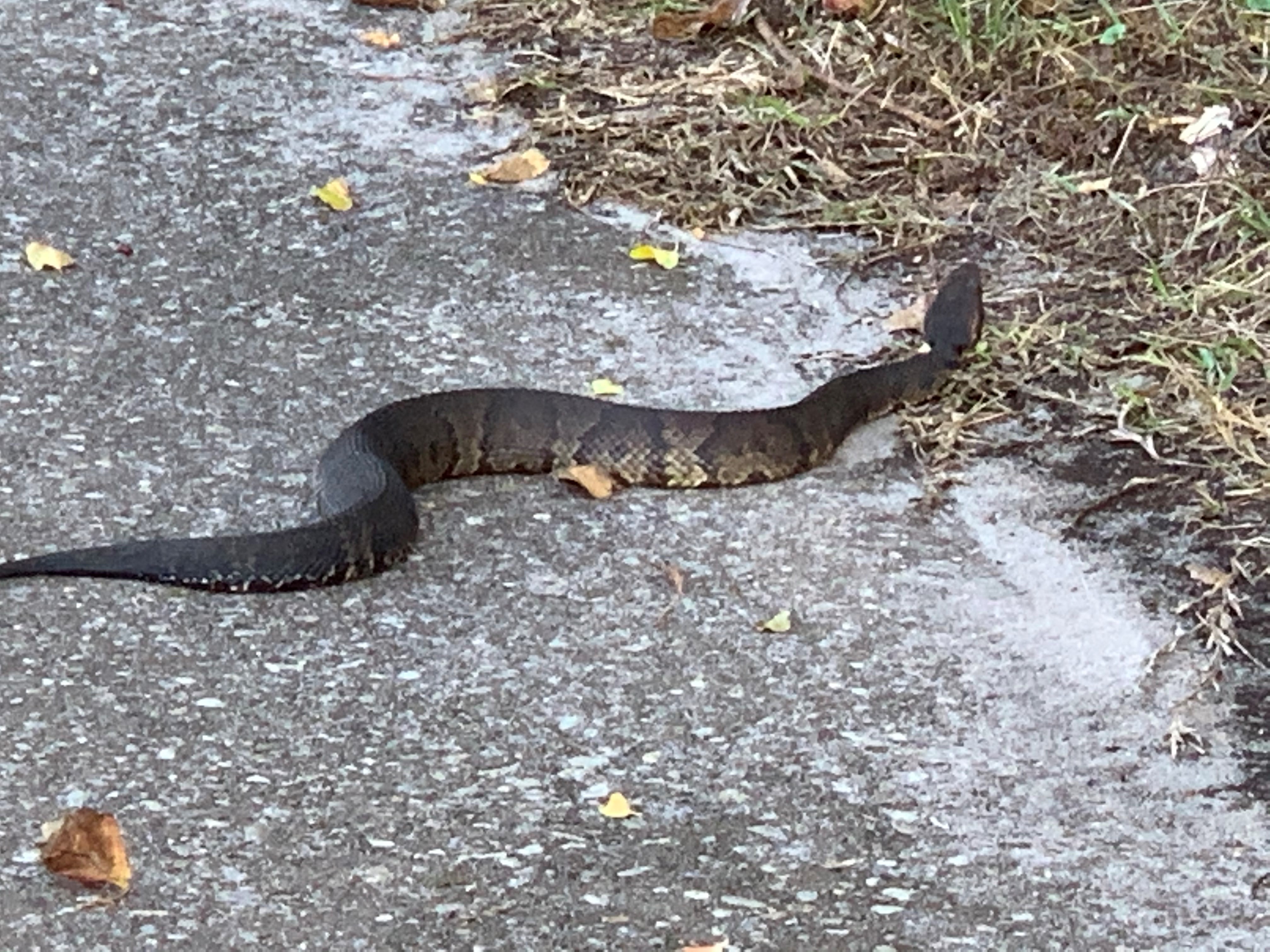
The cottonmouth is one of the more commonly encountered snakes in the western panhandle.
Photo: Bob Jackson
So, what has triggered the recent increase in home invasion and other snake encounters?
A week or two ago we experienced massive amounts of rainfall when a frontal system passed over. You might remember the flooding that occurred in Dallas TX and Jackson MS. That same system passed over us and generated a lot of rainfall. Like many animals, when water levels are up, they seek higher ground. During such events snakes are often reported in garages, porches, even in walls of homes. People were telling me they were finding them in the bathrooms, hallways, and even in the cushions of their couches. All of those reported were non-venomous, but cottonmouths are often encountered during these flooding events as well.
Other encounters can be explained as they were in the spring – the weather is changing. You may have noticed the recent decrease in humidity as a front passed over. It is not cold yet, but the lower humidity is signaling the oncoming fall season – and the snakes’ sense this as well. 15 of the 40 species (38%) in the western panhandle have a fall breeding season in addition to the spring one. All of the pit vipers breed in the fall and the rattlesnakes prefer fall breeding to spring. With the oncoming of the fall, males will be out seeking females. And as we mentioned earlier, hormones will force you to move more in the open than they may typically do.
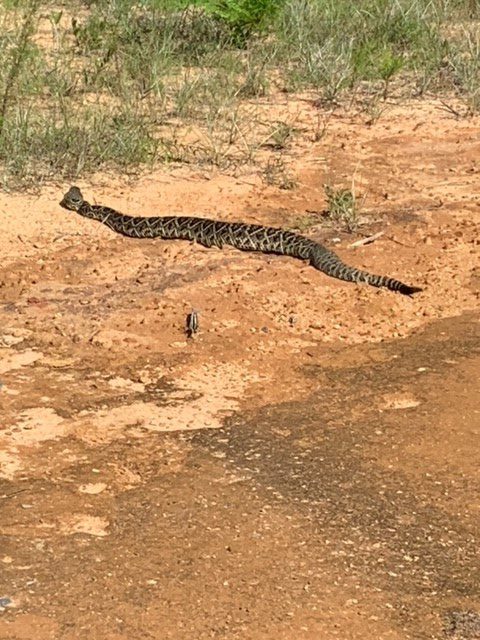
This eastern diamondback rattlesnake was seen crossing a dirt road near DeFuniak Springs shortly after the humidity dropped.
Photo: Lauren McNally
We will continue our snake watch for the rest of the year and will give an update early in 2023. If you do see a snake, please let us know which species and which month you encountered it. If you have questions about snake encounters and snake safety, do not hesitate to contact your county extension office.
Most of you – okay… ALL of you who read this column like the outdoors. Some like it for its peace and beauty, some for recreation opportunities, some like it for both. One activity I have found many enjoy is seeking creatures from a list. A sort of “bingo” approach to observing nature.
For many, they have a list of birds they would like to see. I have a colleague who wants to see each species of turtle in the U.S. in the wild. I heard of a group that was trying to photograph a selected list of turtles in the wild. I have a list of animals I hope to see while camping out west. It is a lot of fun to do. Many like the challenge.
I am not sure how it started, but earlier this year I began asking people to report snakes they see while out and about. Again, it started as just a list but then I decided to see how many of the 40 species and subspecies that call the Pensacola Bay area home we might find in one year. The challenge was on.
I broke the types of snakes into size categories following a guide published by Dr. Whit Gibbons and others. In our area there are seven species of small snakes, eight species of mid-sized snakes, seven species of large snakes, 13 species of water snakes, and four species of venomous snakes. There is one species of introduced snakes. Here are the results so far –
Category
# Known species
# Seen
Small snakes
7
0
Mid-sized snakes
8
3
Large snakes
7
5
Water snakes
13
5
Venomous snakes
4
3
Introduced snakes
1
0
Snake sightings in the Pensacola Bay Area (Jan-Jul 2022)
Seeing no small snakes makes sense… they are small and are mostly nocturnal.
Seeing most of the large snakes also makes sense… they are large and easier to notice.
Not seeing a lot of water snakes also makes sense. First, you have to spend a lot of time on our rivers and lakes to see them. Second, they are not easy to tell apart. That said, we have seen almost half.
It is interesting we have seen three of the four venomous snakes. Cottonmouth encounters are quite common, but the two species of rattlesnakes (pygmy and eastern diamondback) are not. But… the one that is missing… is the eastern coral snake.
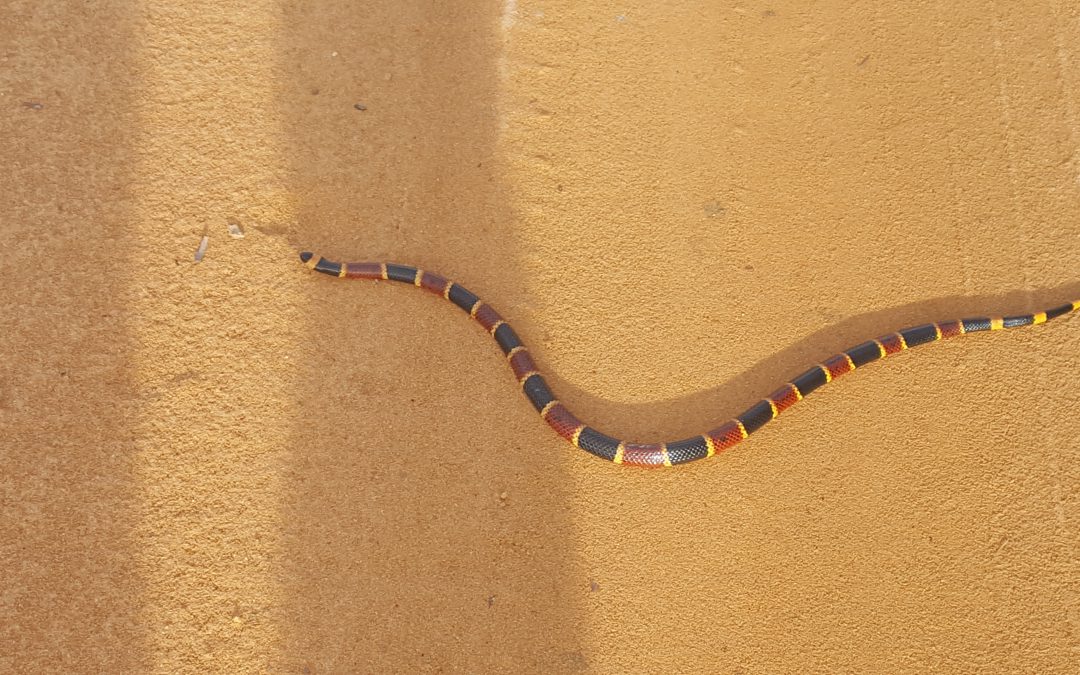
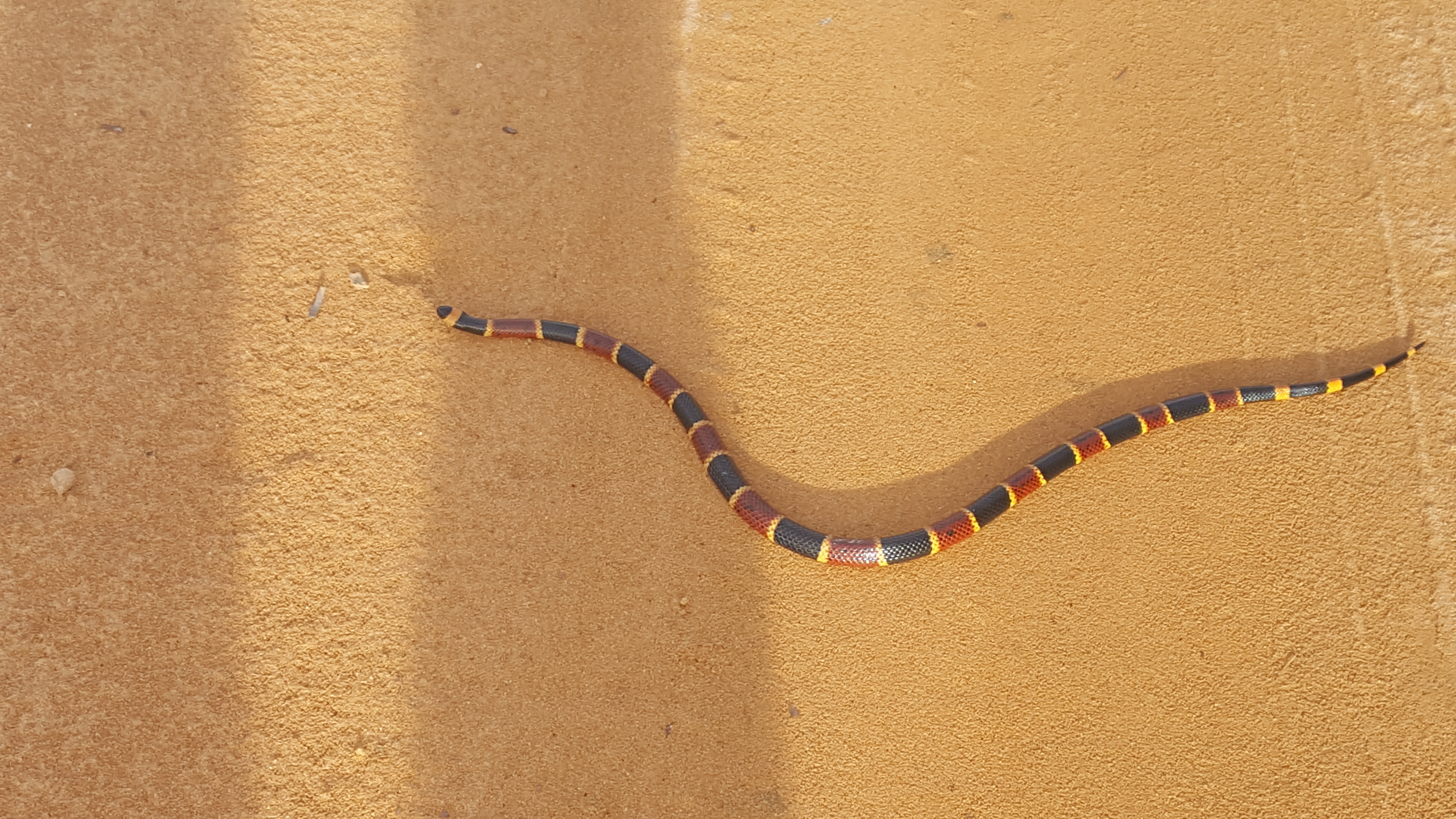
The eastern coral snake.
Photo: Ed Lewis
Seeing a coral snake is actually a rare thing. I bet if you asked 100 people “how many of you have seen a live coral snake in the wild?” very few would reply yes.
Why so few encounters?
Is this species declining?
I personally have only seen only two corals snakes in the wild in my life. Three if you count the time my dad said I was playing with one in the first grade – but I do not remember that. The two I saw were both at the Naval Live Oaks section of the Gulf Islands National Seashore near Gulf Breeze.
The first was when I was a Boy Scout camping there in the late 1960s. We came across the snake coiled around the base of a palmetto. We all knew what it was and did not get close, but all enjoyed watching it thinking how lucky we were. I remember how docile it was. No angry rattle. No nasty gaping white mouth. Just chillaxing and enjoying the day. Being boys, we had to see it move. We got a stick and nudge it. It just looked at us as if to say – “What are you doing? You know who I am? You know what I can do?” We left it alone, but it was an amazing experience.
The distinct black head of the coral snake.
Photo: Ed Lewis
The second encounter was also at Naval Live Oaks, but many years later. I was conducting a box turtle survey within the Seashore and following a transect I had set to search. I was moving slowly, looking hard, when I heard to some rustling in the leaves to my right. The type of rustling you hear when an armadillo is moving nearby. But there was no armadillo. I continued to hear the noise and searched for a small mammal when I realized it was coming from beneath the leaf litter. Using my hiking stick, I moved the leaves to find a large coral snake crawling. You can imagine my excitement. At this stage of my life, I had been a science educator for a long time and had taught about these snakes a lot, but only had seen one in my life.
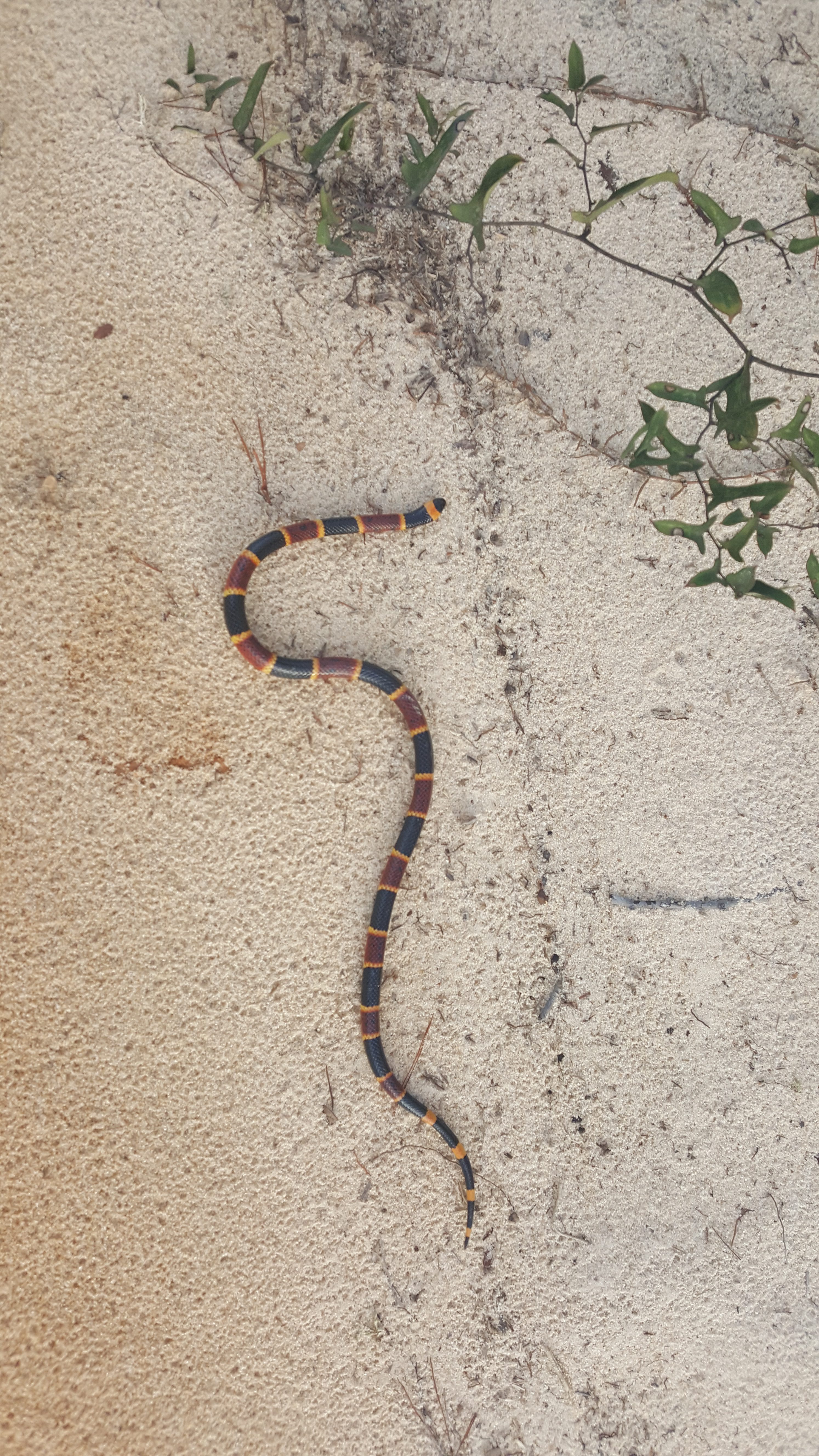
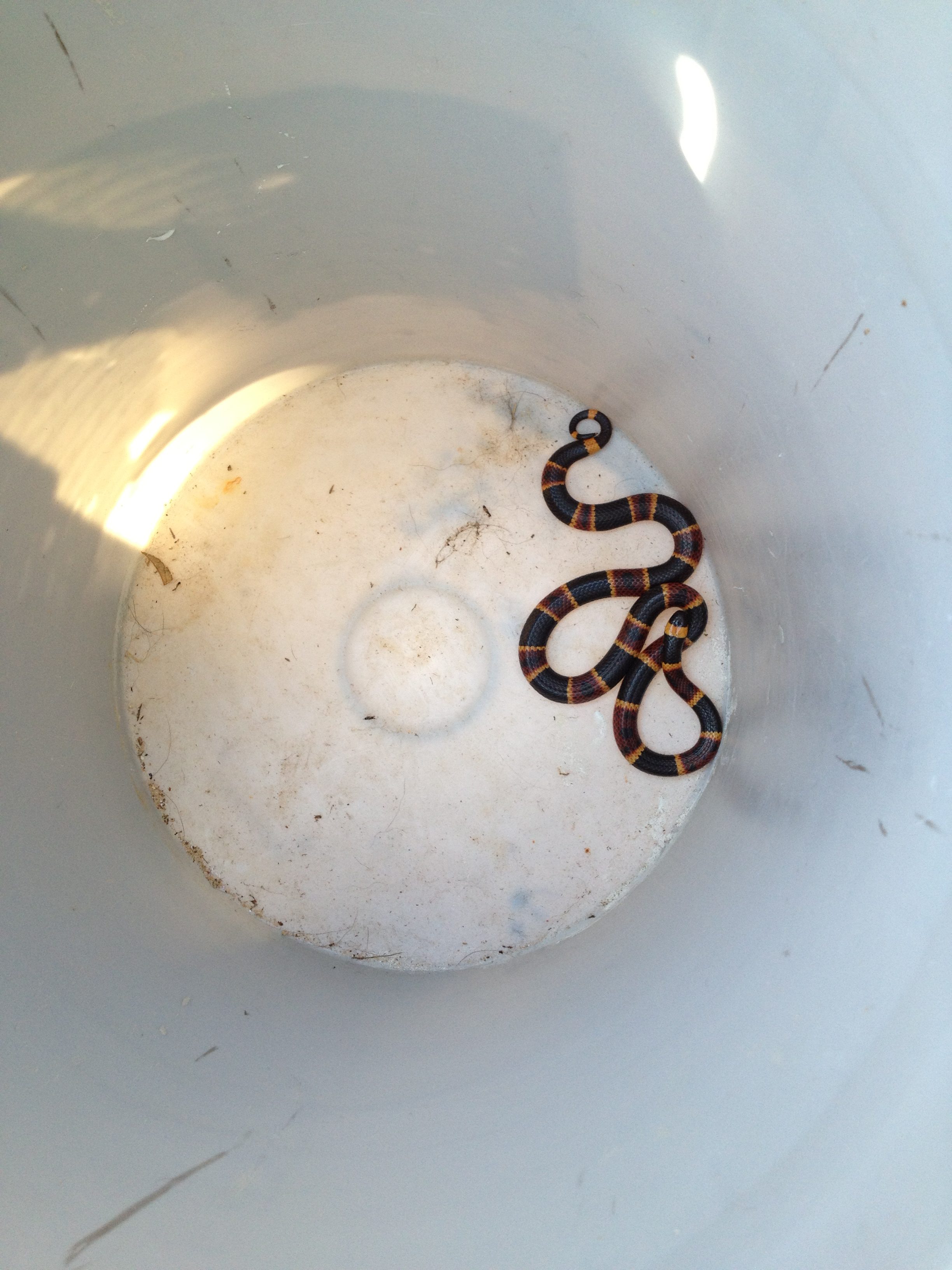
The eastern coral snake (Micrurus fulvius fulvius) is found across much of the coastal southeastern United States. There are records in Florida, Georgia, South Carolina, North Carolina, Alabama, and Mississippi. They do seem to be more common in Florida than other states. They can easily be recognized by their classic red/black/yellow banded colors. There are mimics who have this coloration but the old song “red on yellow will kill a fellow” does work with this subspecies. Also, the mimics in our region have red heads, where the eastern coral has a black one. The literature states they prefer dry sandhill environments but can be found in hardwoods (which where I found them) and wet flatwoods dominated by pines.
The best chance to find one is in the spring and fall and most often found during or after rain. As I found, they spend most of their time beneath the ground or under leaf litter but when they do move above ground, they seem to prefer mornings.
Coral snake found near Eglin AFB.
Photo: Carrie Stevenson
Their food of choice are lizards and snakes. They will grab their prey and chew releasing the venom. They do have their predators. Kingsnakes, notorious for eating other snakes, are one, but indigo snakes, and black racers will also consume them. When they encounter a potential predator their first response is usually to try and hide underground. If this does not work, they will flatten their bodies hiding their heads beneath a coil and sometimes raise their tails to appear as the head end. As I observed, they are not terribly aggressive snakes but anyone seeing one should keep their distance.
Coral snakes have a neurotoxin, different than the hemotoxins find in the pit vipers. They are more closely related to sea snakes and cobras, who have a similar toxin. Deaths from this snake are rare, but encounters and bites are also rare.
Do I encourage you seek out this snake for our project?
No… The bite from this animal can be very serious. Though the majority of venomous snake bites come from copperheads, and most fatalities from western diamondback rattlesnake, this is NOT a snake to mess with. If you do see one, let us know and consider yourself lucky. But keep a safe distance. It is amazing to see one.
When hiking around the Florida panhandle in midwinter, most snakes are undercover trying to avoid the chilly cold fronts that pass through and can drop temperatures close to freezing. So, the probability of seeing one is low. But one species, the eastern garter snake, seems to tolerate cold temperatures better. They are often found basking on open areas this time of year and are quite common not only on the trails, but in our home landscapes as well.
But not to fear…
This is one of the 40 non-venomous snakes found in our state. Many are afraid of these animals because… well… because they are snakes, and that is all that need to be said – at least for some. But for others, they understand the benefits snakes provide to the ecosystem (controlling unwanted pests) and to see one is kind of exciting. Being non-venomous does not mean they will not bite, they certainly will, but no venom is associated with it. Larger non-venomous snake bites can be painful, but not deadly. Garter snake bites barely hurt.
The eastern garter snake is one of the few who are active during the cold months. Photo: Molly O’Connor
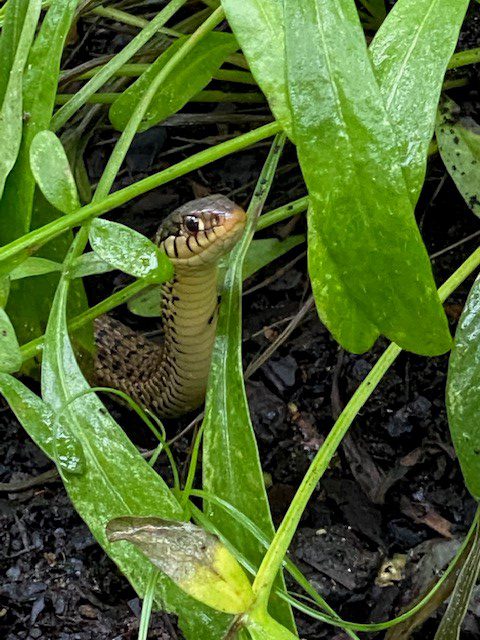
Recently my wife and I were on a hike with our grandsons in central Escambia County. At one point my oldest grandson said “snake”. I am not sure how he saw it actually. It was a young eastern garter snake basking in the middle of the trail. These snakes have colorful patterns of stripes and squares that help them blend in well. We knew right away what it was and were all excited to see it. Knowing it was harmless we allowed him to pick it up but warned him that it would most likely bite. Garter snakes tend to flee when first alarmed but will turn and bite if cornered. They will sometimes rattle their tails in the leaves giving off a “buzzing” sound and can release a musk to warn the predator. But this young snake did neither, no rattling, no musk. However, it did try to bite him. After a few photos and the amazement of seeing one, we released it in a sunny spot to continue its midday basking. It was pretty cool.
Many reading this have seen many garter snakes and know this as a harmless animal. They are found all across the state of Florida and much of the eastern United States. There is a subspecies, the blue-striped garter snake, that can be found in the Big Bend area of Florida, but the differences are minor.
Eastern garter snakes are smaller snakes, usually reaching two feet but there is a four-footer on record. They like to inhabit areas that are near water where their favorite prey (amphibians) can be found. Preferring open grassy areas, they can be found in wooded habitats and are often found in lawns and gardens of local neighborhoods.
They hunt primarily during the daylight hours for amphibians but will also eat fish and earthworms. Some have been found to feed on snails, slugs, and even small snakes, birds, and mammals. They are not constrictors but rather grab their prey and swallow it whole.
They are famous for their large gatherings during breeding season. In spring, females will release a pheromone to attract the males, and the males will come, many of them at one time. There are locations in Canada where literally thousands gather at one location. The females do not lay eggs but rather give birth to about 20-30 live young in late summer or fall, it could be up to 100 in a litter. These large groups of slithering garters bring back images from movies where “snake pits” and “a den of snakes” are portrayed. I have never seen such a gathering, and in the southeast, they do not happen in such large numbers as these, but it would be cool.
This time of year, on sunny days in open basking areas, you may see this small but neat snake. The same could be true if hiking near an open sunny location. So, keep your eyes down and maybe you will get lucky.
It seems like there has always been a soft spot in my heart for snakes. From a young age, I was fascinated with all reptiles. The rural fabric of where I grew up in Central Florida (think late-1960s) afforded many opportunities for us kids to roam the woods and fields in search of adventure during summer vacation. I vividly remember the occasional eastern hognose snake that we would catch as kids. They were easy to house for a while, as there was no shortage of toads for a food source. This article will focus on some of the common species of snakes in NW Florida and a couple of snake safety tips.
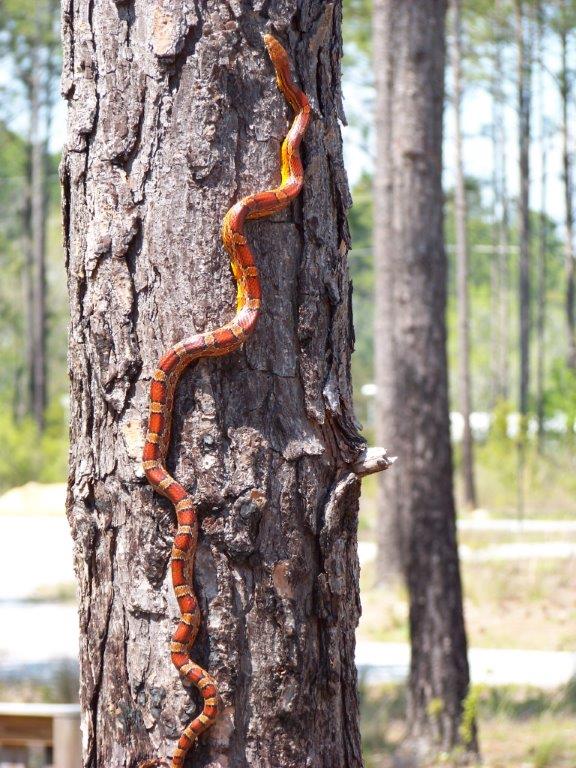
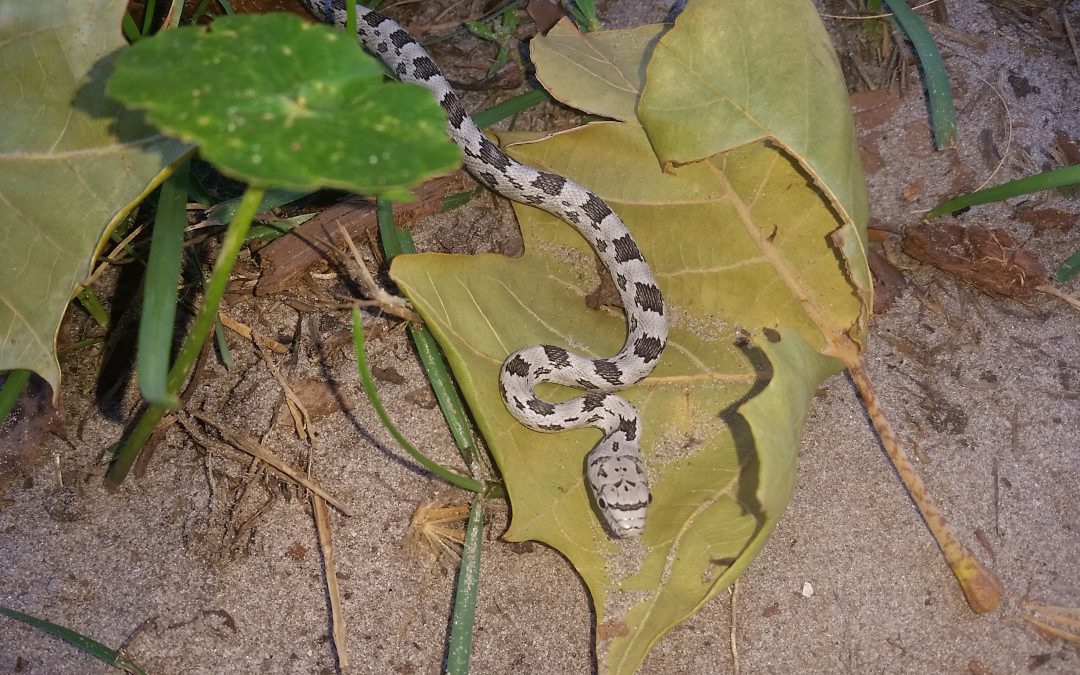
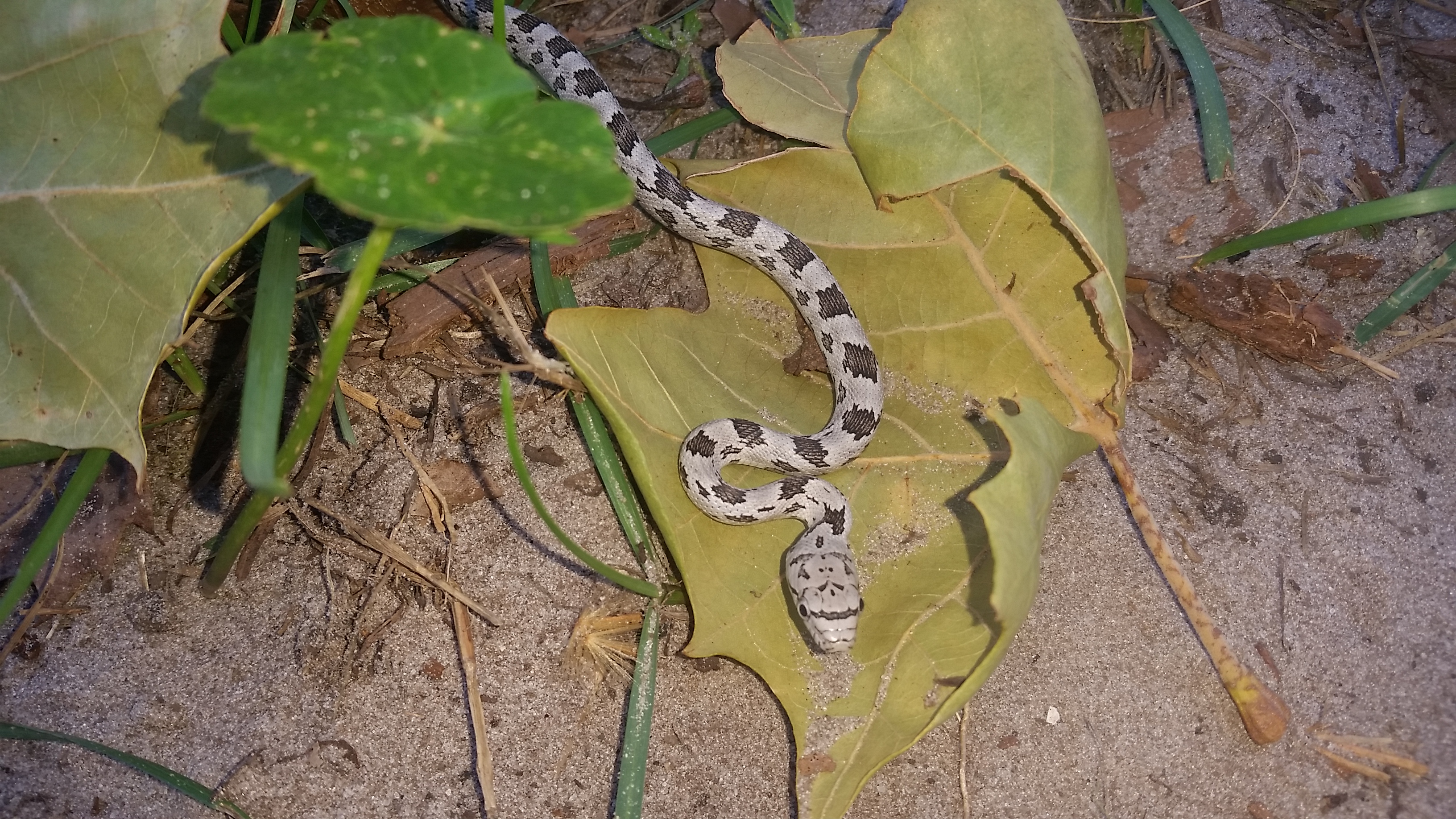
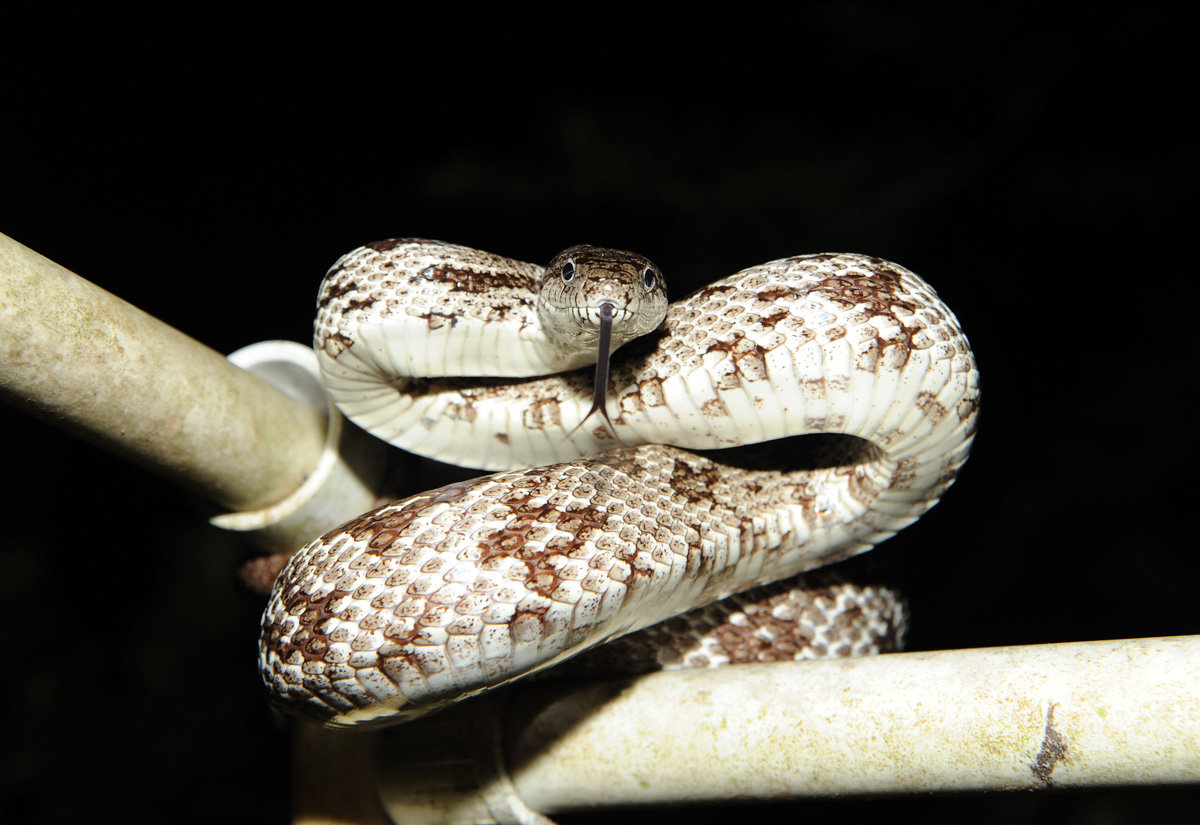
Very likely, one of the first species of snakes most people encounter in North Florida is the gray rat snake (aka oak snake). If you raise chickens, you can greatly reduce the time it takes to enjoy your first encounter. I pull oak snakes out of our nest boxes on a regular basis. I have also encountered some rather large pine snakes in this manner; one with eight egg lumps in its mid-section. These are both harmless, beautiful creatures that can unfortunately make you hurt yourself in a dimly lit coop as you reach in to collect eggs. Another commonly encountered snake in our area is the corn snake, also called a red rat snake. The orange background and dark-red blotches make this one of our most beautiful species. Southern black racers are also a commonly seen species due to their daytime hunting habits. Racers are black on the back with a white chin and very slender for their length. They live up to their name and can disappear in a flash when startled. Two other species regularly encountered here are in the “garter snake” group. The eastern garter snake is one of very few species in our area with longitudinal stripes. They can have a tan to yellowish background color or even a greenish or blue color. The closely related ribbon snake looks similar in color and pattern but has a much slimmer build.
Gray rat snakes are also called oak snakes and are quite common in North Florida
My home county of Wakulla is home to four species of venomous snakes, which include the eastern diamondback rattlesnake, pygmy rattlesnake, coral snake and Florida cottonmouth. However, if you live in other parts of North Florida, you may have five or possibly even six species that are venomous. The copperhead’s range extends into North Florida in a few Counties along the Apalachicola River and the canebrake (or timber) rattlesnake ranges slightly farther south in the peninsula to North-Central Florida. I’ve only seen one canebrake rattlesnake and it was crossing a road on the north side of Gainesville many years ago. Both pygmy rattlers and cottonmouths can be very abundant locally in the right habitats but diamondbacks and coral snakes are less common these days having lost much of their preferred habitats to development.
My best advice for those worried about being bitten by a snake is don’t try to pick one up, and watch where you put your hands and feet. It really is relatively easy to avoid (key word here is avoid) being bitten by a snake. There are many good medical sites on the web with detailed recommendations for snakebite treatment. In the very rare circumstance when someone is envenomated, the best policy is to remain as calm as possible and head for medical attention. Do not cut the skin and try to suck out the venom or apply a tourniquet. These strategies generally cause more harm than good.
I always appreciate the chance to get a look at one of our incredible native snakes when afield, especially if it happens to be one of our venomous species. A big diamondback rattlesnake is an impressive animal to happen on when afield. This appreciation does not mean that I don’t get startled occasionally when surprised, but once that instinctive reaction passes, I can truly appreciate the beauty of these scaly critters.
I was recently gathering information together for a presentation on Florida snakes, highlighting those in the Florida panhandle. This particular reference listed 44 species found in the state. Of those, 29 were found throughout the state – north, central, and south Florida. Granted, there were subspecies for many which made for some distinction, but most of our snakes (66%) have few barriers and seem to have adapted to the different habitats and climates. And let’s face it, north and south Florida are two different worlds. That says a lot for the adaptability of these animals, they are pretty amazing.
Snakes do make many nervous but most of our 44 species are nonvenomous. Photo: Nick Baldwin
Another trend was obvious. As you looked at those species which were only found in north Florida (here defined as the panhandle across to Jacksonville and south to Gainesville) and compared that to species only found south of Gainesville, we have a rich diversity of snakes in our part of the state. There were 12 species found in Florida that were only found in north Florida. South and central Florida only had 3 species that were unique to their part of the state. I saw this same trend with turtles. Of the 25 species of turtles found in Florida, 9 are unique to north Florida, 2 to central and south.
It has been known that the biodiversity of the panhandle is pretty amazing, and that the Apalachicola River basin in particular is a biodiversity hot spot. In the panhandle, several “worlds” collide and species, many using these river systems we find here, can easily reach this area. Some produce hybrid versions of two species. Some produce new species only found here. There may be more reptiles / acre in central and south Florida (I did not look at that) but the variety of these creatures in the north Florida is pretty amazing.
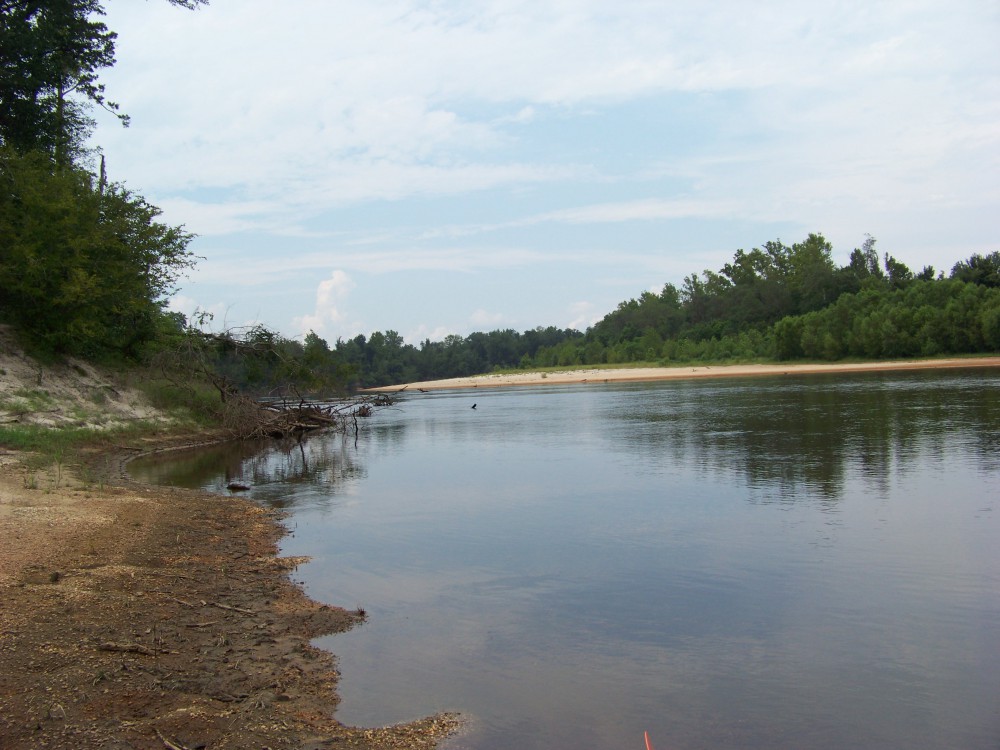
The Escambia River. One of the alluvial rivers of the Florida panhandle. Is a natural highway for many reptiles to disperse into our state. Photo: Molly O’Connor
But what about those 12 species unique to our part of the state?
Four of them are small terrestrial snakes, rarely getting over a foot in length. These are easy prey and nonvenomous so are most often found beneath the leaf litter of the forest, or beneath the ground, coming out at night to feed on small creatures. We generally find them living in our flower beds and gardens. Most are ovoviviparous (producing an egg but instead of laying it in a nest, the female keeps it internally giving live birth), with only the Southeastern Crowned Snake laying eggs (oviparous).
Smooth Earth Snake (Virginia valeria) This snake has records from Pensacola Bay area and areas south of the Georgia line.
Rough Earth Snake (Virginia striatula) This snake has most records west of the Apalachicola River, but there are records from the Suwannee basin in north Florida.
Red-bellied Snake (Storeia occipitomaculata) Common across north Florida.
Southeastern Crowned Snake (Tantilla coronate) Found only in the panhandle.
Six of the unique panhandle 12 are nonvenomous water snakes. This would make sense in that we are host to several long alluvial rivers that reach deep into the southeast. The Escambia, Choctawhatchee, and Apalachicola Rivers are highways for all sorts of riverine species, and those closely associated with rivers, to cover hundreds of miles of territory with few barriers (except for the occasional dam). Though these water snakes are nonvenomous, they are known for the “bad attitudes” and high tendency to bite. They feed on a variety of prey and are often seen basking along the riverbank or in a tree branch hanging over the water where they can escape quickly if trouble comes, and they do escape quickly. Some are quite large (over 4 feet) and most are ovoviviparous. The northern watersnake is known to have a placenta-like structure to nourish its young (viviparous) and the rainbow snake lays eggs (oviparous).
The banded watersnake is one found throughout the state and resembles the cottonmouth. Photo: UF IFAS
Queen Snake (Regina septemvittata) is only found in the western panhandle (west of the Apalachicola River). This snake likes cold, clear streams with rocky or sandy bottoms and plenty of crayfish.
Northern Watersnake (Nerodia sipedon) also is only found in the western panhandle. It can be found in almost any body of water and has been reported on barrier islands.
Plain-bellied Snake (Nerodia erythrogaster) This snake also can be found in just about any water system.
Diamondback Watersnake (Neroida rhombifer) has only been found in the Pensacola Bay area (Escambia and Santa Rosa counties). They can be found at times in large numbers around almost any body of water.
Western Green Watersnake (Neroida cyclopion) only as records in one Florida county – Escambia. There they have been found in a variety of water habitats including man-made ones.
Rainbow Snake (Farancia erytogramma) This snake likes to feed on American eels and is usually found in aquatic systems where this prey inhabits.
Another interesting trend with these unique panhandle watersnakes is the number only found in the western panhandle. Four of the six are only found there and two are only found in the Pensacola area. Some say, “Pensacola is not really Florida”, the snakes might agree.
The last two of the unique 12 are venomous snakes. Florida has six species of venomous snakes, but two are only found in the north Florida.
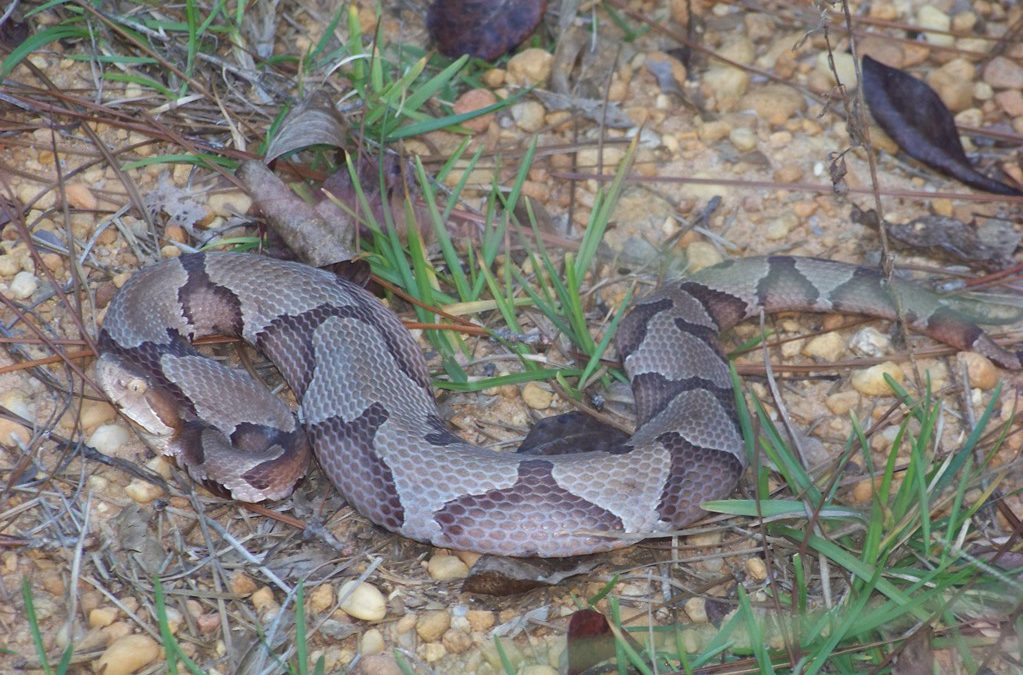
This copperhead was found JUST across the state line in Alabama. The more copper color and “hour-glass” pattern of their bands lets you know it is not it’s cousin the cottonmouth. Photo: Molly O’Connor
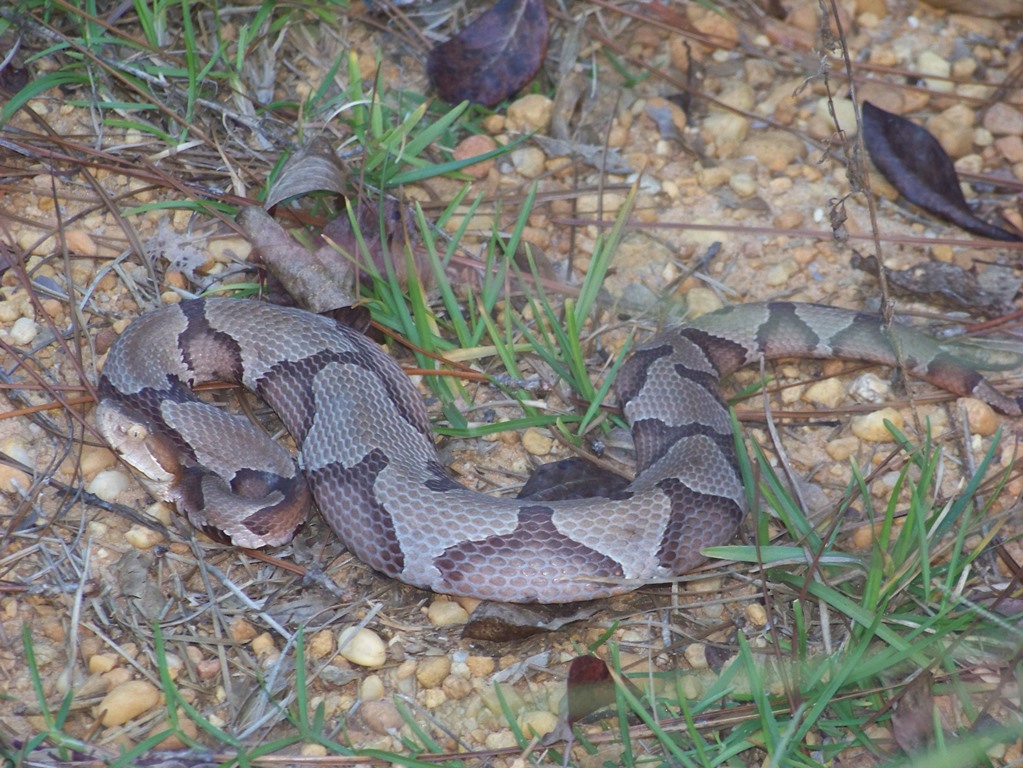
Copperhead (Agkistrodon contortrix). Though quite common in Alabama and Georgia, most records in our state are from the Apalachicola River basin area. Many local panhandlers will tell you they see this snake everywhere, but they use this name for the cottonmouth also (a close cousin). The true copperhead is not common here. It seems to like rocky areas further north and is usually found with limestone rock areas that have been formed over time from river erosion.
Timber Rattlesnake (Crotalus horridus). As with the copperhead, this is a common snake in Alabama and Georgia associated with rocky terrain and is not common in our state. Many ole timers will speak of the “canebrake”, which was found in the common cane of north Florida. There was discussion at one point of this being a separate species from the timber rattler, but the specialist now believe they are one in the same. So, the name canebrake is no longer used by herpetologists. Records of this snake in Florida are mostly east of the Apalachicola River and not common.
This timber rattlesnake has chevrons (stripes) instead of the diamond pattern on its back. Photo provided by Mickey Quigley
I think the diversity of wildlife in our part of the state is pretty special. Even if you do not like snakes, it is pretty neat that we have so many kinds not found south of the Suwannee River. Snake watching is not as popular as bird watching, for obvious reasons, but it is still neat that we have these guys here.