Almost everyone has heard of red tides and know they periodically occur off the coast of Florida. The more frequent events occur off southwest Florida between Tampa and the Keys, but they have occurred in other parts of the state.
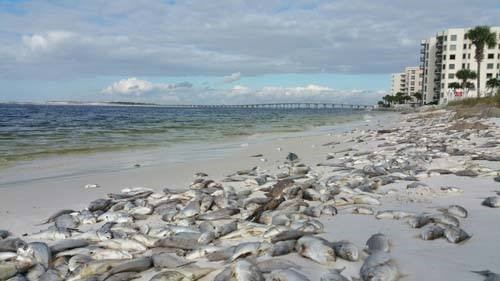
Dead fish line the beaches of Panama City during a red tide event in the past. Photo: Randy Robinson
When they do occur in the panhandle, they seem to be more common on the east side – Bay, Gulf, and Franklin counties. This year there has been a rather large red tide event that has lingered several weeks now in this area. There have been multiple samples that have been reported as HIGH (1,000,000 cells or more / liter). Cells in this case is referring to the organism that causes red tide – Karenia brevis.
The dinoflagellate Karenia brevis. Photo: Smithsonian Marine Station-Ft. Pierce FL
K. brevis is a microscopic plant that belongs to the dinoflagellate group. They occur naturally in Florida waters and when conditions are good – will begin to multiple and create a bloom. These blooms can be large enough to discolor the water – often making it a rusty/reddish color… hence the red tide. Good conditions would be those you would think plants like – plenty of sunlight, warm temperatures, plenty of nutrients. When the wind is lower the water moves less allowing them to concentrate into large patches producing “the tide”. These small plants can release a toxin, known as brevotoxin. Brevotoxins are neurotoxins that affect the transmission of nerve signals, which can lead to several internal complications and possibly death for marine life.
Humans and animals typically ingest or inhale brevotoxins during a large red tide event. Fish kills are a common phenomenon during large events, but marine mammals and sea turtles have also been killed. During the recent red tide event in the St. Joe area fish kills have been reported, as well as respiratory problems with humans. We now also can include diamondback terrapins as a victim.
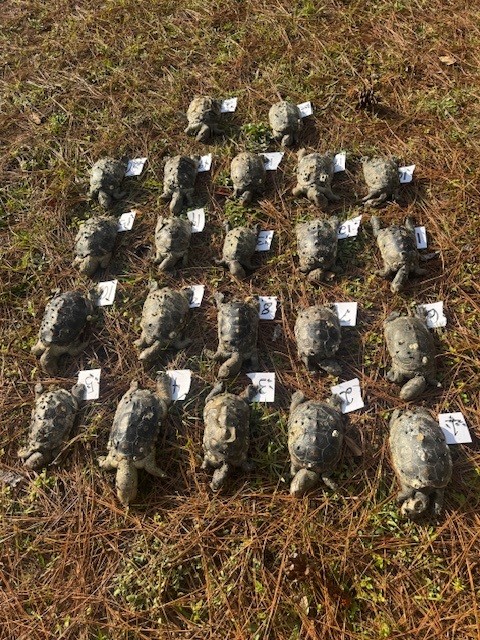
Terrapins are smaller brackish water turtles found along the coast of Florida. At the time of this article, scientists with the US Geological Survey had logged 66 dead terrapins from the St. Joe area, all were females, and most were large females.
Diamondback terrapins lost during the recent red tide in St. Joe Bay. Photo: Dan Catizone
At the time of this writing the tide in this area continues. High concentrations have been reported from Gulf, Bay, and Franklin counties. The most recent FWC report at the time of this article (December 5) red tide had been detected in 20 samples from the panhandle. Cell concentrations of >100,000/liter (medium-high) were reported from five of those. Background to medium concentrations were reported from Bay County. Background to low in Gulf and Franklin counties. Fish kills suspected to be related to the red tide occurred in Bay County but there were no reports of respiratory problems anywhere at that time.
Red tides seem to be more common in late summer and fall. NOAA believes the same climate pattern that has caused the drought, and no named tropical storms to hit Florida, may be the cause of the current patterns holding the red tide near the St. Joe area. Concentrations SEEM to be declining. Hopefully this one will not last much longer.
Diamondback terrapins are the only resident turtle within brackish water and estuarine systems. Their range extends from Massachusetts to Texas but, prior to 2005, their existence in the Florida panhandle was undocumented. The Panhandle Terrapin Project was developed to first determine whether terrapins exist in the panhandle (Phase I) and, if so, what is their status (Phase II and III).
The project began at the Marine Science Academy at Washington High School (in Pensacola) in 2005. Between 2005 and 2010 the team was able to verify at least one record in each of the panhandle counties. For Phase II we used what we called the “Mann Method” to determine the relative abundance of terrapins in each area. To do this we needed to conduct assessments of nesting activity in each county. In 2012 the project moved from Washington High School to Florida Sea Grant. At that time, we developed a citizen science program to conduct Phase II of this project. Effort first focused on Escambia and Santa Rosa counties, but in recent years has included Okaloosa County. Florida Sea Grant now partners with the U.S. Geological Survey (based out of Gulf County) to assist with Phase II and lead Phase III, which is estimating populations using mark-recapture methods, as well as satellite tagging to better understand movements and habitat use. The focus of Phase III has been Gulf County, but tagging has occurred in Okaloosa and Escambia counties.
Over the years we have trained 271 volunteers who have conducted thousands of hours of nesting surveys and helped obtain a better picture of the status of diamondback terrapins in the Florida panhandle. Here are the 2023 project results.
Results from 2023
We trained 67 volunteers; 35 (52%) of which participated in at least one nesting survey.
The volunteers conducted 196 surveys logging 212 hours.
During those surveys terrapins (or terrapin sign) were encountered 43 times; a Frequency of Encounter (FOE) of 22%.
Three terrapins were tagged. Two from Okaloosa and one from Escambia. All but two of the nine primary survey beaches saw nesting activity (78%). One new nesting beach was discovered.
Escambia County
Two nesting beaches. 47 surveys. 7 encounters (FOE = 15%).
The Mann Method assumes the sex ratio is 1:1 (male: female) but recent studies suggest the ratio may be as high as 5:1 (male: female). Based on these two rations the number of terrapins estimated to be using these beaches ranged from 4-36.
One terrapin (“Dollie”) was tagged. Fire ants and torpedo grass were reported on some beaches.
Santa RosaCounty
Three nesting beaches. 68 Surveys. 14 encounters (FOE = 21%).
The number of terrapins estimated to be using these beaches ranged from 6-30.
No terrapins were captured, though one was seen nesting. No invasive species were reported from the nesting beaches.
OkaloosaCounty
Four nesting beaches. 67 surveys. 21 encounters (FOE = 31%).
The number of terrapins estimated to be using these beaches ranged from 2-66.
Two terrapins were tagged (“Kennedy” and “Molly”). Phragmites were reported from all beaches.
Walton County
Walton county currently does not have a volunteer coordinator and surveys are not occurring at this time. We are working with an individual who may take the lead on this.
BayCounty
This team is just beginning and currently there are no primary beaches. The team focused on five beaches encountering terrapin nesting activity on one of them. They conducted a total of 14 surveys encountering terrapin tracks on 1 of those (FOE = 7%). The estimated number of terrapins using this beach ranged from 4-12.
Baldwin County Alabama
Due to the proximity of terrapin habitat and nesting beaches at the Alabama/Florida line, and the possibility of terrapins using habitat in both states, a team was developed in Baldwin County Alabama this year. The team began conducting Phase I surveys and encountered one deceased terrapin. No nesting beaches have been identified at this time.
Summary
The results of this year’s surveys suggest that, based on the number of nesting beaches we know of, there are anywhere from 2-66 terrapins utilizing them. Again, two of the primary beaches did not have nesting activity this year. USGS tagging studies will provide better population estimates and a better understanding of how these animals are utilizing these habitats. The current population estimate for Gulf County is a little over 1000 individuals and most are showing relatively small range of habitat utilization, although two individuals in the western panhandle moved from one county to the neighboring one.
Training for volunteers occurs in March of each year. If you are interested in participating, contact Rick O’Connor – roc1@ufl.edu.
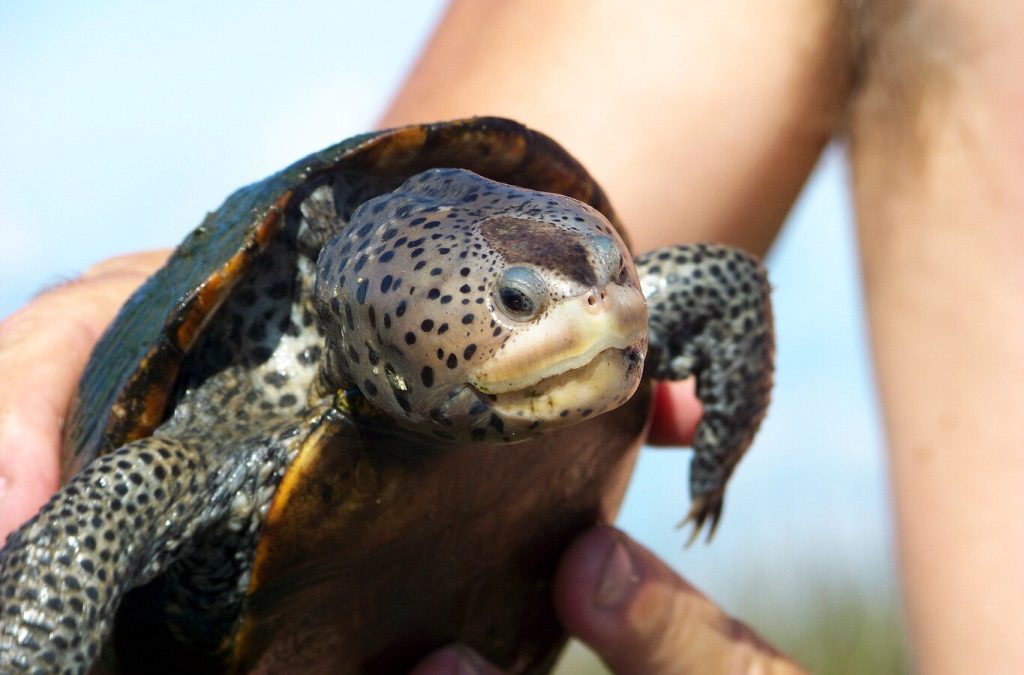
Since 2007 Florida Sea Grant has worked with partners, and trained volunteers, to assess the status of the diamondback terrapin in the Florida panhandle. This small emydid turtle is the only one that lives in brackish water and prefers salt marshes. Very little is known about this turtle in this part of the country, and the Panhandle Terrapin Project has the goal of changing that.
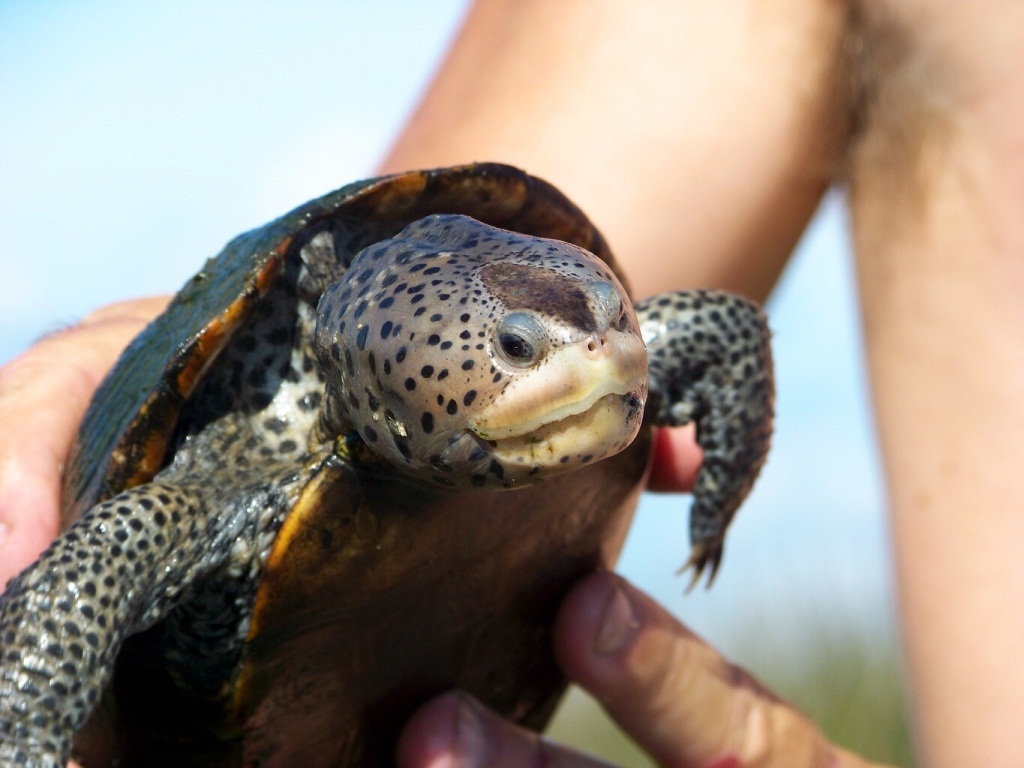
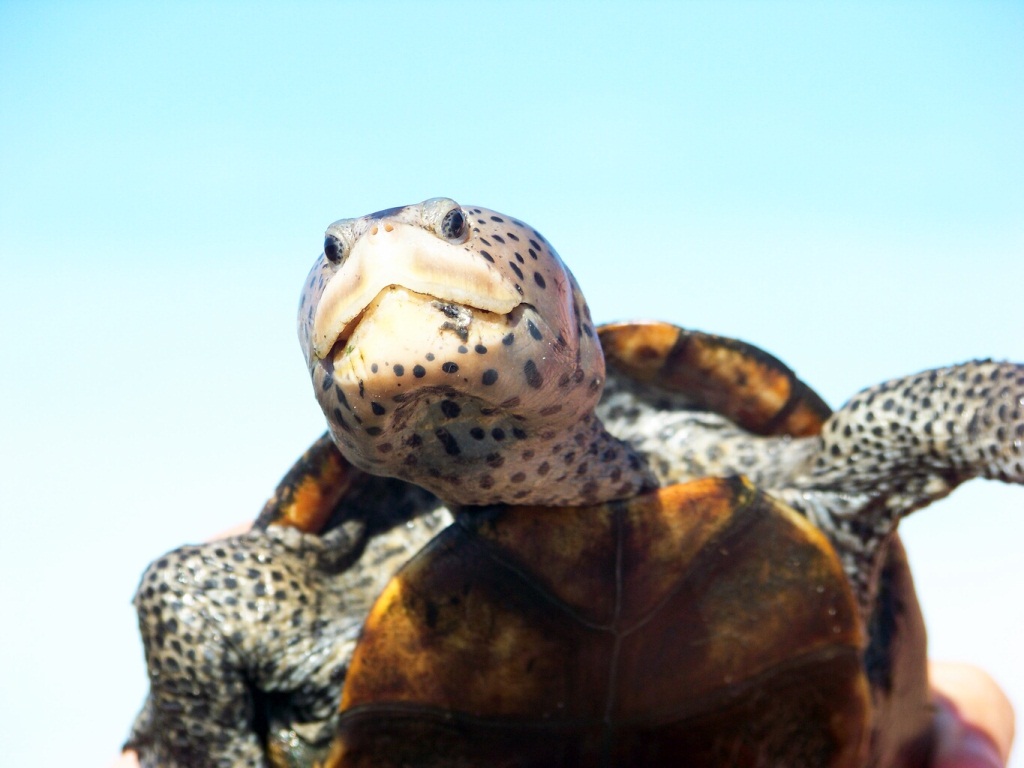
Female diamondback terrapin.
Photo: Rick O’Connor
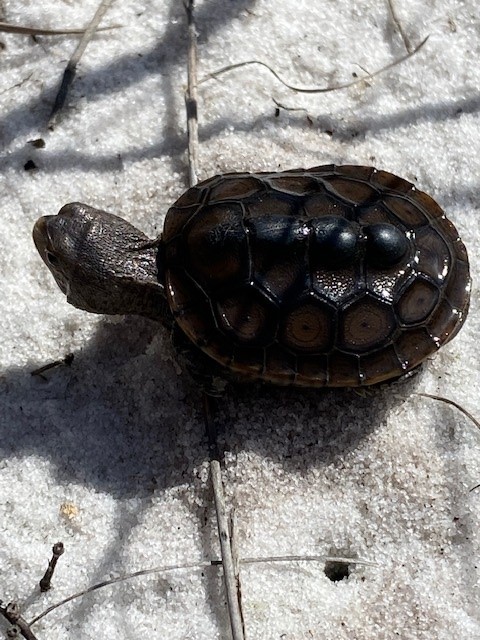
Terrapins have strong site fidelity, meaning they do not roam much, and spend most of their day basking in the sun and feeding on shellfish – marsh snails being a particular favorite. Like many species of turtle, they breed in the spring. Gravid females leave the marsh seeking high dry sandy beaches along the shores of the estuary to lay their eggs. Unlike sea turtles, she prefers to do this on sunny days – the sunnier the better. She typically lays between 7-10 eggs, and they hatch in about two months. The hatchlings spend their early months on shore, hiding under wrack and debris feeding on small invertebrates before heading to the marsh where the cycle begins again.
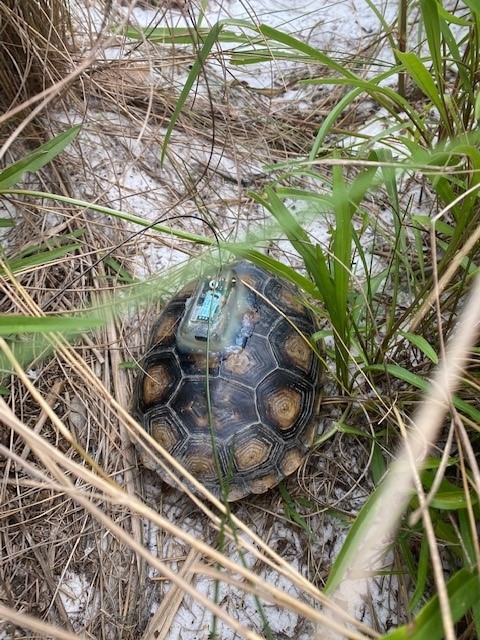
The project has three objectives each year. One, to survey known (primary) nesting beaches for nesting activity. The number of nests, tracks, and depredated nests can be used to calculate a relative abundance of these animals using those beaches. Two, survey potential (secondary) nesting beaches for any presence of nesting activity. Three, tag terrapins using the old notch method, PIT tags, and a small few with satellite tags. This will help us track terrapin movement and better understand how they use the habitat.
Since the project began, we have been able to verify at least one terrapin in each of the seven panhandle counties being surveyed and have identified nesting beaches in four of those. Relative abundance is rather low when compared to other regions within their range, but those beaches remain active.
The nesting season historically begins in late April and 2023 has been busy early. Seven hatchlings that overwintered in their 2022 nests emerged and were found by volunteers, and others. Two depredated nests were located, and one nesting female was captured and tagged. The volunteers will continue to survey the rest of the spring and much of the summer. Reports of these turtles are important in our assessment. If you believe you have seen a terrapin, contact Rick O’Connor – roc1@ufl.edu – (850) 475-5230 ext.1111. and let us know where.
Female terrapin fixed with a satellite tag for tracking.
Photo: Rick O’ConnorSmall terrapin hatchling released on Santa Rosa Island.
Photo: Rick O’Connor
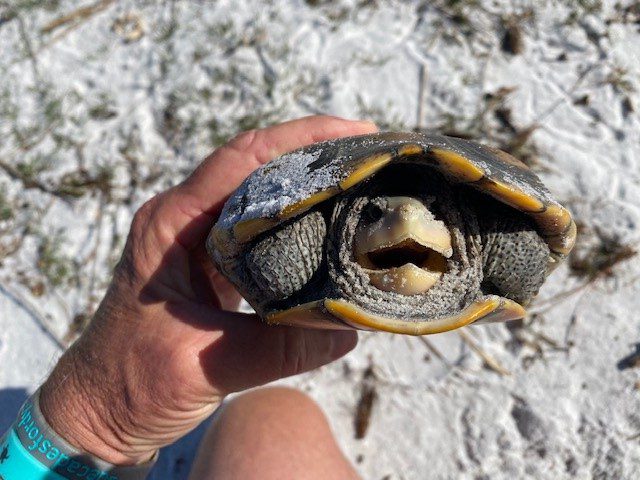
Since 2005 we have been tracking and monitoring diamondback terrapins in the Florida panhandle. For those of you who are not familiar with the animal, it is a turtle in the family Emydidae. Emydid turtles include what we call “pond turtles” and also include the box turtles. Terrapins differ from the others in that (a) their skin is much lighter, almost white, and (b) they like salt water – more accurately, they like brackish water.
Diamondback terrapin (photo: Molly O’Connor)
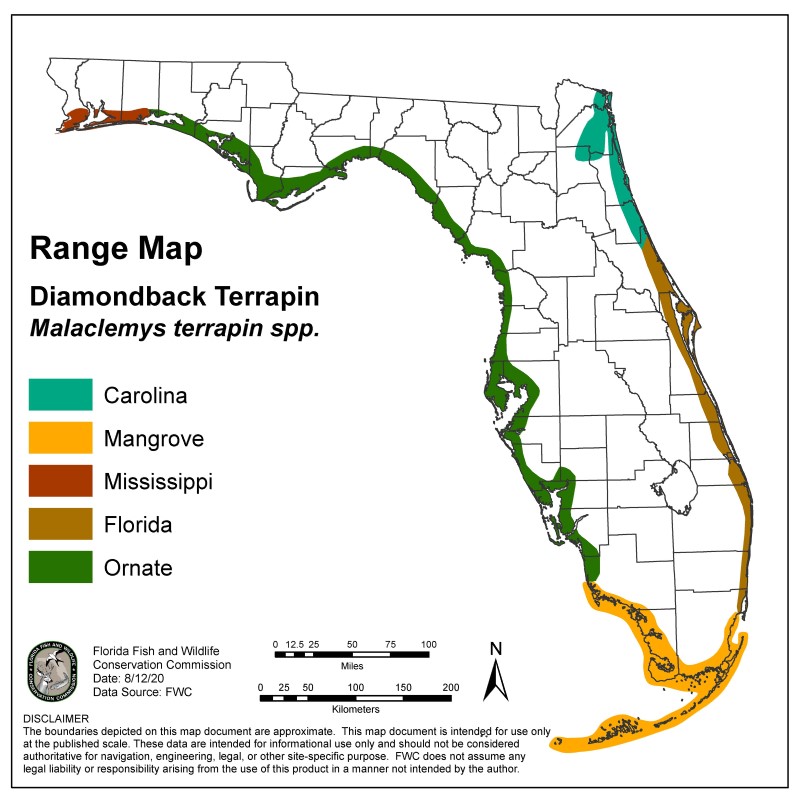
The animals range from Massachusetts to Texas and within this there are seven subspecies. Five of these live in Florida, and three only live in Florida. In the Florida panhandle we have two subspecies: the Ornate terrapin (Malaclemys terrapin macrospilota) and the Mississippi terrapin (M.t. pileata). It is believed the that the Mississippi terrapin only exist in Florida within Pensacola Bay – more on that in a moment.
Image provided by FWC
There are literally no peer reviewed publications on terrapins from the Florida panhandle… none. And this was how the Panhandle Terrapin Project began. The first objective for the project was to determine if terrapins even existed here. We began surveying for evidence of terrapins in 2005 using students from Washington High School in Pensacola. The project quickly fell to myself and my wife due to the best time to do terrapin surveys was May and June. And the worst time to work with high school students was May and June. Between 2005 and 2012 we were able to verify at least one terrapin record in each of the panhandle counties. Yes… terrapins exist in the Florida panhandle.
The second objective was to assess their population status. To do this we used what I call the Mann-Method. Tom Mann, Mississippi Department of Wildlife, had developed a method of using nesting surveys to estimate relative abundance of terrapins within a population. Terrapins tend to have strong site fidelity – they are “home bodies” – and do not move from marsh to marsh. If you can find their marsh, you can find their nesting beaches. If you can find their nesting beaches you can use the Mann-Method to assess their relative abundance.
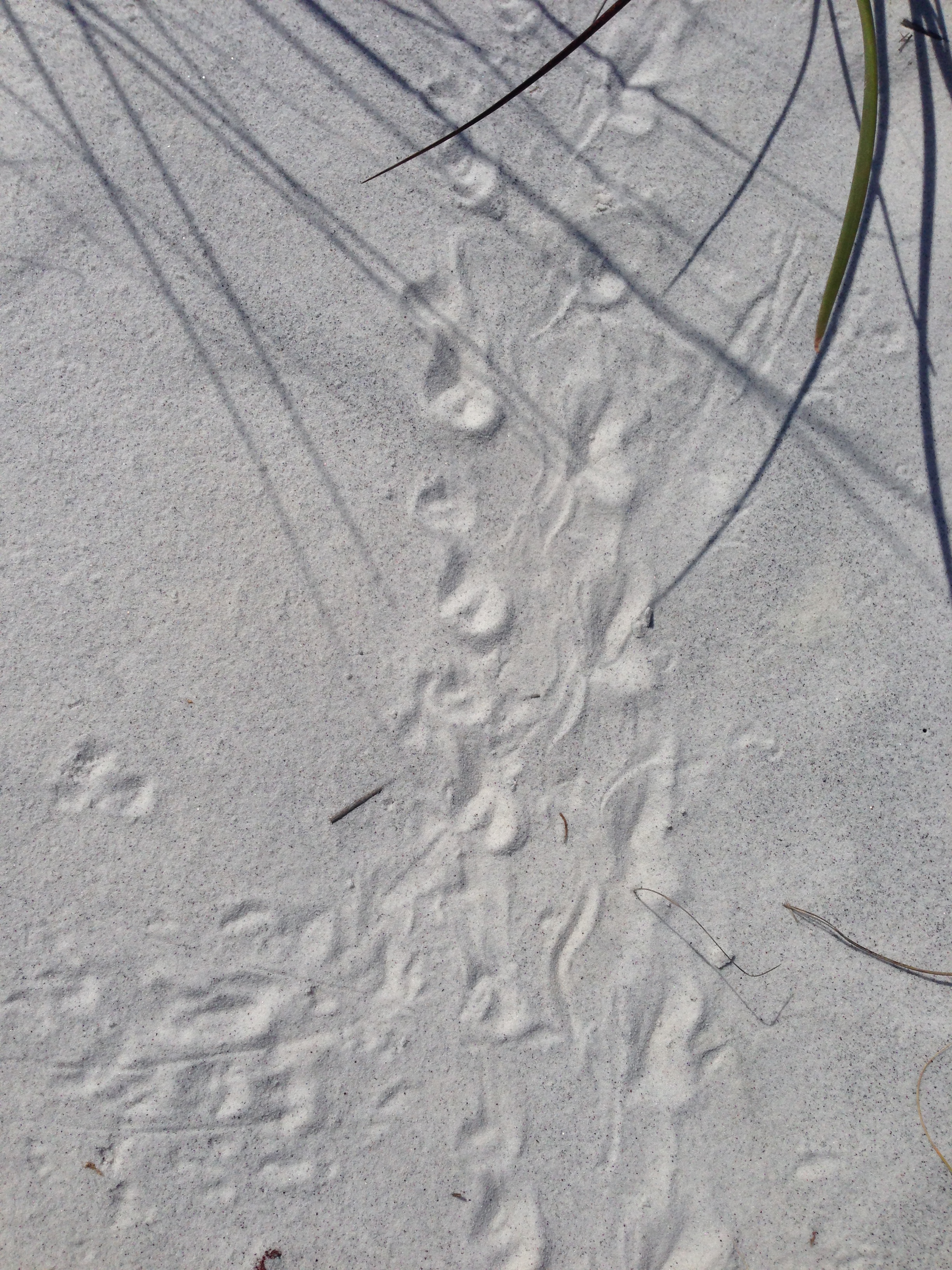
Tracks of a diamondback terrapin.
Photo: Terry Taylor
There are a couple of assumptions with the Mann-Method. (1) You are assuming every female in the population nest every year – we are not sure that is true. (2) You are assuming that each female will lay more than one clutch of eggs each season – we do believe this is true. (3) You are assuming that each female will not lay more than one clutch in a 16-day period – we are not sure this is true. (4) You know where all of the nesting beaches are – we are not sure we do. (5) The sex ratio of male to female is 1:1 – we are sure that is not the case. One study suggested that in the panhandle the ratio may be 1:3 in favor of males, another suggested 1:5 in favor of males.
Based off this model, and its assumptions, during a 16-day period of the nesting season, each track/nest would be an individual female. Using 1:1, 1:3, and 1:5 as your sex ratio you can get an estimate of relative abundance.
Another method for estimating relative abundance is counting the number of heads in a 30-minute period. It is understood that if I see different heads during periods of the survey, I may be seeing the same head, but the argument is that if I typically see 10-15 heads during a 30-minute and over time that becomes 15-20, or 20-25, the relative abundance of terrapins is increasing – and visa versa.
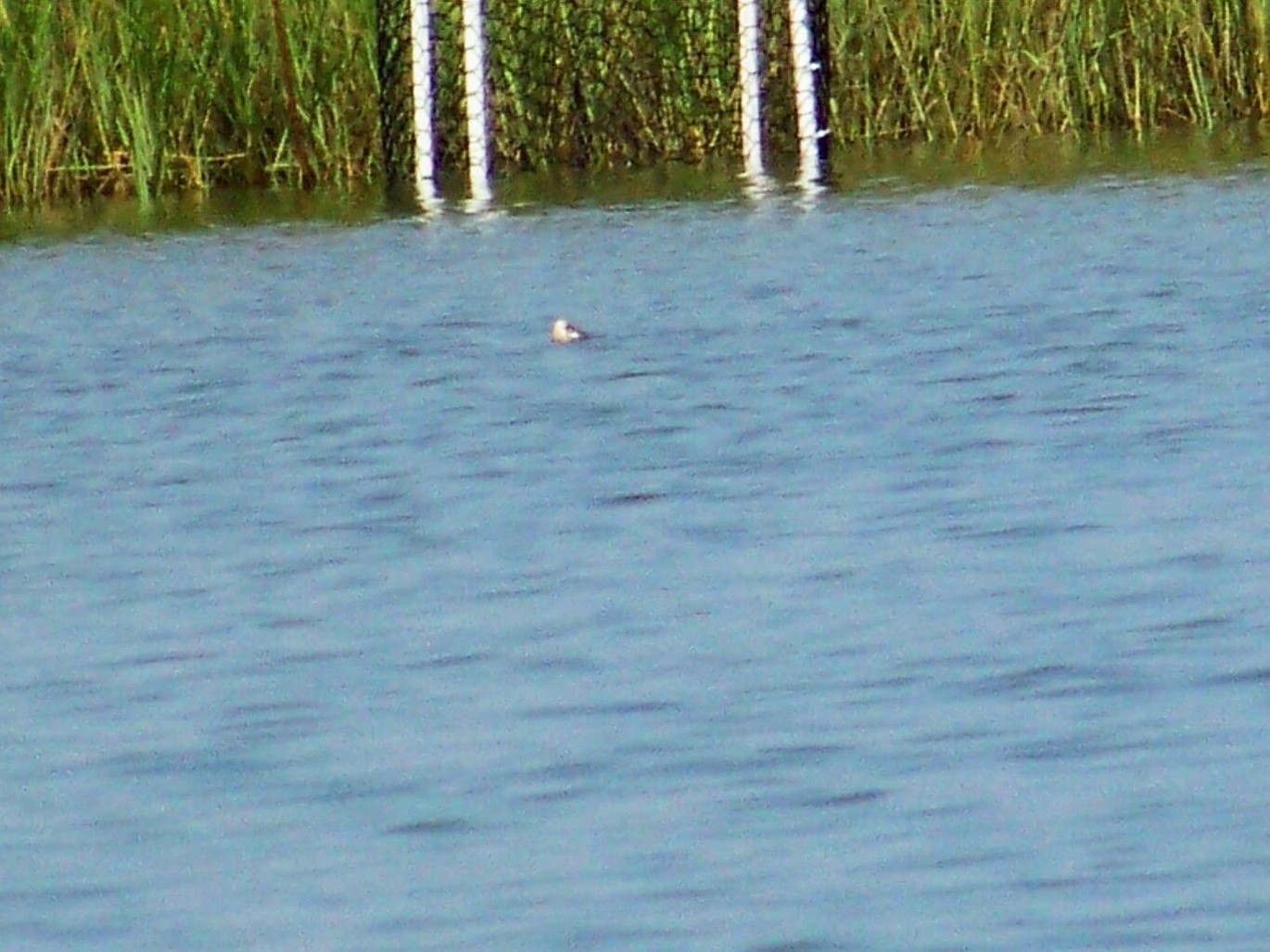
A terrapin swimming near but not entering a modified crab trap.
Photo: Molly O’Connor
And we now have a third and fourth objective. A third objective is to capture animals to place tags on them. Doing this can give us a better idea of how these terrapins are using the habitats in the panhandle, how far they may travel and how they are getting there. The fourth objective is to obtain tissue samples for genetic analysis. The purpose of this is to determine whether the populations in Pensacola Bay are Mississippi terrapins, Ornate terrapins, or hybrids of the two.
Since 2015 this work is now being conducted by trained volunteer citizen scientists – people like you – and we do the trainings in March if interested.
So… how did things go in 2022?
In 2022 we trained 47 volunteers to be survey beaches. 25 (53%) participated in at least one survey.
173 surveys were conducted between April 2 and July 31 at 14 nesting beaches between Escambia and Bay counties. Encounters with terrapins, or terrapin sign, occurred during 43 of the 173 surveys (25%) and three terrapins were captured for tissue and tagging.
Escambia County
Number of Surveys
Dates
Number of Surveys / Day
29
Apr 3 – Jul 31
0.2
Number of Encounters
Frequency of Encounters
Heads / 30-minutes
Estimated Relative Abundance
4
.18
No surveys conducted
4-12
Santa Rosa County
Number of Surveys
Dates
Number of Surveys / Day
58
Apr 4 – Jul 5
0.6
Number of Encounters
Frequency of Encounters
Heads / 30-minutes
Estimated Relative Abundance
15
.26
N=2, 0-49, X = 24
30-90
Okaloosa County
Number of Surveys
Dates
Number of Surveys / Day
43
Apr 18 – Jul 15
0.5
Number of Encounters
Frequency of Encounters
Heads / 30-minutes
Estimated Relative Abundance
25
.58
N=17, 0-32, X = 11
30-90
No surveys were conducted in Walton County
Bay County
Number of Surveys
Dates
Number of Surveys / Day
43
Apr 2 – Jun 30
0.5
Number of Encounters
Frequency of Encounters
Heads / 30-minutes
Estimated Relative Abundance
0
.00
No surveys conducted
0
Summary of 2022 Terrapin Season
Surveys of nesting beaches occurred in four of the five counties in the western panhandle.
Terrapins were encountered in each of these cand captured in two of them.
The relative abundance ranged between 0 (Bay County) to between 30-90 individuals (Santa Rosa and Okaloosa counties) and was about 64-192 animals for the entire western panhandle (depending on the sex ratio you use).
We are sure that we have not found all of the nesting beaches in this region and will continue to look for more.
We are awaiting results from the tissue sampling to determine whether we have a distinct population of Mississippi terrapins in Pensacola Bay, but more samples will be needed.
We need to place satellite tags on some females to get a better idea of how they travel through the system.
And our relative abundance numbers suggest that populations in the Florida panhandle are relatively small compared to others within the terrapin range.
More needs to be done and we will continue to survey each spring. If you are interested in becoming a member of the Panhandle Terrapin Project, contact me (Rick O’Connor) at roc1@ufl.edu.
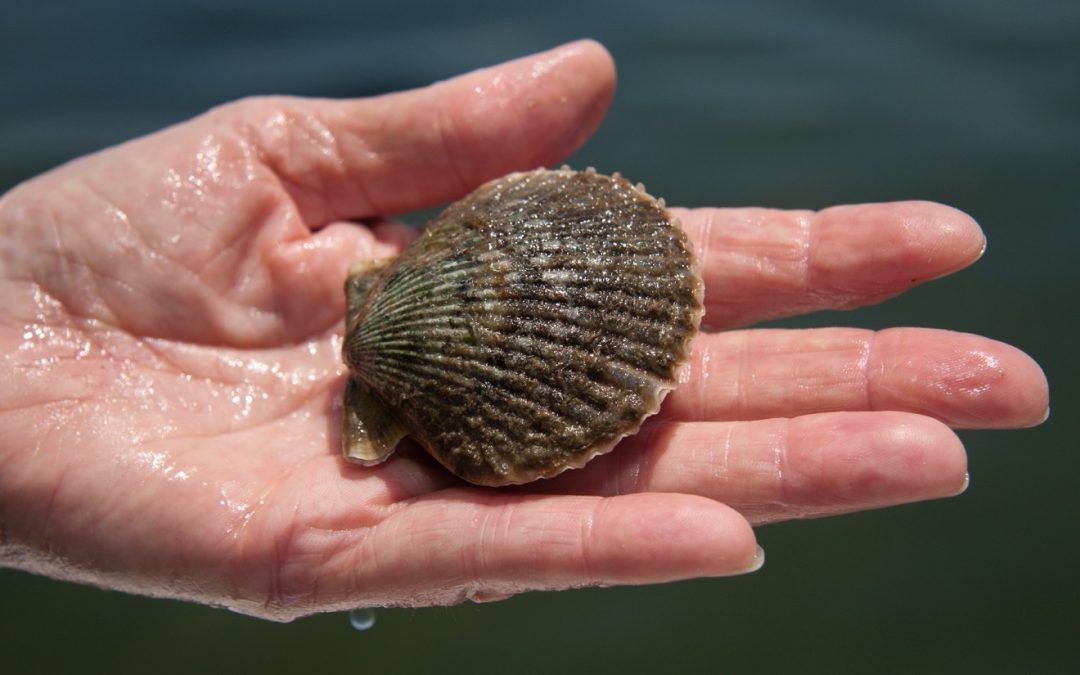
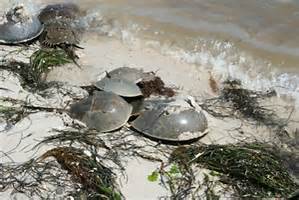
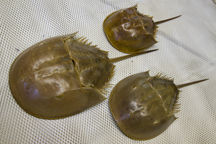
One of the programs I focus on as a Sea Grant Extension Agent in Escambia County is restoring the health of our estuary. One of the projects in that program is increasing the encounters with estuarine animals that were once common. Currently I am focused on horseshoe crabs, diamondback terrapins, and bay scallops. Horseshoe crabs and bay scallops were more common here 50 years ago. We are not sure how common diamondback terrapins were. We know they were once very common near Dauphin Island and are often found in the Big Bend area, but along the emerald coast we are not sure. That said, we would like to see all of them encountered more often.
Horseshoe crabs breeding on the beach. Photo: Florida Sea Grant
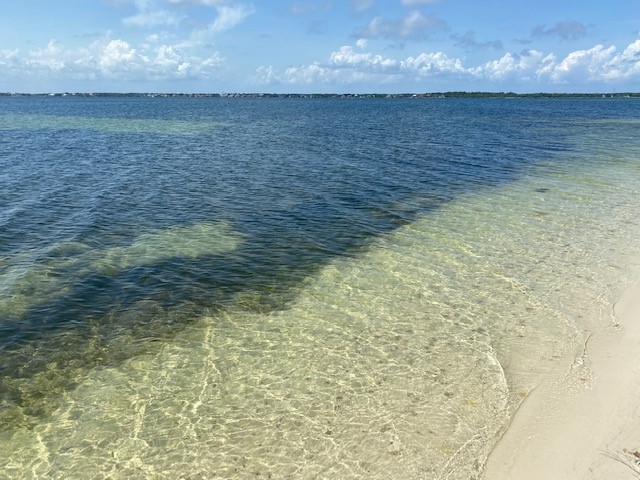
There are a variety of reasons why species decline in numbers, but habitat loss is one of the most common. Water quality declined significantly 50 years ago and certainly played a role in the decline of suitable habitat. The loss of seagrass certainly played a role in the decline of bay scallops, but overharvesting was an issue as well. In the Big Bend region to our east, horseshoe crabs are also common in seagrass beds and the decline of that habitat locally may have played a role in the decline of that animal in our bay system.
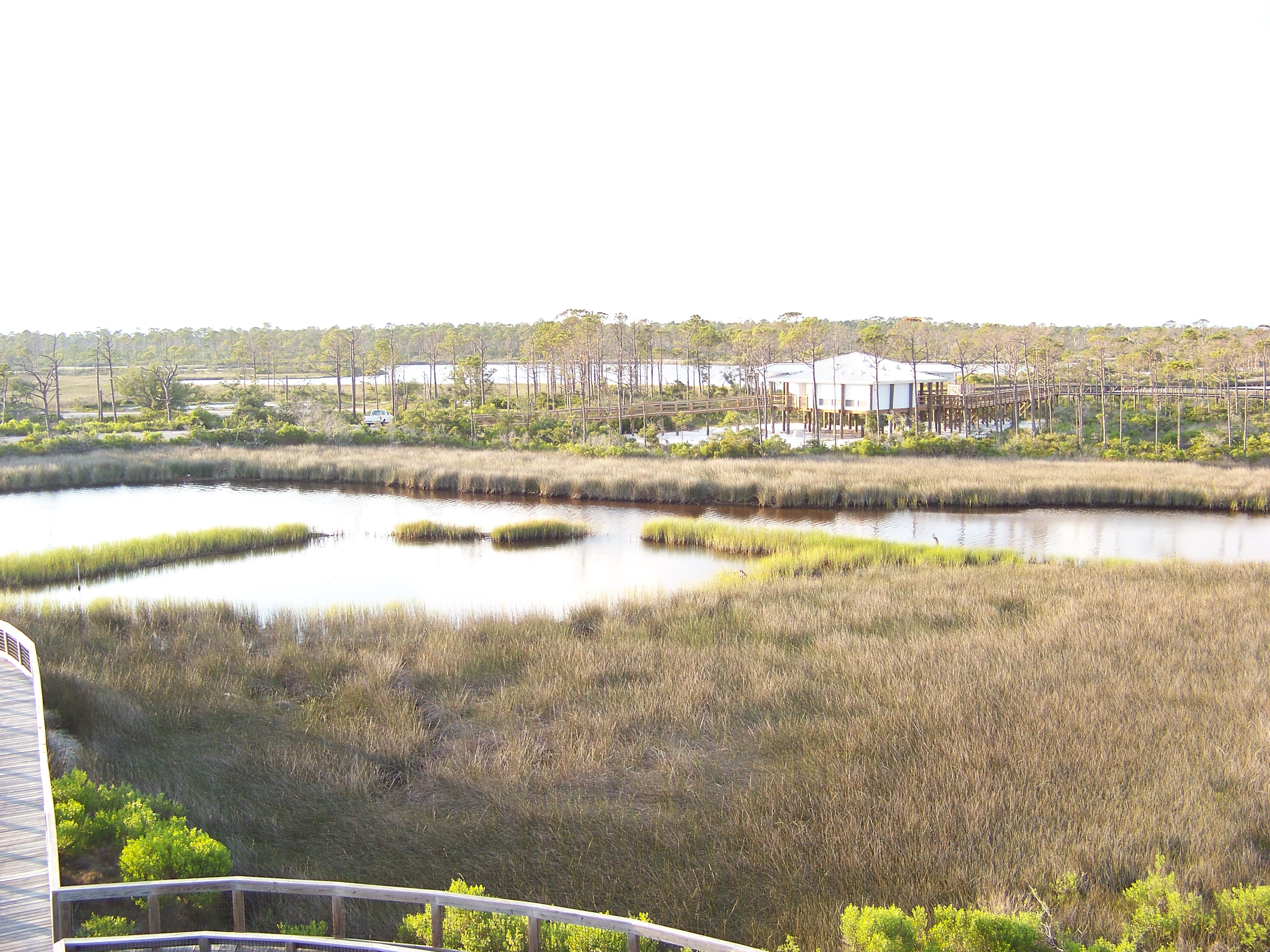
Salt marshes are what terrapins prefer. We have lost a lot of marsh due to coastal development. Unfortunately, marshes often exist where we would like houses, marinas, and restaurants. If the decline of these creatures in our bay is a sign of the declining health of the system, their return could be a sign that things are getting better.
Seagrass beds have declined over the last half century. Photo: Rick O’Connor
Salt marshes have declined due to impacts from coastal development. Photo: Molly O’Connor
For over 10 years we have been conducting citizen science monitoring programs to monitor the frequency of encounters of these creatures. All three are here but the increase in encounters has been slow. An interesting note was the fact that many locals had not heard of two of them. Very few knew what a horseshoe crab was when I began this project and even fewer had heard of a terrapin. Scallops are well known from the frequent trips locals make to the Big Bend area to harvest them (the only place in the state where it is legal to do so), but many of those were not aware that they were once harvested here.
I am encouraged when locals send me photos of either horseshoe crabs or their molts. It gives me hope that the animal is on the increase. Our citizen science project focuses on locating their nesting beaches, which we have not found yet, but it is still encouraging.
Volunteers surveying terrapin nesting beaches do find the turtles and most often sign that they have been nesting. The 2022 nesting season was particularly busy and, again, a good sign.
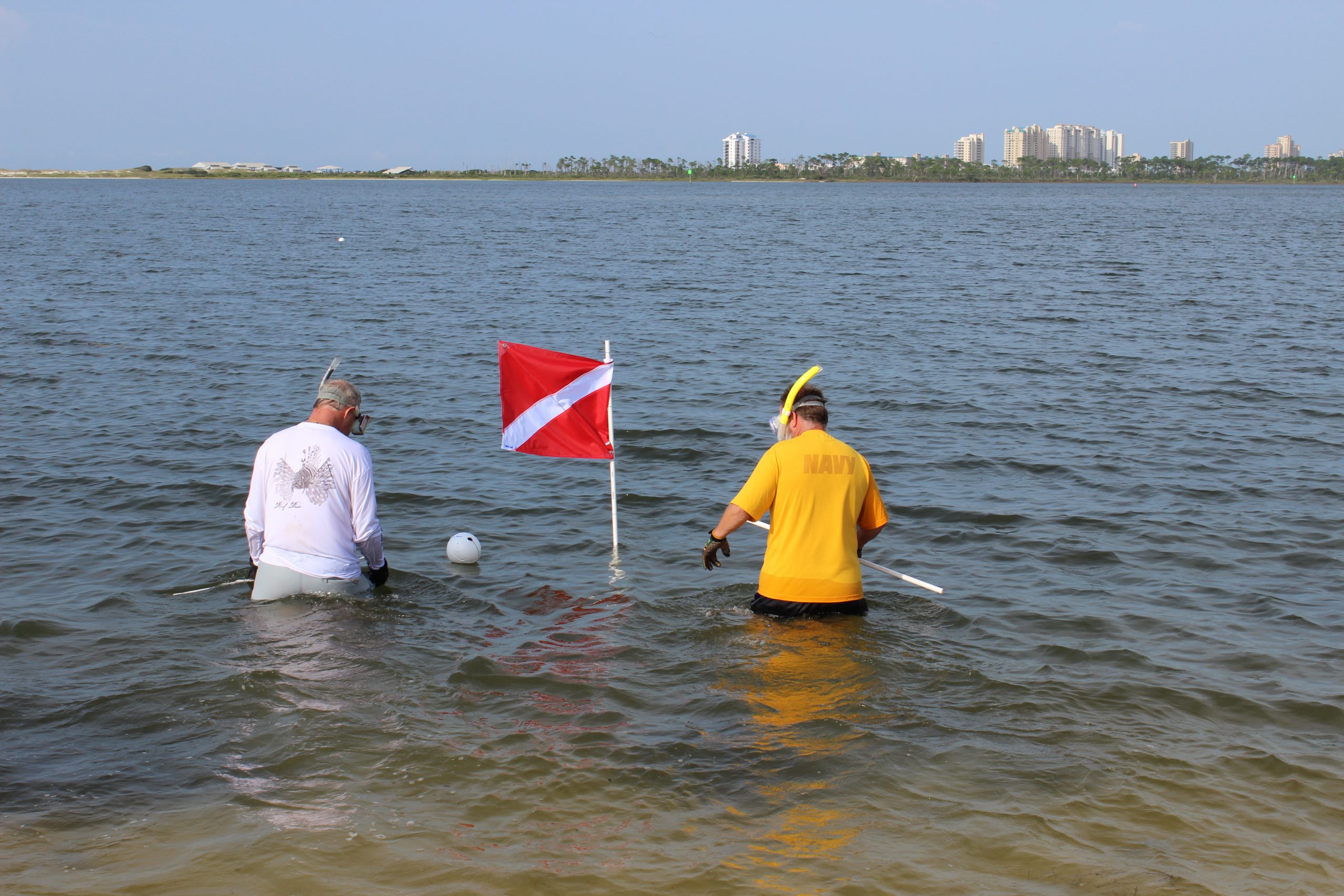
It is now time to do our annual Scallop Search. Each year we solicit volunteers to survey a search grid within either Big Lagoon or Santa Rosa Sound. Over the years the results of these surveys have not been as positive as the other two, but we do find them, and we will continue to search. If you are interested in participating in this year’s search, we will be conducting them during the last week of July. You can contact me at the Escambia County Extension Office (850-475-5230 ext.1111) or email roc1@ufl.edu or Chris Verlinde at the Santa Rosa County Extension Office (850-623-3868) or email chrismv@ufl.edu and we can set you up.
Bay scallops need turtle grass to survive. Photo: UF IFAS
Volunteers participating in the Great Scallop Search. Photo: Molly O’Connor
Final note…
Each June I camp out west somewhere and each year I look for those hard-to-find animals. After 10 years of looking for a mountain lion, I saw one this year. Finding these creatures can happen. Let’s hope encounters with all three become more common in our bay.