Versatile, easy-care, beautiful, native – what’s not to love about muhly grass?
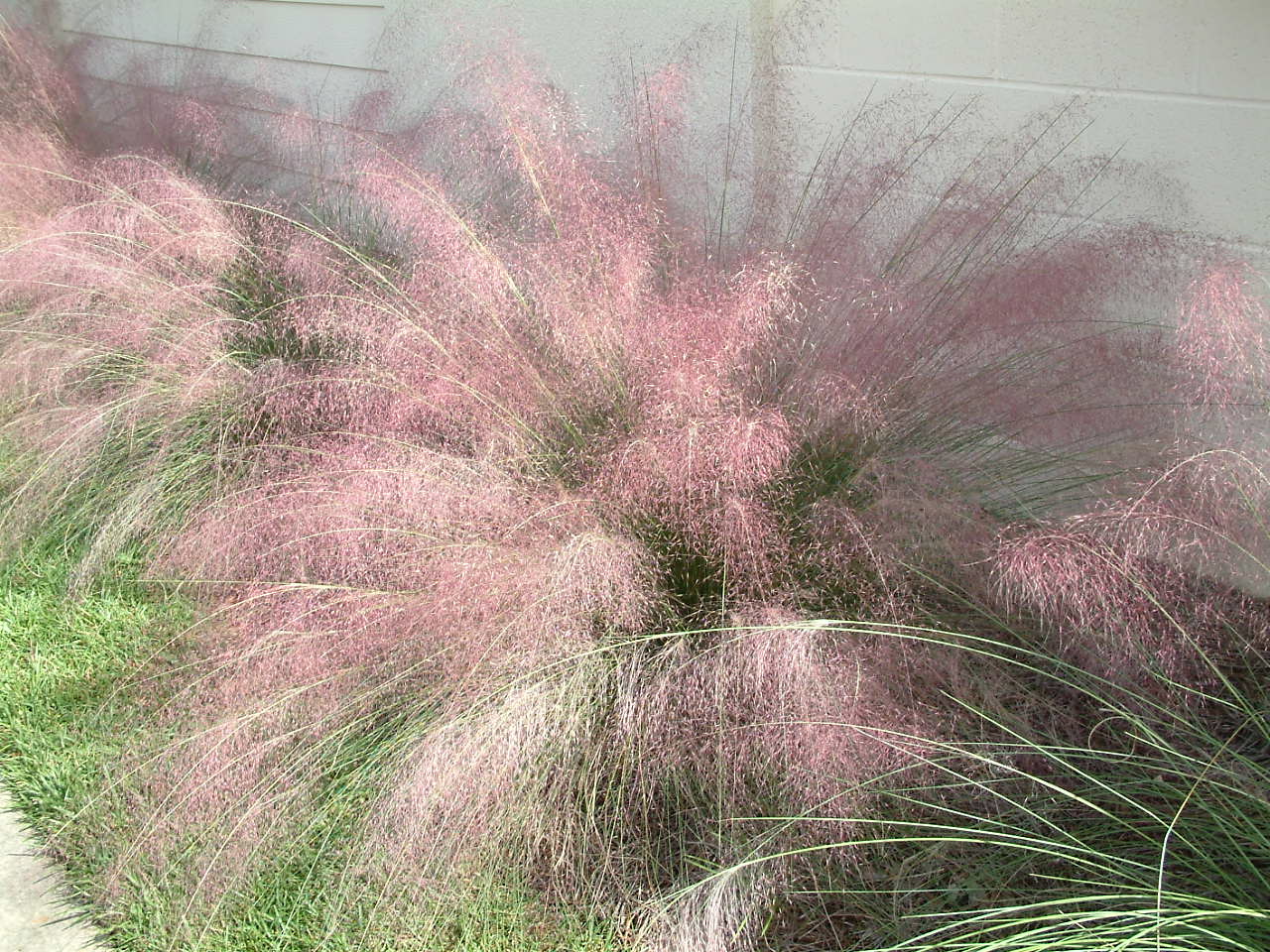
Muhly grass is a hardy landscape choice with dramatic fall blooms. Photo credit: Carrie Stevenson, UF IFAS Extension
How is it versatile? It makes a perfect border along a fence or structure. Plant it in a single or double row depending on available space. Use a single plant as a specimen in a smaller landscape. Muhly grass can also be planted in mass to serve as groundcover in a larger landscape.
What makes it easy-care? Since it only grows into a 3-foot-tall mound, there is no need to continually prune it as you would have to do for many landscape shrubs that serve a similar function. Plant muhly grass in areas where you only want to have plants grow to a 3-foot height, such as under windows or along a short fence. This clumping grass can be pruned in late winter to remove dead leaf blades, but it is not necessary. There are few pest and disease issues and its’ fertility needs are low. This tough plant can handle both drought and inundation with water. Perfect for a rain garden! Flowering is best in full sun, but it can take part sun as well.
What’s so beautiful about a grass? In the fall, abundant pink to pinkish/purple blooms cover the canopy of the grass and add color to the fall landscape. The wispy blooms move with the breezes and add interest with their movement. The new cultivar ‘Fast Forward’ blooms as early as August and into the winter. If pink is not your color, there is a form with white blooms known as ‘White Cloud’.
Consider adding some muhly grass to your landscape. You will love it as I do.
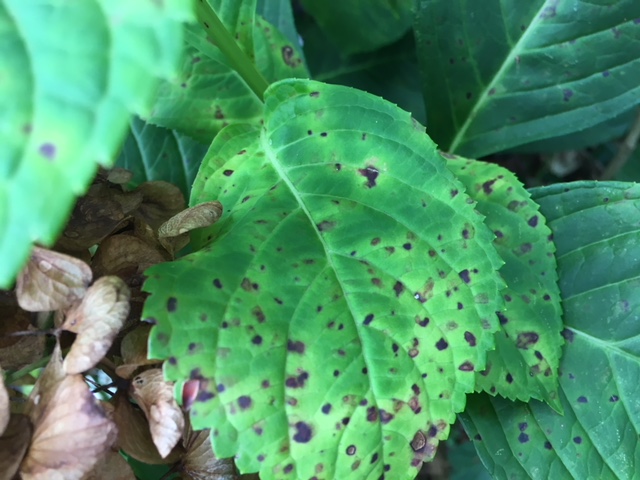
Hydrangea leaf spot disease Photo credit: Larry Williams
It is not uncommon to see leaf spots on your hydrangeas during late summer and fall.
These spots are caused by a number of fungal diseases. Plant fungi and wet weather go hand-in-hand. Florida’s high humidity, heavy dews and frequent rains during spring and summer provide perfect conditions to allow fungal diseases to flourish. Bacterial leaf spots can be part of this foliage disease mix, too.
Common foliage diseases seen on hydrangeas this time of year include Phyllosticta leaf spot, Target leaf spot, Bacterial leaf spot, Botrytis and Cercospora leaf spot.
These foliage diseases are the norm rather than the exception as we move into the wet summer months and on into fall. As a matter of fact, you would be hard-pressed to find any hydrangea in our area without some evidence of infection now.
This late in the year it is more of a “grin and bear it” problem. In other words, it’s too late to do much about the fact that your hydrangea plant has leaves covered in ugly spots. By now many of the infected leaves are turning brown, withering and dropping prematurely from the plant.
Cercospora leaf spot is one of the most common foliage diseases of hydrangeas. Along with most of the leaf spot diseases, it begins as small dark-colored specks on the leaves. The small specks generally go unnoticed. But as the spots continue to slowly enlarge, mostly maintaining a circular shape, they become more obvious. With heavy infection, individual spots can coalesce forming larger irregular shaped brown areas on individual leaves. The individual spots may have a purplish halo with gray center.
There are some fungicides that can help prevent these leaf spots. But you’d have to begin treatment early in spring before any leaf spots exist and spray the plant every 10 to 14 days during favorable disease development (humid, rainy weather), which is pretty much our spring and summer months. These types of diseases are prevented, not cured. That’s the “grin and bear it” part of waiting until now.
The fungus survives on infected leaves. So, the best thing to do now is to remove and dispose of infected leaves. Also, be careful to not wet the leaves when irrigating the plants during the growing season.
New leaves of spring should be spot/disease free as they emerge. But the cycle of life for these leaf spot diseases will again result in spotted/diseased leaves on your hydrangeas next summer and fall without persistent treatment.
The good news is that these leaf spot diseases normally do not cause permanent/long-term damage for hydrangeas. They just make the plant look ugly.
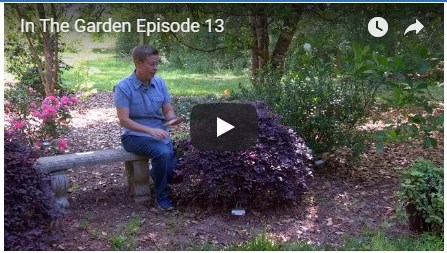
A very popular landscape shrub installed by both professionals and homeowners is Loropetalum or Chinese fringe. This shrub offers attractive foliage and flowers along with being evergreen.
When you visit a nursery to select this plant for your landscape, realize that there are now many selections of Loropetalum available. Learn about a few of the common selections in this recording of ‘In the Garden’, with UF/ IFAS Extension Escambia County Horticulture Agent Beth Bolles, so that you are successful at matching the appropriate plant with your landscape needs.
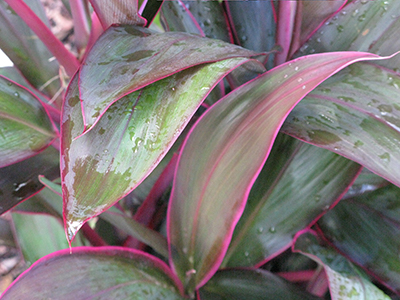
Too often, would be gardeners travel to exotic locales, become intoxicated with the beautiful floral display of Plumeria, Jatropha, Bird of Paradise and Bougainvillea, and come home with visions of homemade leis picked from the garden dancing in their heads. As anyone who has attempted to grow any of the aforementioned plants in the Panhandle will tell you though, fulfilling those visions in the landscape are easier said than done! However, not all is lost for the gardener wanting to bring the tropics home. A tropical feel in the landscape can be achieved, you just have to look beyond the aforementioned flowering plants that will have long since succumbed to winter frost by the time they mature and begin flowering and instead to tropical foliage plants that can be enjoyed for a season and easily (cheaply too!) replaced the following spring. Of all the tropical foliage options available for Panhandle landscapes, my favorite is the Ti Plant, sometimes called Hawaiian Ti.
Ti Plant foliage
Even if you have never heard of Ti, you have probably seen it. The strap like, 12-18” long, purple and pink striped leaves are hard to miss and add an unmistakable tropical flair in the landscape! Ti Plants grow generally in single, unbranched stalks, though most commercial growers combine several plants into a single pot to give a bushy, multi trunked appearance that looks more appealing on a retail nursery bench. These plants will easily reach 4-6’ in height in a single warm season, providing a powerful punch of pink/purple all summer long. In addition to its considerable attractiveness, Ti boasts a cosmopolitan constitution, as it will grow in sun or shade, outside or inside. Of course, some cultural do’s apply to Ti broadly, regardless of where it is grown, as well as a few don’ts.
In general, Ti will be more colorful in brighter light. Though it grows well in shade, its leaves tend to lose their luster and fade to a dull purple in full shade. Similarly, though it will survive in full, all day sun, Ti’s foliage tends to bleach a bit in these conditions and can turn a whitish gray. It is best to shoot for somewhere in the middle for the most vivid foliage color. If growing indoors, give Ti as much light as you can. If growing outdoors, full sun through midafternoon is appropriate, as is bright shade throughout the day. Be sure to give Ti plants consistent moisture, as they will readily wilt down under prolonged drought conditions. As with watering, Ti prefers a consistently fertile soil and will appreciate a topdressing of a complete, slow release fertilizer (made by Osmocote, Harrell’s and others) at planting, with a follow up application 60-90 days later (possibly more frequently depending on temperature and frequency of watering).
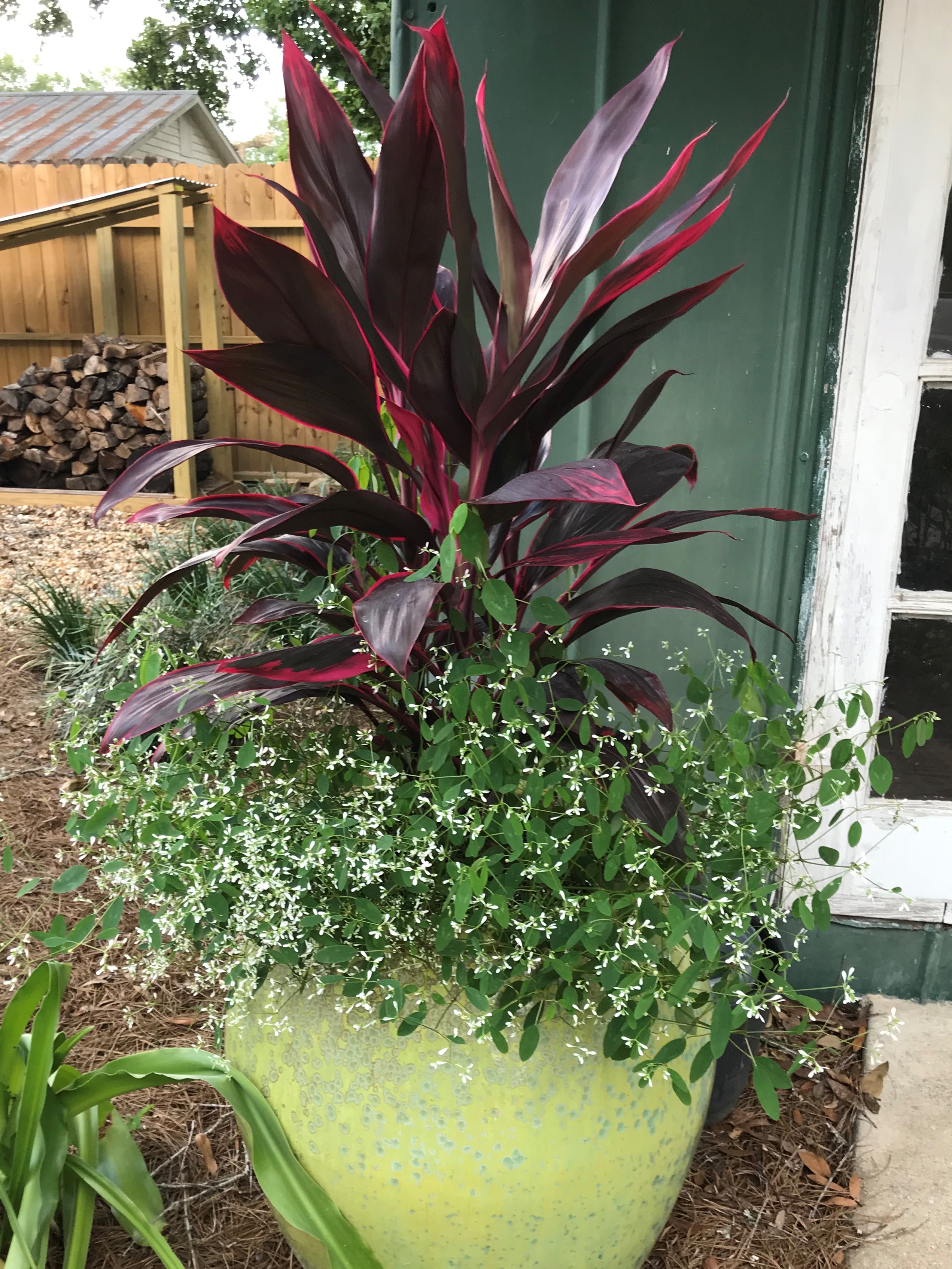
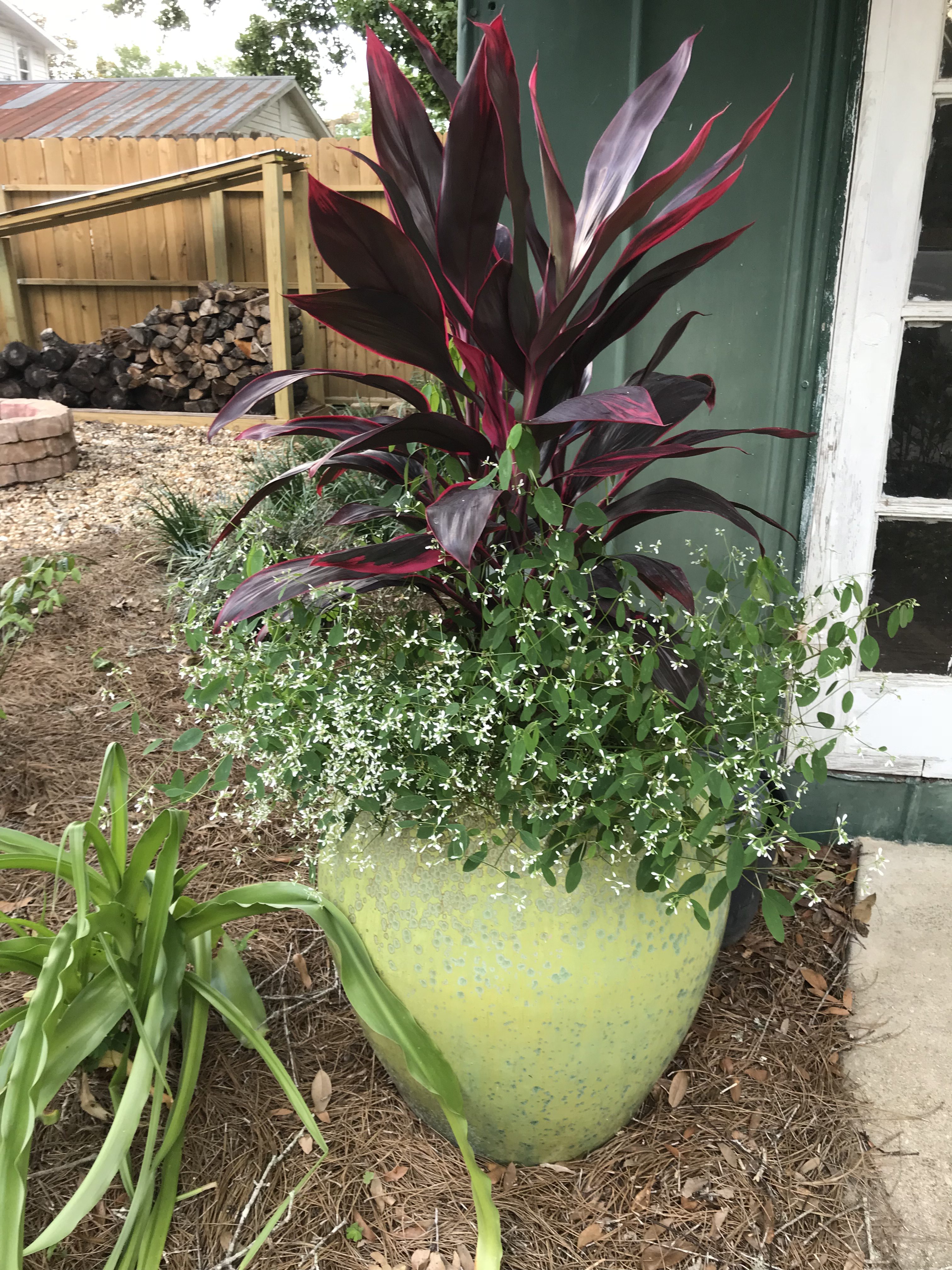
Ti plant in a mixed container – Photo Courtesy Daniel Leonard
Though Ti performs well planted in the ground in Northwest Florida as an annual specimen to brighten a border (think of it like a supersized Coleus), it really gets to shine in large, mixed containers. Ti’s upright growth habit and traffic stopping color make it the perfect thriller in the widely used “thriller, filler, spiller” container design. Because Ti can grow quite large relative to other common container plants, a large 20-45 gallon container is necessary to facilitate optimum root growth and plant development. If a smaller container is chosen, water management will become an issue as the Ti plant’s root mass will quickly crowd the container. I prefer glazed ceramic or concrete containers as these are often painted in bright colors that complement Ti’s foliage, do not allow as much air exchange as terra cotta planters (soil in terra cotta containers dry very quickly in hot, dry weather), and are heavy enough that tall Ti plants won’t cause them to blow over in windy conditions. Mix smaller, mounding filler plants and trailing spiller plants under and around Ti in containers. For a striking contrast in color, choose companion plants in white, yellow, orange or chartreuse (remember, plants don’t have to flower to be colorful, vivid foliage plants like coleus or caladium work too!).
Regardless of how you use Ti Plant, you’ll find it to be one of the most high value color plants in the landscape. Plant one today and happy gardening!
National Pollinator Week is only recognized in June, but efforts to encourage pollinators shouldn’t end then.
Pollination occurs when pollen grains are moved between two flowers of the same species, or within a single flower, by wind or animals that are pollinators. Successful pollination, which may require visits by multiple pollinators to a single flower, results in healthy fruit and fertile seeds, allowing plants to reproduce. Without pollinators, we simply wouldn’t have many crops!
Worldwide, approximately 1,000 plants grown for food, beverages, fibers, spices, and medicines need to be pollinated by animals in order to produce the goods on which we depend. Foods and beverages produced with the help of pollinators include blueberries, chocolate, coffee, melons, peaches, pumpkins, vanilla, and almonds.
About 75% of all flowering plants rely on animal pollinators and over 200,000 species of animals act as pollinators. Of those, about 1,000 are hummingbirds, bats, and small mammals. The rest are insects such as beetles, bees, ants, wasps, butterflies, and moths. Western honey bees are the most common.
Most species of bees don’t sting. Although all female bees are physically capable of stinging, most bee species native to the U.S. are “solitary bees,” that is, not living in colonies and don’t sting unless they are physically threatened or injured. Only honey bees are defensive and may chase someone who disturbs their hive.
It is wise, though, to avoid disturbing any bee or insect nest.
What everyone can do for pollinators:
Watch for pollinators. Get connected with nature. Take a walk, experience the landscape and look for pollinators which are most active midday in sunny, planted areas.
Reduce your impact. Reduce or eliminate your pesticide use, increase green spaces, and minimize impervious surfaces.
What you can do to create a pollinator-friendly habitat:
Design your garden so that there is a continuous succession of plants flowering from spring through fall. Check for the species or cultivars best suited to your area.
Plant native to your region using plants that provide nectar for adults plus food for insect larvae, such as milkweed for monarchs. If you do use non-native plants, choose ones that don’t spread easily, since these could become invasive.
Select old-fashioned varieties of flowers whenever possible because breeding has caused some modern blooms to lose their fragrance and/or the nectar/pollen needed to attract and feed pollinators.
Avoid pesticides, even so-called “natural” ones such as Bacillus thuringiensis (Bt). If you must use them, use the most selective and least toxic ones and apply them at night when most pollinators aren’t active.
Supply water for all wildlife. A dripping faucet or a suspended container with a pinhole in the bottom is sufficient for some insects. Other wildlife need a small dish of water.
Provide water for butterflies without letting it become a mosquito breeding area. Refill containers daily or bury a shallow plant saucer to its rim in a sunny area, fill it with coarse pine bark, sand or stones and fill to overflowing with water.
Fun facts:
A tiny fly (a “midge”) no bigger than a pinhead is responsible for the world’s supply of chocolate
One out of every three mouthfuls of food we eat is delivered to us by pollinators.
It’s that time of year. School is out, hurricane season is in, and the mercury is up! Gardens wilt by midday and gardeners retreat into the air conditioning long before then. Unless you have your toes in the water on one of Northwest Florida’s beautiful beaches, it can be a miserable time to be a Floridian, for plants and people! However, despite the relentless heat and blistering sunshine, low-maintenance, eye-catching color can still be had in the landscape. When the calendar flips to June, I turn to my two favorite Florida-Friendly annuals to do the heavy lifting in my landscape: ‘Diamond Frost’ Euphorbia, and the ‘Cora’ Vinca series.
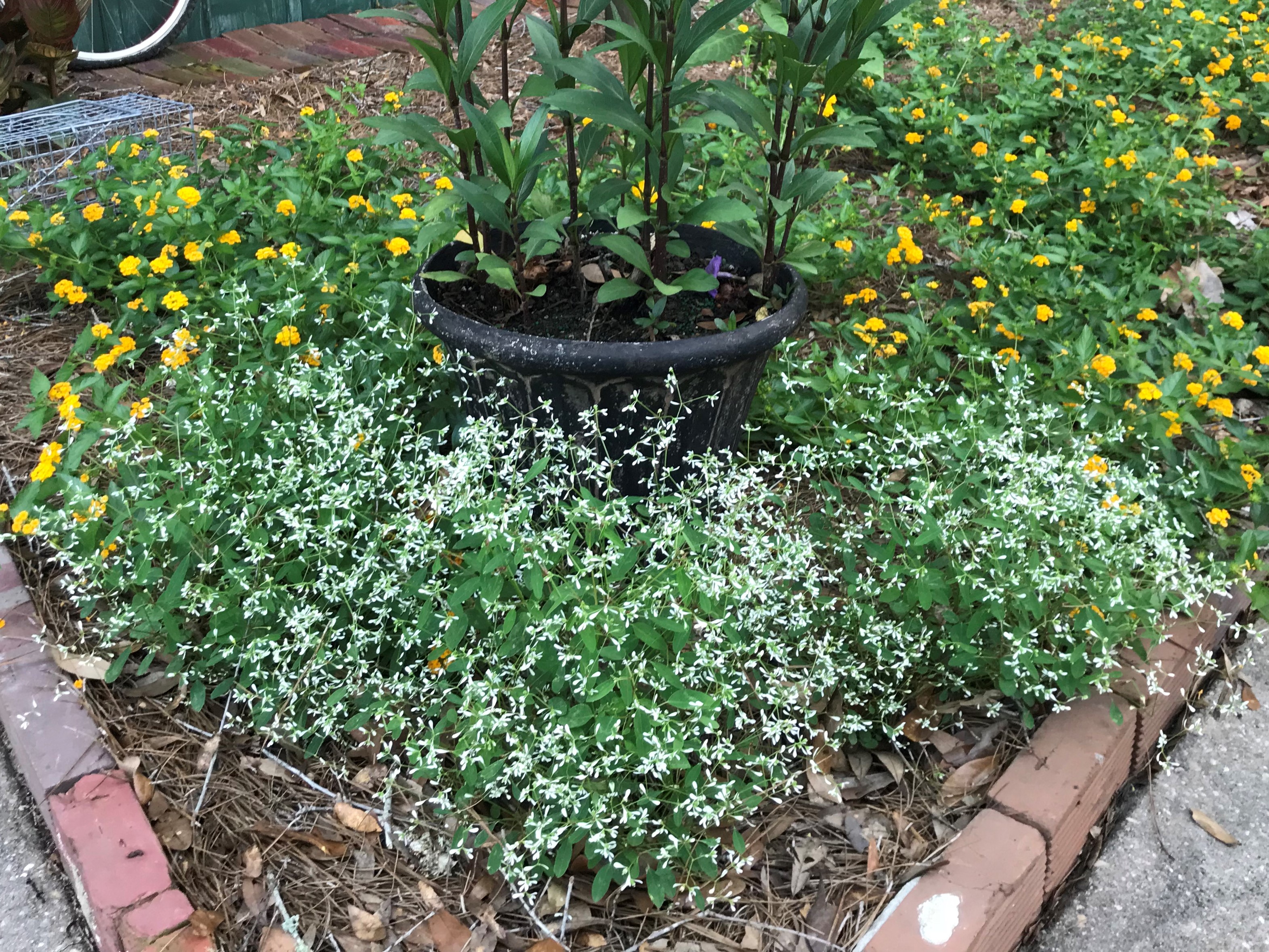
‘Diamond Frost’ Euphorbia – Photo Courtesy Daniel Leonard
A relative newcomer to landscapes, the award winning ‘Diamond Frost’ Euphorbia is an amazing introduction from Proven Winners. The ultimate in tough, ‘Diamond Frost’ does great both as a mounding accent in a container or as a standalone bedding plant in the landscape. Though its individual, teardrop-shaped, white flowers are tiny, the hundreds of them that open each day really pack a floral punch in the landscape! One caveat: if planting in the landscape, I find ‘Diamond Frost’ to be most effective massed in groups of three or more. Due to the daintiness of the flowers, a single plant can get lost among other garden inhabitants. However, when done right, ‘Diamond Frost’ is a proven winner in any landscape!
Mixed container featuring ‘Diamond Frost’ Euphorbia – Photo Courtesy Daniel Leonard
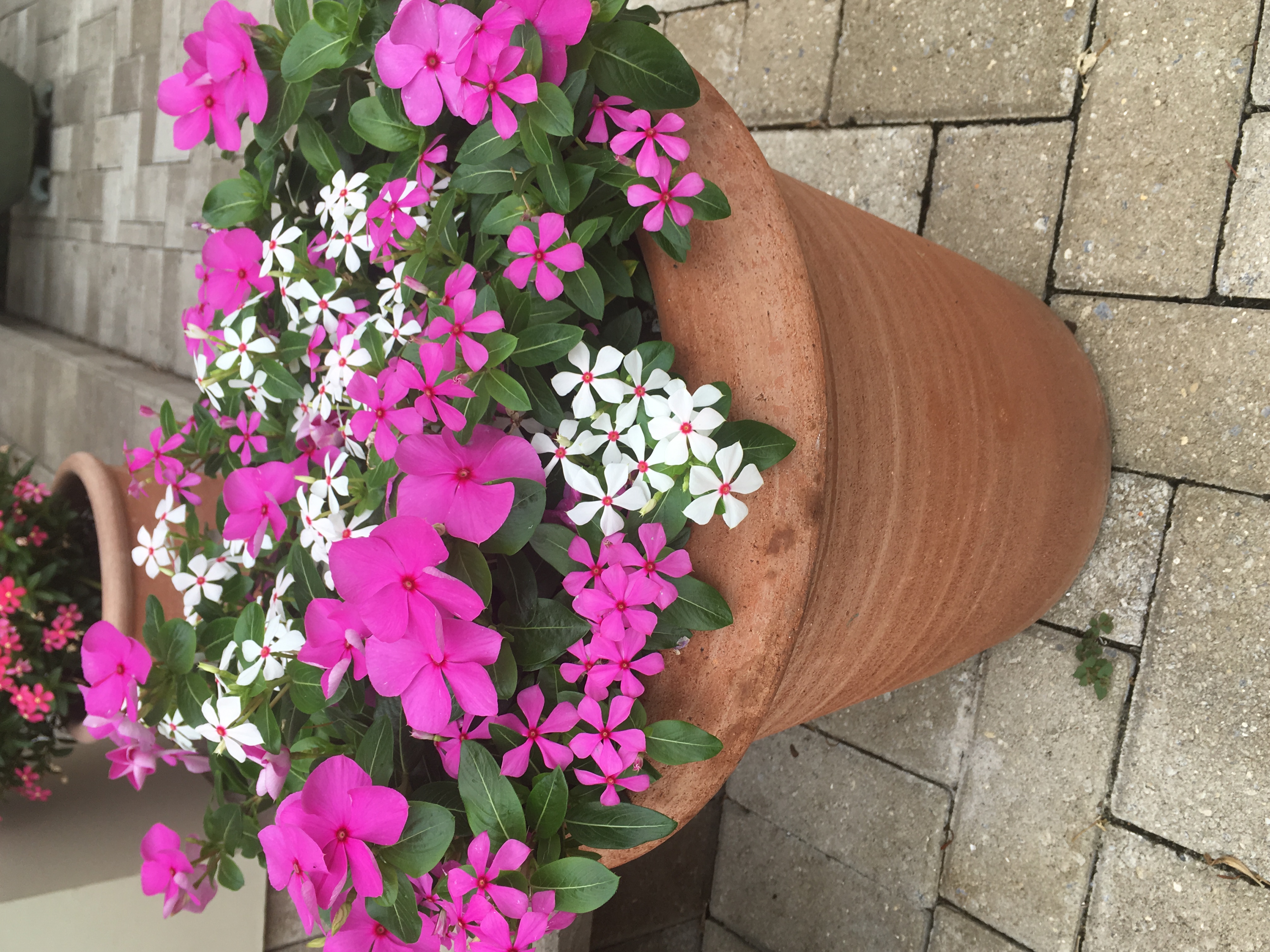
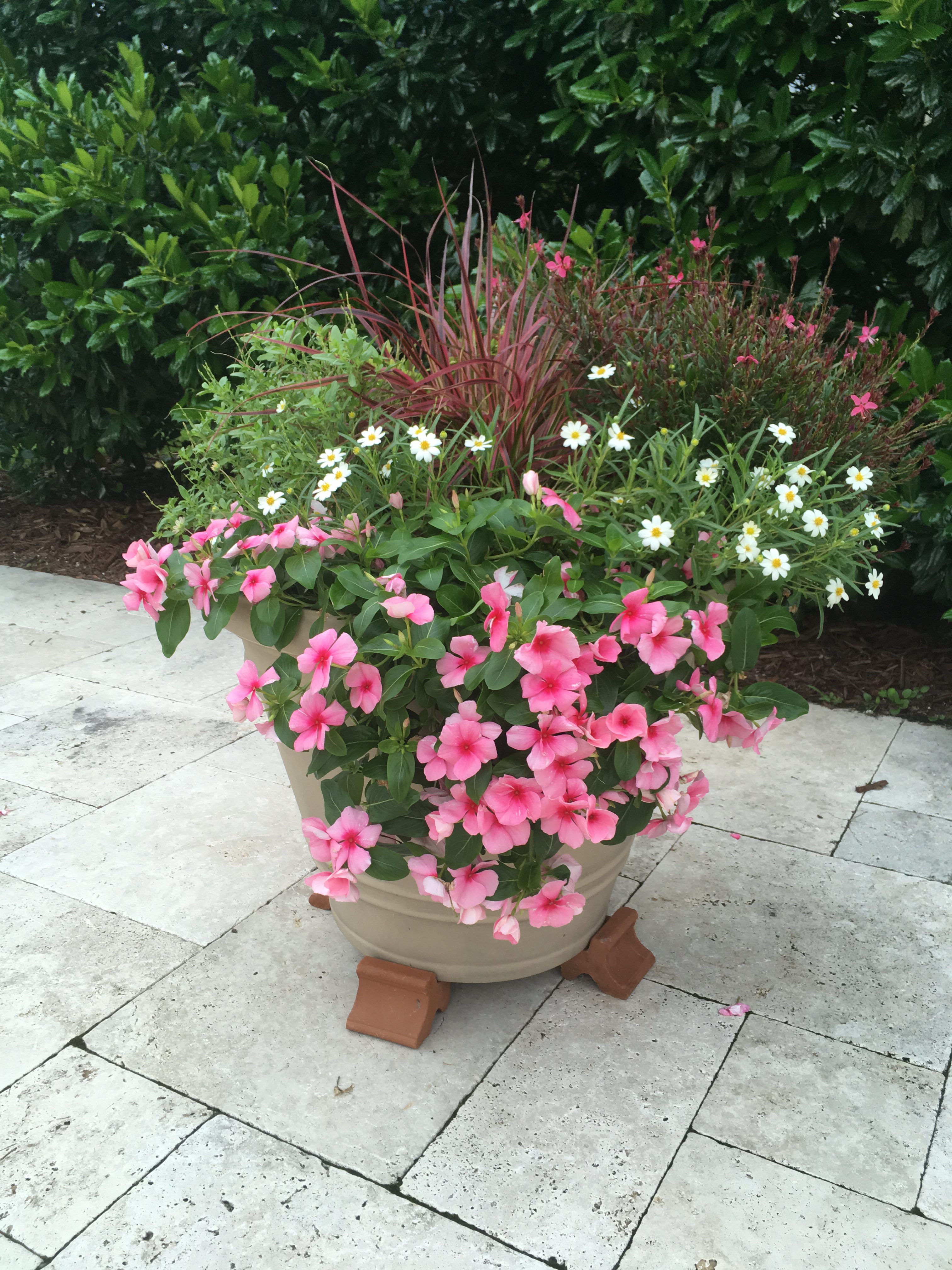
Next, the ‘Cora’ series of Vinca (Catharanthus roseus), also introduced by Proven Winners, is an improvement on an old favorite. Note: This species is also, on occasion, called Periwinkle. However, do not confuse it with the spreading, purple-flowered, perennial groundcover of the same common name! Gardeners in the South have been growing Vincas for years. This species is unbelievably tolerant of harsh conditions, sometimes even seen growing in sidewalk cracks! However, the unimproved species had an Achilles heel: susceptibility to Phytophthora, a devastating fungal rot disease. ‘Cora’ overcomes this issue and is as close to a perfect bedding annual as you’re likely to find. The ‘Cora’ series is composed of cultivars with pinwheel-shaped white, pink and lavender flowers, a color for everyone! The kind (and clever) marketing folks at Proven Winners have even made ‘Cora’ easy to spot on retail nursery benches; just look for the plants in the hot pink containers!
‘Cora’ Vinca Photo: Andrea Schnapp
Both of the above-described plants are extremely undemanding of gardeners. Once established, little is required in the way of irrigation and fertilization. To ensure success, water daily for the first week after planting, back off to a couple of times per week for the next two weeks or so and then watch ‘Diamond Frost’ and ‘Cora’ thrive with only rainfall for the rest of the summer! Keep in mind, during periods of excessive drought, supplemental watering may be required to keep any plant, even drought tolerant ones, looking their best! To meet the minimal nutrition demands of these plants, I incorporate a quality, slow-release fertilizer (for example, Osmocote, Harrell’s Polyon, or any other similar product) at planting. These products last two or three months in our rainy, hot, humid climate and generally need a second application accordingly for full-season performance. ‘Diamond Frost’ Euphorbia and ‘Cora’ Vinca also require full, blazing sun for maximum floral performance. Don’t be shy about siting them in harsh, sunny places, even a few hours of shade tend to make leggier plants that flower less!
Mixed container with ‘Cora’ Vinca accent Photo: Andrea Schnapp
When you need low-maintenance, season long color that can beat the heat, look for ‘Diamond Frost’ Euphorbia and the ‘Cora’ series of Vinca at your local nursery! Stay cool out there folks and happy gardening!