Talking about a live oak might bring to mind pictures of grand, old, stately trees, limbs dripping with Spanish moss. The Southern live oak is a staple of the coastal south, but it prefers to live inland from our beaches. It leaves the salt-sprayed beach sand to its cousin, the sand live oak.
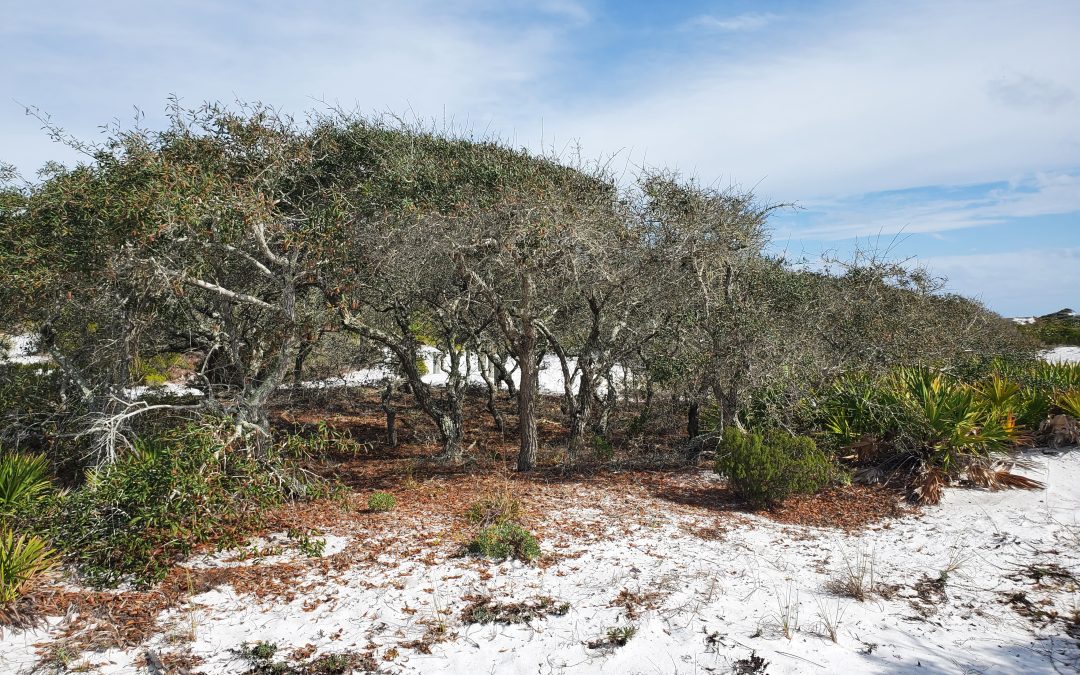
A grove of sand live oak trees.
Sand live oak can potentially grow as tall as its relative, but is rarely seen reaching such heights. Growing on beach dunes, it is constantly pruned back by the wind and sometimes remains as a low shrub. When given some relief from the elements, it will happily grow taller.
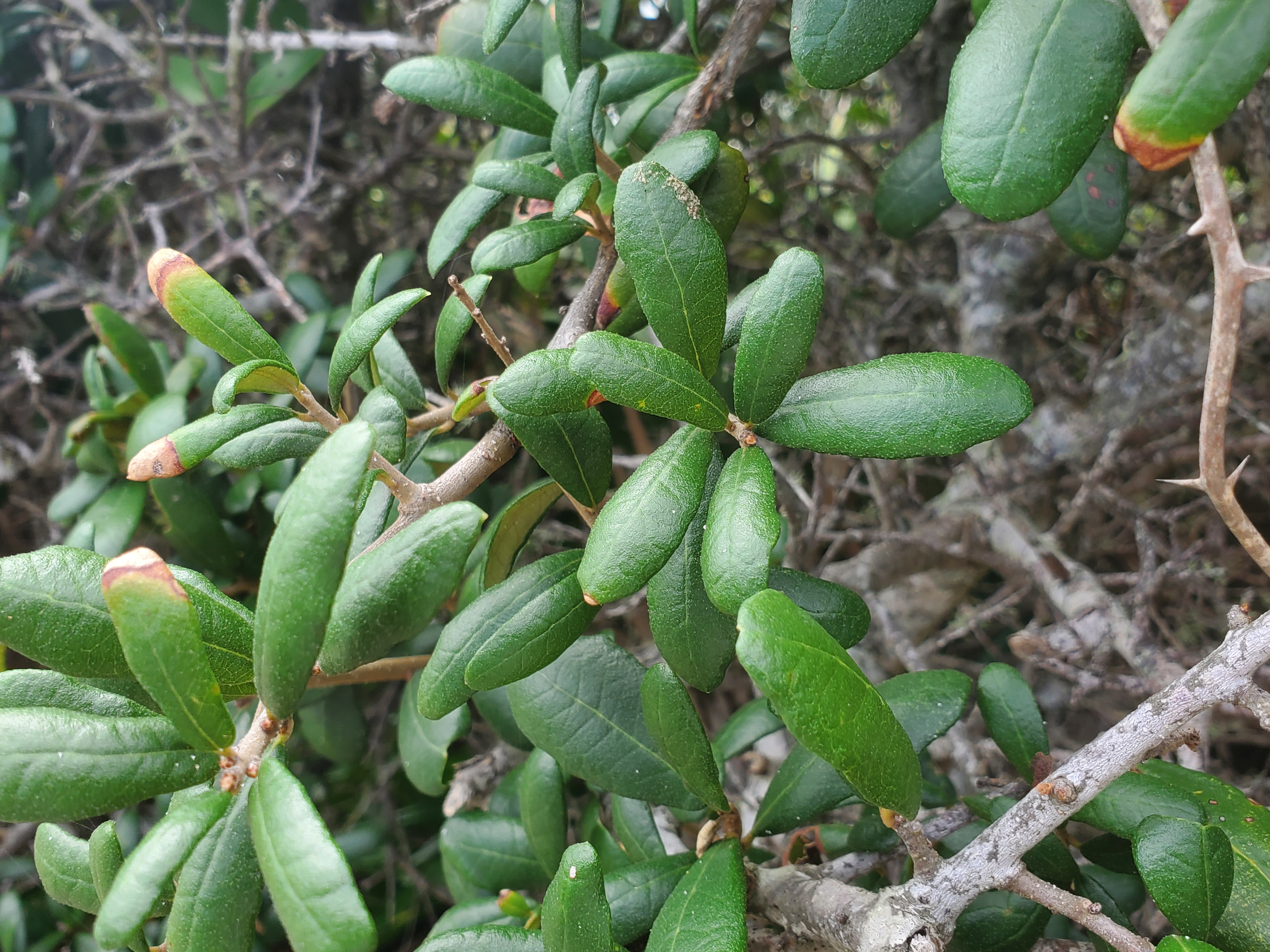
The leaves of a sand live oak.
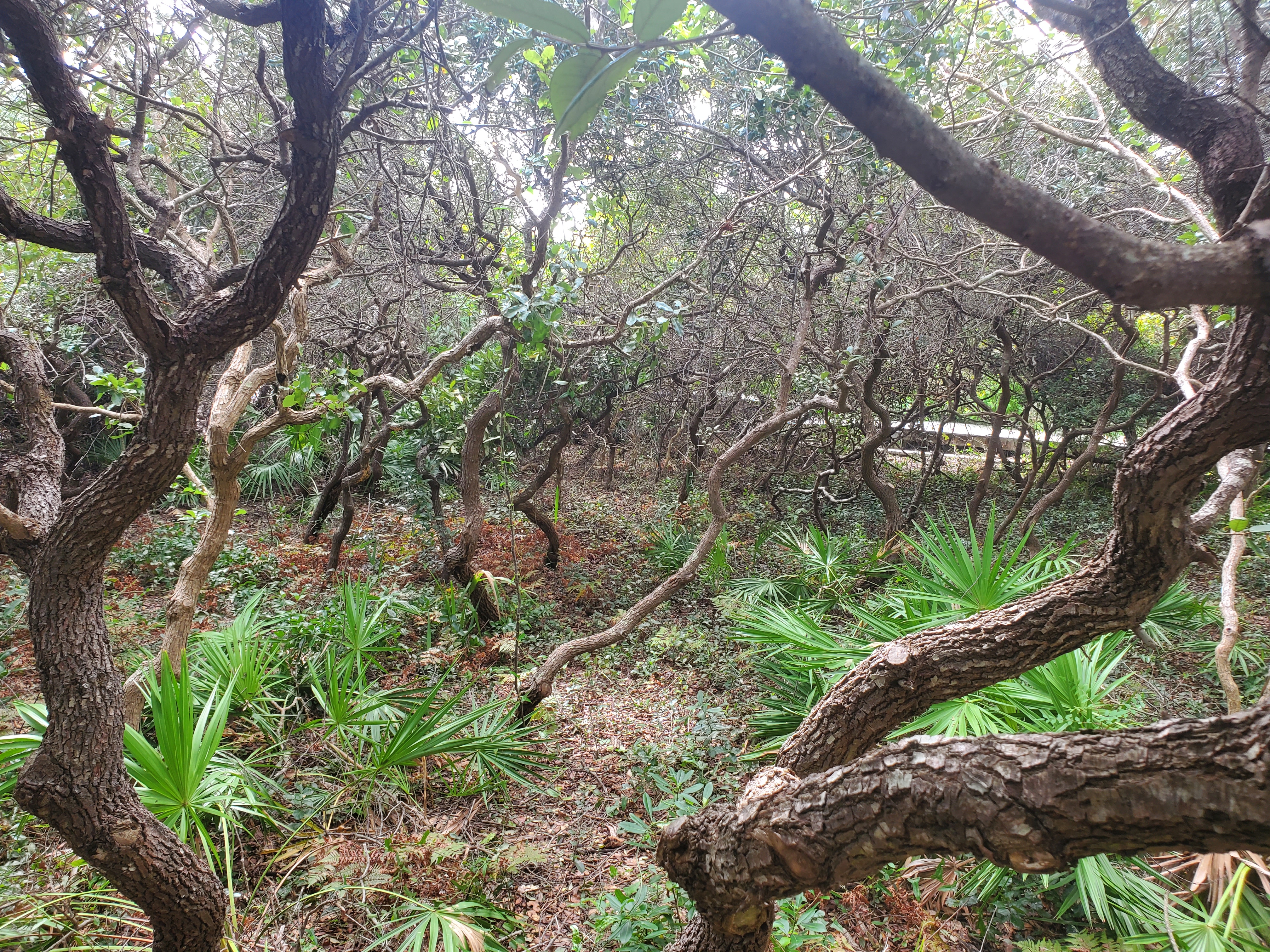
Its scientific name, Quercus geminata, comes from latin, meaning ‘twinned‘. This refers to its acorns, which are typically borne in pairs. The tree’s leaves are tough, leathery, and relatively small, with the edges curled downward. The bottoms of the leaves are gray to whitish, often with a fuzzy texture to them. While the sand live oak stays green all year, it does drop its leaves in the spring and immediately replaces them. It often grows in clusters, sometimes due to its ability to regenerate from its roots after a fire. This can lead to groves of wavy, leaning trunks that spread out widely, each reaching for its own patch of sunlight.
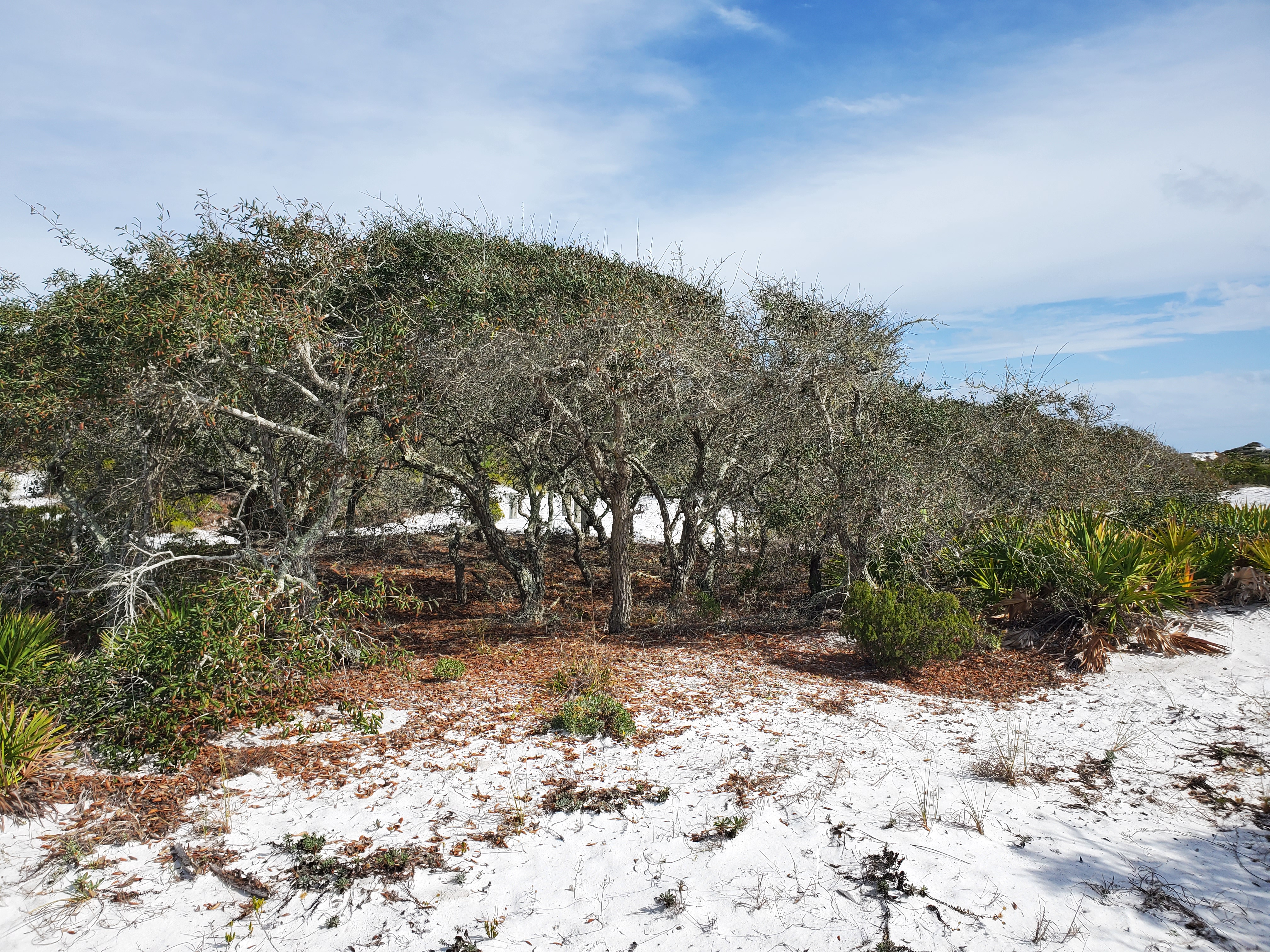
Very little seems to harm a sand live oak. They are sturdy in intense wind, able to withstand extreme drought, tolerant of salt spray, and do not mind intense sun and blazing hot temperatures. They are usually pest and disease free, though overwatering can damage their roots and cause dieback in the above ground parts.
Sand live oaks pruned by salt spray and constant wind.
Potential drawbacks of this species include their copious pollen production, and their tendency to stain surfaces with their tannin-rich leaves and acorns. In all, however, they are incredibly hardy and beautiful trees when planted in their native habitat. They require little to no maintenance and offer benefits to wildlife, who will snack on their acorns. For a shade tree near the beach, make sure to put the sand live oak at the top of your list.
Not all fall color is a good thing. This statement is especially true when it comes to twig pruners and twig girdlers. These two species of longhorned beetles can certainly disappoint your grand expectations of a beautiful array of fall color. Both species cause the tips of twigs to fall to the ground in late summer, sometimes leaving your trees in an undesirable form.
Twig Pruners
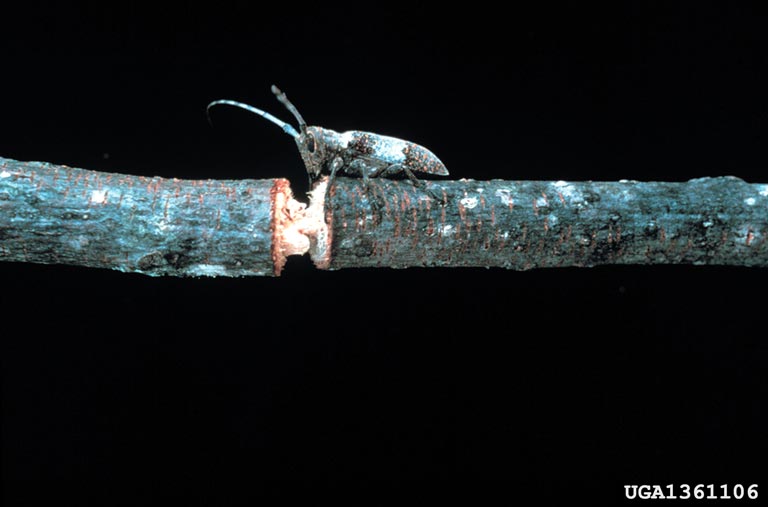
The twig pruner (Elaphidionoides villosus or Anelaphus villosus) is a small longhorned beetle that attacks numerous species of hardwoods. It is usually classified as a secondary pest of declining trees and shrubs. Female twig pruners lay their eggs in late spring at the leaf axils. When the eggs hatch, the grubs bore into twigs and continue to bore as they mature. The larvae then chew concentric rings just underneath the bark. The infested twigs and branches eventually drop to the ground with the larvae inside. The larvae pupate inside the fallen twig throughout the winter.
An adult twig pruner. Photo Credit: University of Georgia
Twig Girdlers
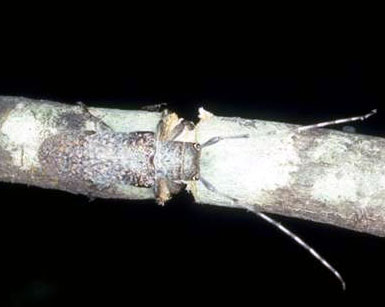
The twig girdler (Oncideres cingulata) is a small longhorned beetle that invades many species of hardwoods. Female twig girdlers lay their eggs in late summer in small twigs (about 3/8 inch diameter) that are covered with a thin layer of bark. The female chews a concentric ring around the outside of the twig, causing the end of the twig to die. The female chews a small notch in the dead twig and lays her eggs. After the eggs hatch, the larvae feed on the dead twigs and develop into adults before chewing their way out. The adults fly away to new host trees.
An adult twig girdler. Photo Credit: Lacy L. Hyche, Auburn University
Management and Control
It’s important to plant the right plant in the right place. Healthy trees and shrubs are the best defense against insect pests. Twig pruners and twig girdlers live in dying or dead twigs and branches. If you have trees that have suffered damage from these pests you will notice an abundance of fallen twig ends around the base of your trees. Rake and remove fallen twigs from around the trees and destroy or dispose them. This will help reduce pruner and girdler numbers in subsequent years.
It has been a hard summer climate wise and as we go into fall it is nice to start getting some relief from the heat. As the heat tones down, we are still facing a drought, which is not as severe as areas to our west but is still significant across much of the Panhandle. In our tree cover, the stress from the harsh summer this year is starting to show. You can see it in trees around the area, and it particularly seems to affect certain trees and conditions more than others. Where you are starting to see it most is in our ever-present pines, which make up the majority of our forest and tree cover in our region. If you keep a look out you may notice some pines in the areas with yellowing or brown needles or that are losing their needles. Those are clear signs of a possible bark beetle attack, which is a common issue when pines are stressed or damaged. Trees planted in the last year that are not yet fully established often show stress in a hot dry summer like this year. Even older and well-established trees in areas are showing some signs of stress from the hot dry conditions we have had this summer. Some trees are less adapted to dryer areas and when planted off site can experience more stress in dry conditions. If you look around across the Panhandle right now you can see clear signs of stress in some trees. It becomes more evident in late summer and early fall as the accumulated stressors of summer push trees into physiological conditions that cause stress responses. The big question is what to do if you notice a landscape tree that is exhibiting signs of stress, particularly drought stress.
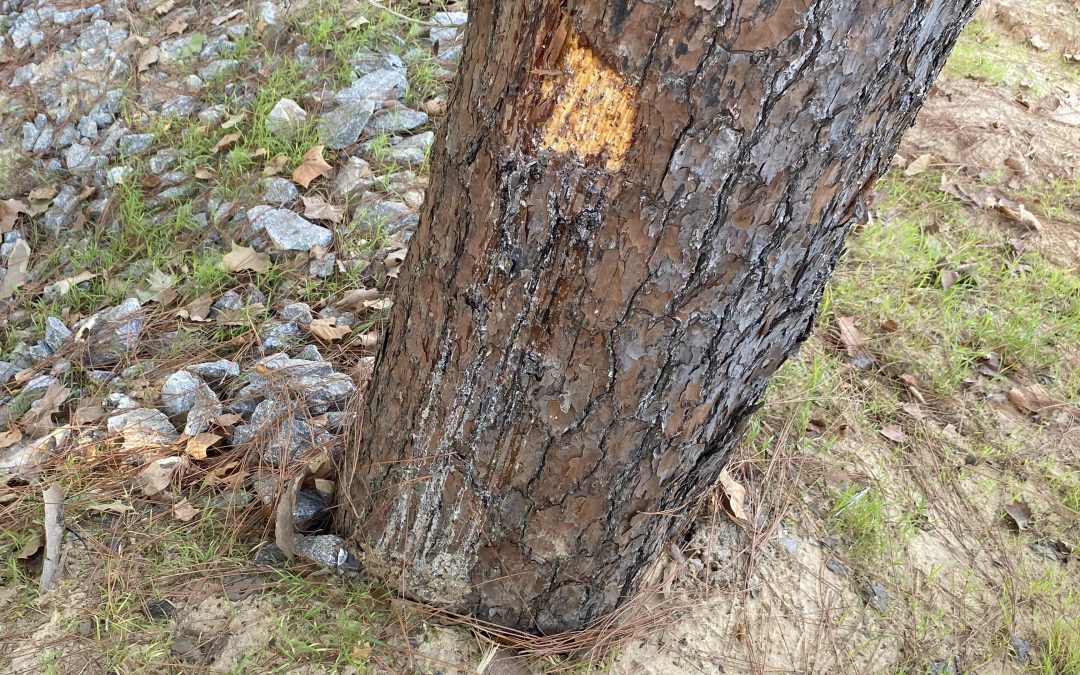
Pine damaged by construction equipment. Barking injuries like this can encourage bark beetle attacks. Photo Credit: Ian Stone
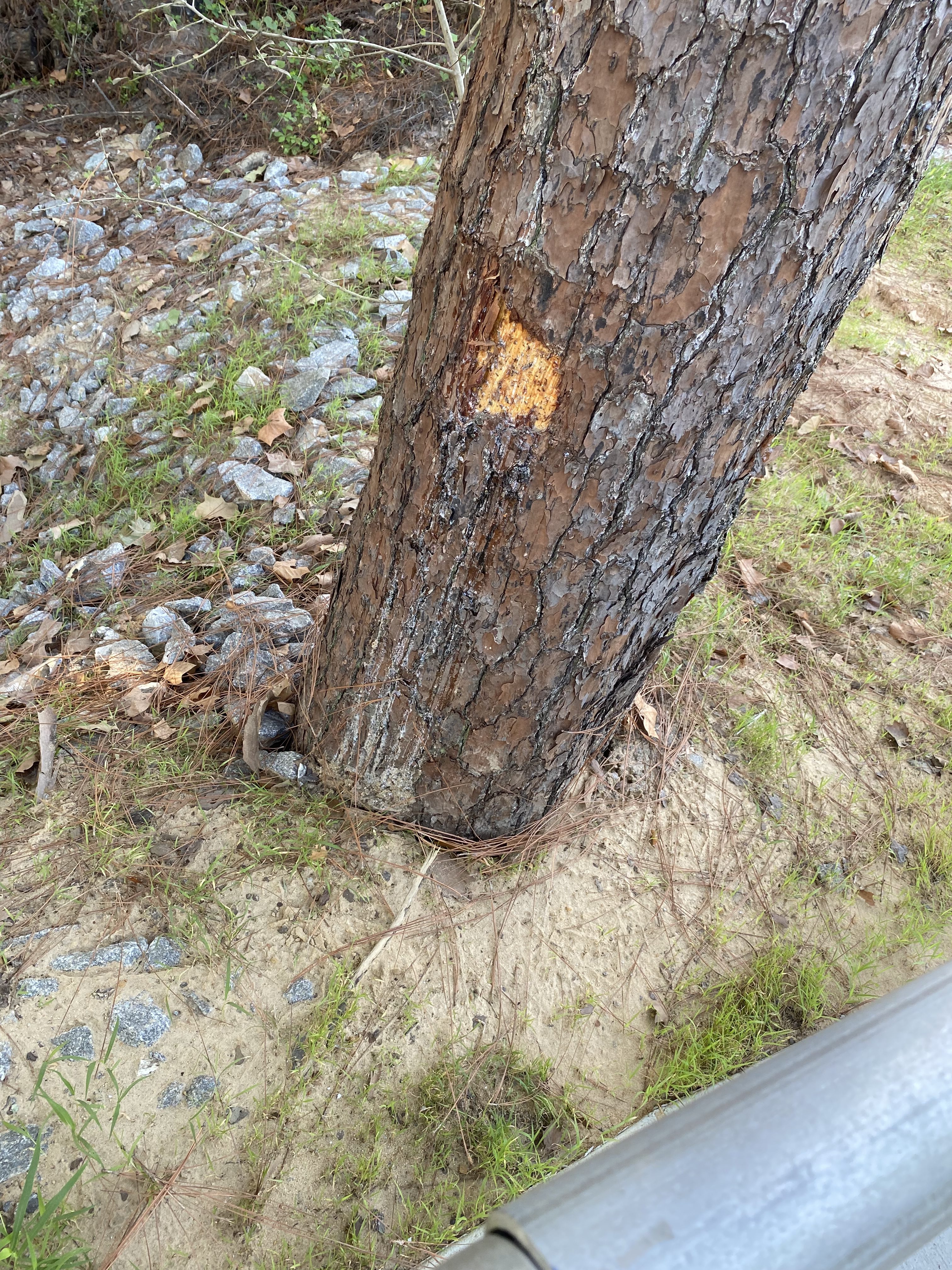
For pines the issue is likely to be bark beetles, of which there are several types. All pine bark beetles are native to our area and the degree of damage they do varies by species and conditions. The issue with stressed trees is that most bark beetles attack those trees. When a hot dry summer occurs bark beetle activity increases as the stressed trees become less able to fend off attacks by these beetles. Unfortunately, when bark beetles attack a pine in an area the best answer is prompt removal and disposal of the infected tree material. To protect high value trees in an area where bark beetles are active there are some injection pesticides that can prevent infestation, but once a tree has been infested and begun to show symptoms little can be done to bring it back. When bark beetles attack a stressed pine, most are effectively finishing off a tree that may have died regardless. The key is to prevent them from spreading to other pines in the area or attracting them to a stressed tree in an area. With trees already stressed in our area the big prevention option is not to damage or stress any pines already on the landscape. Most pine bark beetles are attracted to trees by chemicals in pitch and resin given off by wounds or damage. Often the stress from new landscaping projects or construction around pines can cause several to succumb to bark beetles. Your best prevention is to keep equipment well away from the tree and avoid damaging or injuring the tree, especially scraping areas of bark off. Larger and older trees can be vulnerable, as well as overcrowded trees that are too dense or overtopped by others. As the cooler weather approaches bark beetle activity should decrease along with the risk of losing a pine to these pests.
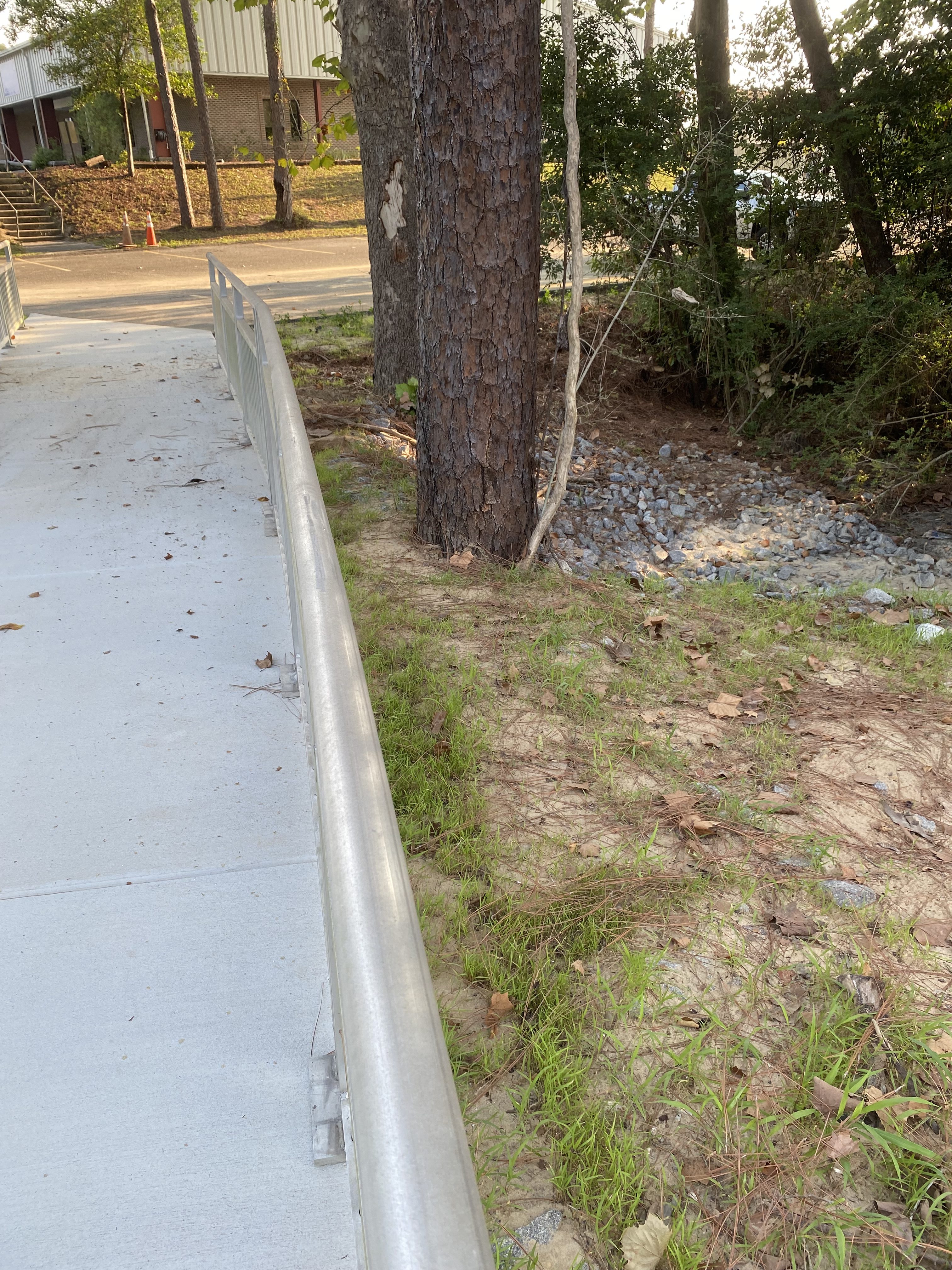
Recently constructed sidewalk. Construction activities extended well into the root zone of the tree, which can cause stress and damage. Photo Credit; Ian Stone
For other trees there are additional precautions that can be taken to lessen the potential that a tree will succumb to drought and other stress. Newly planted trees or those established in the last several years are particularly at risk and should be watered regularly during this dry period. Until rains return, a good method of slowly applying water deeply to the root zone is best. Properly applied mulch can help keep the soil cooler and moist around a newly planted tree. Drip irrigation, soaker hoses, and similar methods are best, and a method that specifically applies water slowly to the tree’s root zone gives the best results. Watering your lawn does not supply sufficient water to landscape trees, especially in drought conditions. Lawn irrigation is designed to apply irrigation needed to the top portion of the soil that is available to the grass. Trees have completely different requirements and need different watering methods and amounts. If you don’t have dedicated irrigation available and you have a tree that needs water, you can use irrigation donuts or bags. These are often a good solution for a tree that needs watering temporarily. Once a tree is well established it usually can withstand even severe drought, but during the establishment phase paying attention to water needs is critical in a summer drought like we have had.
Large established trees are also not immune from the heat and dry conditions that have plagued the Panhandle this summer. Usually when conditions change these trees recover but may abort some branches or exhibit some leaf drop while stressed. Leaf drop is a phenomenon that can occur when deciduous trees are stressed. It is a method of conserving water needs by reducing the leaf demand. Usually, the tree will recover and leaf out again fine next year. A tree may abort some branches or have some branch tips die back to make it through a rough period. Trees that are overcrowded, overtopped, or have other issues are the most at risk from environmental stress. This is why good tree selection along with proper tree care and maintenance is essential. When a hot dry summer like we have had comes along well cared for and maintained trees do best. Trees that prefer more moisture like bald cypress, red maple, sycamore, and some oaks can be planted in dryer sites, but when a severe drought comes along they often don’t have the ability to handle the moisture stress that trees adapted to dryer sites can. This is why site selection is so important, it is when we have extreme conditions that off site plantings typically suffer the worst and those can be larger more established trees.
With the cool weather hopefully we will get a reprieve and some rain soon. Given that fall is one of our dryer periods it may be likely that drought conditions could persist until early winter. Good care and tree maintenance is essential to getting your trees through stressful periods like this summer. For younger trees watering and care is essential while they get established. For older established trees avoid doing any construction or other disturbing activities around them until conditions improve. If you have trees that are exhibiting signs of decline or pest attacks call your local extension office or Florida Forest Service County Forester office. With any luck, colder weather with winter rains will be here soon and trees in our area will recover over the dormant period.
Moderate to strong El Nino conditions were predicted for this summer and I think this revelation has come true. The heat and humidity in the latter part of June were on the verge of being unbearable and the precipitation cycle is unpredictable. In the middle of the month, a series of storms with strong winds hit a number of areas in the panhandle, bringing down some large trees. University of Florida/IFAS Extension recommends removing large branches and trees that pose a threat to damaging your home and other structure before the start of each hurricane season. However, sometimes we just don’t get around to removing these trees until after they fall.
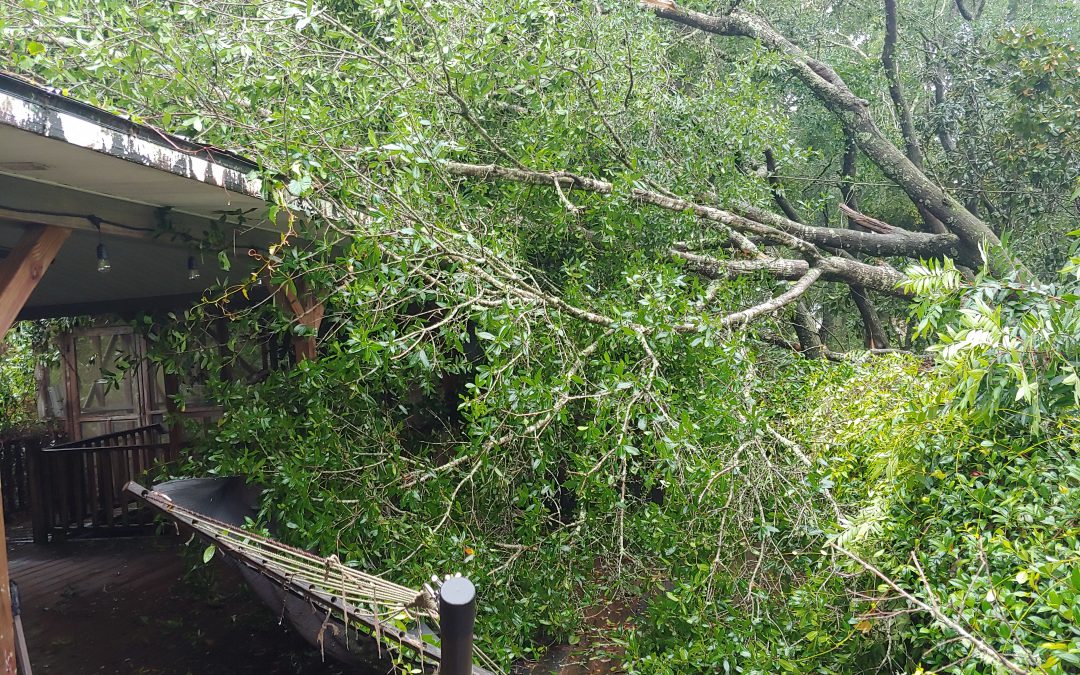
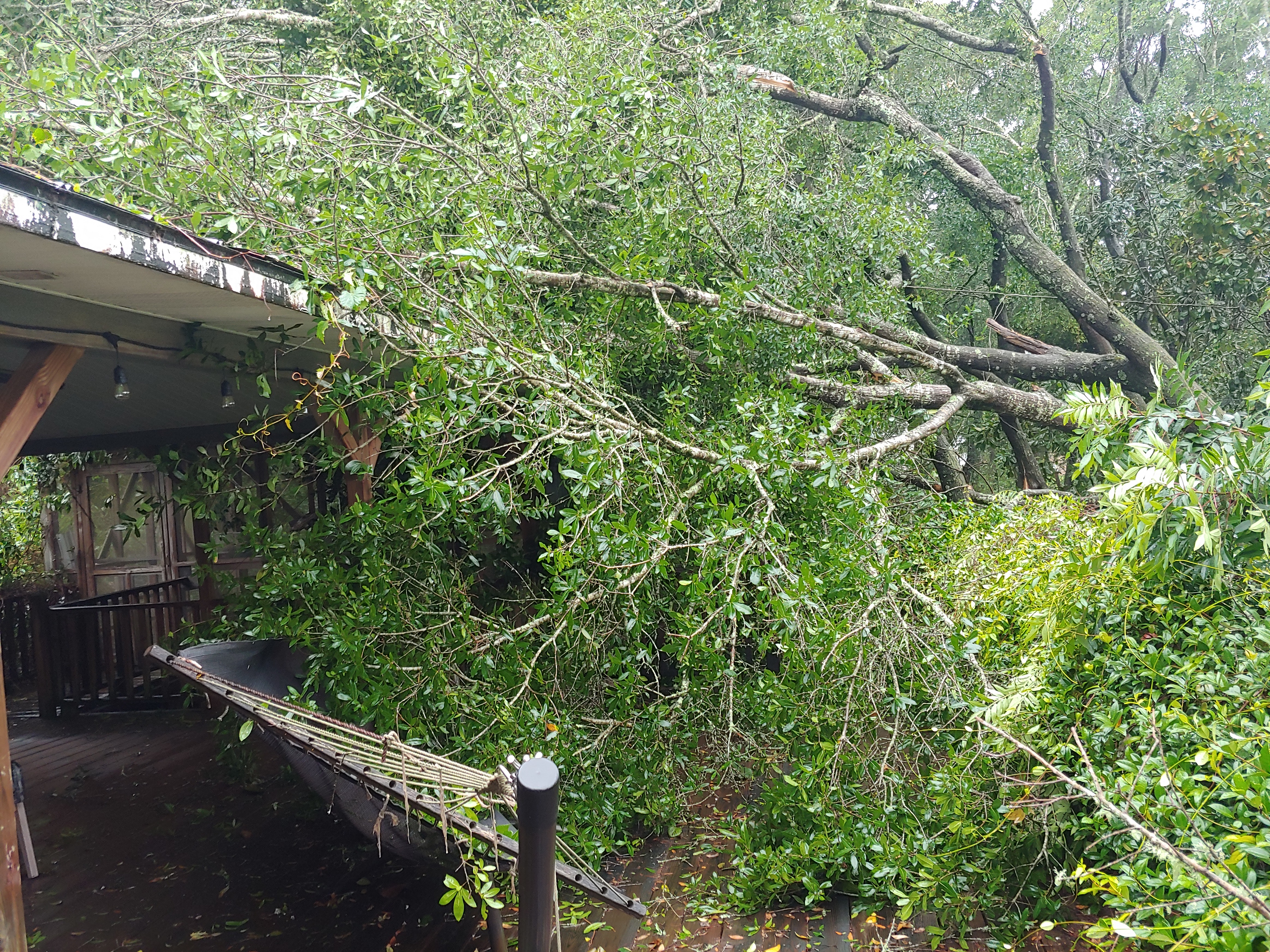
Trees laying on the corner of a house. Photo Credit: Matt Lollar, University of Florida/IFAS Extension – Santa Rosa County
Luckily only the tops of the trees in the photo above fell on the roof of the house. These are laurel oaks (Quercus laurifolia) which are fast growing but not tolerant of wind. In this situation, four trees fell together and are laying on the corner of the roof. The trees also pulled down the power, cable, and phone lines to the house.
So where do we go from here? Unfortunately the trees were uprooted and pose the potential for additional harm to the house if not removed correctly. In this situation, a tree service that owns a crane was recommended to remove the trees without administering more damage to the home and other trees and plants in the landscape and to avoid knocking down the powerlines again.
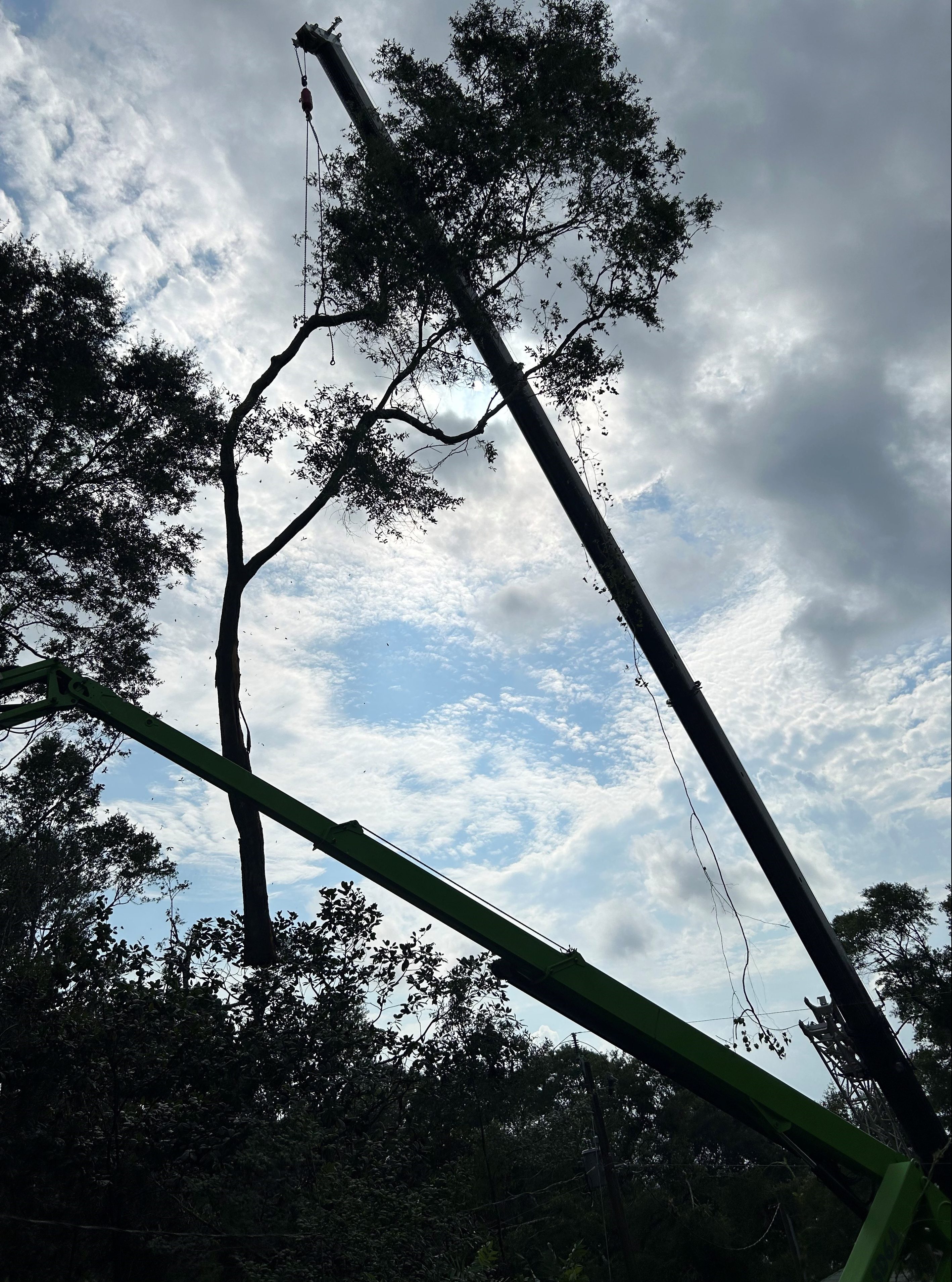
A crane used in conjunction with a boom lift to cut and lift trees off of a house. Photo Credit: Matt Lollar, University of Florida/IFAS Extension – Santa Rosa County
The tree service utilized a boom lift and a crane to safely lift the trees away from the house and utility lines. The employee on the lift connected each section of the tree to the crane before each cut. The boom was then moved to a safe location before each tree section was lifted away to the road to be cut into smaller pieces.
In this situation, the homeowner was lucky. There was no damage to the house other than a couple bent panels on the metal roof. However, this little bit a damage could have been totally avoided if these weak trees had been removed before the storm hit.
The trees featured in this article fell during a thunderstorm and possible tornado. If these trees had fallen during a weather event that was Federally declared, then a portion of the cost for their removal and cleanup might have been eligible to be considered an itemized deduction on Federal income tax forms. For more information on filing this type of loss please read the publication “Income Tax Deduction on Timber and Landscape Tree Loss from Casualty” from the USDA Forest Service.
After Hurricane Michael indiscriminately felled millions of trees in the Florida Panhandle five years ago, I’ve gotten much more selective with which trees I recommend to shade-seeking homeowners. Category 5 hurricanes don’t strike every year, or even every decade, but Michael reminded us that 150 mph+ wind events are possible, and we should choose the trees we plant accordingly. Keeping Michael’s lesson in mind, the shade tree I’ve recommended most to area homeowners lately is the ultra-wind resistant Nuttall Oak (Quercus texana) *.
While probably not native to our area (Nuttall is native to Mississippi River Valley bottomlands and nearby Gulf Coast regions), Nuttall Oak is a well-adapted deciduous oak species perfect for the Panhandle. The species is a strong, long-lived tree, yet also a quick grower (3-4’ per year in its youth, reaching 60-80’ at maturity). Unlike many rapidly growing trees, Nuttall is extremely resistant to wind breakage, disease, and other disfiguring issues. There are several Nuttall Oaks in Panhandle landscapes that survived Michael’s fury completely intact, with little more than wind-whipped leaves as evidence a storm had passed.
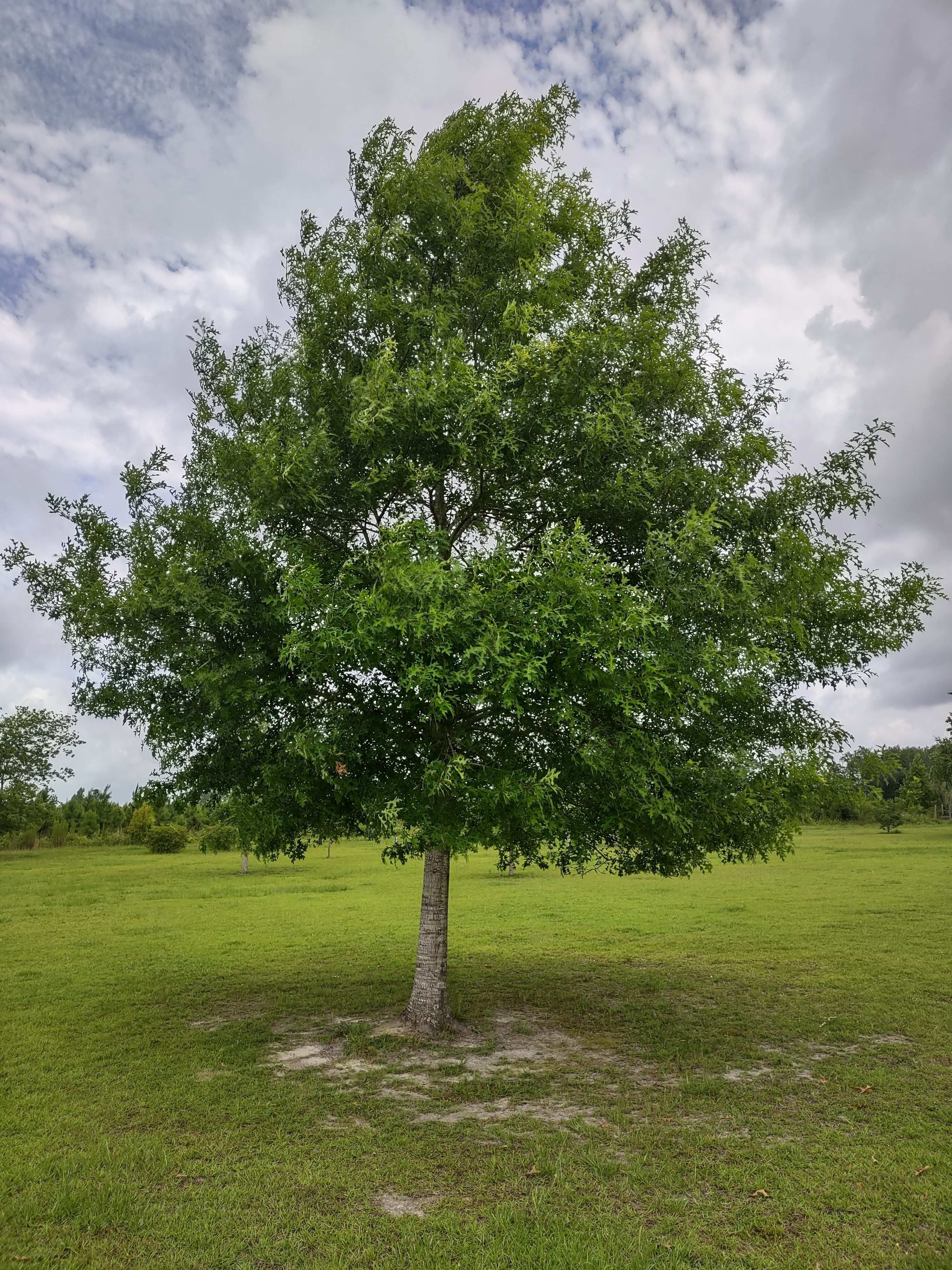
10 year old Nuttall Oak in a Calhoun County landscape. Photo courtesy of Daniel Leonard.
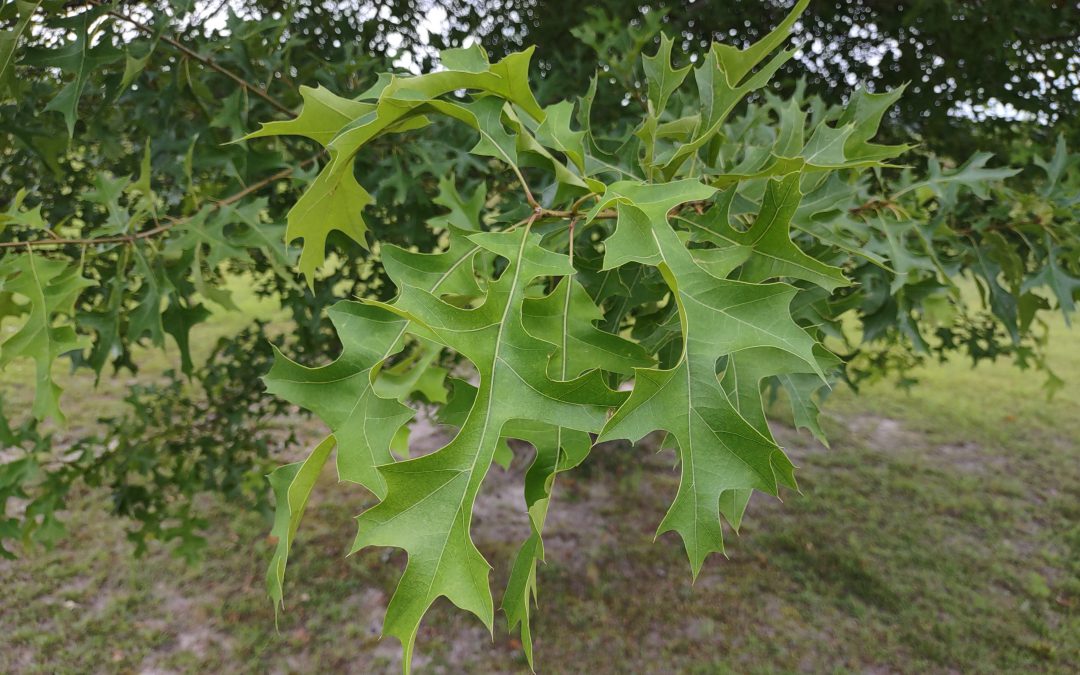
Nuttall is also an awesome landscape ornamental and a wildlife magnet in maturity. The species possesses a strong central leader and a stately, upright-rounded appearance. In summer, Nuttall leaves are large, dark green, deeply lobed, and pointed, somewhat reminiscent of our native Southern Red Oak. In fall, trees are capable of Blue Ridge quality color with fiery orange-red foliage, though the foliage show is not as consistent year to year here as farther north. The bark of Nuttall even has aesthetic appeal – dark and smooth in youth becoming ridged/furrowed with age. And it’s not just people that find Nuttall attractive, several beneficial insects use Nuttall as a host plant and various wildlife (deer, squirrel, and ducks especially) are fond of the prolific, highly nutritious acorns that mature trees produce in earnest each winter.
Finally, Nuttall is among the easiest of trees to grow and thrives in a variety of landscape conditions. Because it’s adapted to grow in poorly drained bottomlands that are either seasonally flooded or very dry, Nuttall is very tolerant of both compacted, poorly aerated soils common in urban areas and unirrigated, often droughty soils present in many Panhandle landscapes. However, like any tree, Nuttall Oak performs best with regular water and fertilizer for the first couple of years until established.
If you’ve been searching for a native-ish, hurricane-resistant, quick-growing, low-maintenance, wildlife-attracting shade tree for your property, Nuttall Oak is an excellent option and one I can fully recommend! For more information on Nuttall Oak or any other horticultural topic, please contact your local UF/IFAS County Extension Office. Happy gardening!
*Nuttall Oak was recently reclassified botanically from Quercus nuttallii to Quercus texana.